Advertisements
Advertisements
Question
A hot plate of an electric oven connected to a 220 V line has two resistance coils A and B, each of 24 Ω resistances, which may be used separately, in series, or in parallel. What are the currents in the three cases?
Advertisements
Solution
Given: Voltage of power source (V) = 220 V
Resistance of coil A R1 = 24 Ω
Resistance of coil B R2 = 24 Ω
(a) In the first case - when these coils are connected to separate power sources, then
Current flowing I = `"V"/"R"_1 = "V"/"R"_2 = 220/24` = 9.2 A
Therefore, current flowing through each coil is 9.2 A
(b) In the second case - when they are connected in series, then the total resistance
R = R1 + R2
= 24 Ω + 24 Ω
= 48 Ω
Therefore, the flowing electric current I = `"V"/"R"`
= `(220 "V")/(48 Ω)`
= 4.58 A
= 4.6 A
(c) In the third case – when the coils are connected in parallel, then the total resistance is,
`1/"R" = 1/"R"_1 + 1/"R"_2`
= `1/24 + 1/24`
= `2/24`
R = `24/2` = 12 Ω
Hence the flowing electric current I = `"V"/"R"`
= `(220 "V")/(12 Ω)`
= 18.33 A
= 18.3 A
APPEARS IN
RELATED QUESTIONS
Show how you would connect three resistors, each of resistance 6 Ω, so that the combination has a resistance of 9 Ω.
State the law of combination of resistances in parallel.
An electric heater which is connected to a 220 V supply line has two resistance coils A and B of 24 Ω resistance each. These coils can be used separately (one at a time), in series or in parallel. Calculate the current drawn when:
(a) only one coil A is used.
(b) coils A and B are used in series.
(c) coils A and B are uses in parallel.
Two resistances when connected in parallel give resultant value of 2 ohm; when connected in series the value becomes 9 ohm. Calculate the value of each resistance.
State how are the two resistors joined with a battery when equivalent resistance is less than either of the two resistances.
You have three resistors of values 2Ω, 3Ω and 5Ω. How will you join them so that the total resistance is less than 1Ω? Draw diagram and find the total resistance.
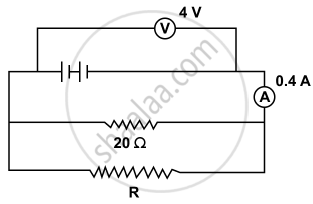
In the following figure calculate:
- the total resistance of the circuit
- the value of R, and
- the current flowing in R.
What is the equivalent resistance of 5 equal resistors, each of value 2`Omega` 1 when oonnected in (a) Series ( b) ParaIleI?
A uniform wire with a resistance of 27 Ω is divided into three equal pieces and then they are joined in parallel. Find the equivalent resistance of the parallel combination.
Show how would you connect three resistors, each of resistance 6 O so that
the combination has a resistance of(a) 9 Ω (b) 4 .Ω
What are the advantages of a parallel connection?
A particular resistance wire has a resistance of 3 ohm per meter. Find the potential difference of the battery which gives a current of 2 A in each of the 1.5 m length when connected in the parallel to the battery (assume that resistance of the battery is negligible).
An electrical appliance has a rating 100 W, 120V. The resistance of element of appliance when in use:
The equivalent resistance of a parallel combination of two resistors of 30 Ω and 60 Ω is ______________.
How does the resistance of a metallic wire depend on the thickness of wire?
The least resistance obtained by using 2 Ω, 4 Ω, 1 Ω and 100 Ω is:
Two resistors having resistance 8 Ω and 12 Ω are connected in parallel. Find their equivalent resistance.
A particular resistance wire has a resistance of 3·0 ohm per metre. Find the resistance of 5 m length of a wire of the same material, but with twice the area of cross section.
