Advertisements
Advertisements
प्रश्न
A hot plate of an electric oven connected to a 220 V line has two resistance coils A and B, each of 24 Ω resistances, which may be used separately, in series, or in parallel. What are the currents in the three cases?
Advertisements
उत्तर
Given: Voltage of power source (V) = 220 V
Resistance of coil A R1 = 24 Ω
Resistance of coil B R2 = 24 Ω
(a) In the first case - when these coils are connected to separate power sources, then
Current flowing I = `"V"/"R"_1 = "V"/"R"_2 = 220/24` = 9.2 A
Therefore, current flowing through each coil is 9.2 A
(b) In the second case - when they are connected in series, then the total resistance
R = R1 + R2
= 24 Ω + 24 Ω
= 48 Ω
Therefore, the flowing electric current I = `"V"/"R"`
= `(220 "V")/(48 Ω)`
= 4.58 A
= 4.6 A
(c) In the third case – when the coils are connected in parallel, then the total resistance is,
`1/"R" = 1/"R"_1 + 1/"R"_2`
= `1/24 + 1/24`
= `2/24`
R = `24/2` = 12 Ω
Hence the flowing electric current I = `"V"/"R"`
= `(220 "V")/(12 Ω)`
= 18.33 A
= 18.3 A
APPEARS IN
संबंधित प्रश्न
State the law of combination of resistances in parallel.
An electric heater which is connected to a 220 V supply line has two resistance coils A and B of 24 Ω resistance each. These coils can be used separately (one at a time), in series or in parallel. Calculate the current drawn when:
(a) only one coil A is used.
(b) coils A and B are used in series.
(c) coils A and B are uses in parallel.
How will you connect three resistors of 2 Ω, 3 Ω and 5 Ω respectively so as to obtain a resultant of 2.5 Ω? Draw the diagram to show the arrangement.
If current flows through two lamps arranged:
(a) in series,
(b) in parallel,
and the filament of one lamps breaks, what happens to the other lamp? Explain your answer.
State how are the two resistors joined with a battery when equivalent resistance is less than either of the two resistances.
Four resistors each of resistance 2Ω are connected in parallel. What is the effective resistance?
Calculate the equivalent resistance between the points A and B in Fig. if each resistance is 2·0 Ω.

Show how would you connect three resistors, each of resistance 6 O so that
the combination has a resistance of(a) 9 Ω (b) 4 .Ω
An electrical appliance having a resistance of 200 Ω is operated at 200 V. Calculate the energy consumed by the appliance in 5 minutes in kWh.
How does the resistance of a metallic wire depend on the thickness of wire?
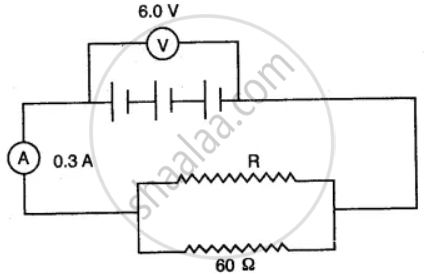
In the figure below, the ammeter A reads 0.3 A. Calculate:
(i) the total resistance of the circuit
(ii) the value of R
(iii) the current flowing through R.
Calculate equivalent resistance in the following cases:
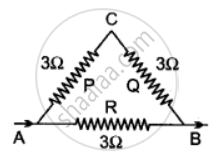
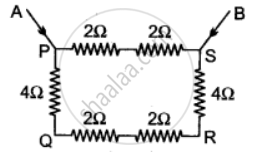
A piece of wire having a resistance R is cut into five equal parts.
- How will the resistance of each part of the wire change compared with the original resistance?
- If the five parts of the wire are placed in parallel, how will the resistance of the combination change?
- What will be ratio of the effective resistance in series connection to that of the parallel connection?
Two resistors when connected in parallel give the resultant resistance of 2 ohms, but when connected in series the effective resistance becomes 9 ohms. Calculate the value of each resistance.
Two devices are connected between two points say A and B in parallel. The physical quantity that will remain the same between the two points is:
The least resistance obtained by using 2 Ω, 4 Ω, 1 Ω and 100 Ω is:
A coil in the heater consumes power P on passing current. If it is cut into halves and joined in parallel, it will consume power:
You have three resistors of values 2 Ω, 3 Ω, and 5 Ω. How will you join them so that the total resistance is less than 1 Ω? Draw a diagram and find the total resistance.
Two resistors of resistance 2 Ω and 3 Ω are connected in parallel to a cell to draw current 0.5 A from the cell. Calculate the current in each resistor.
