Advertisements
Advertisements
प्रश्न
In parallel combination of resistances ______.
विकल्प
p.d. is same across each resistance
total resistance is increased
current is same in each resistance
all of the above are true
Advertisements
उत्तर
In parallel combination of resistances p.d. is same across each resistance.
Explanation:
In parallel combination, the ends of each resistor are connected to the ends of the same source of potential. Thus, the potential difference across each resistance is same and is equal to the potential difference across the terminals of the source (or battery).
APPEARS IN
संबंधित प्रश्न
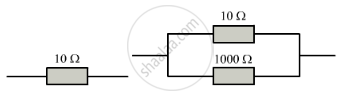
Which of the following arrangement, A or B, has the lower combined resistance?
Explain with the help of a labelled circuit diagram, how you will find the resistance of a combination of three resistors of resistances R1, R2 and R3 joined in parallel.
In the diagram shown alongside, the cell and the ammeter both have negligible resistance. The resistors are identical.
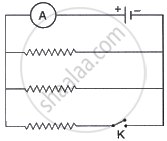
With the switch K open, the ammeter reads 0.6 A. What will be the ammeter reading when the switch is closed?
Two resistances when connected in parallel give resultant value of 2 ohm; when connected in series the value becomes 9 ohm. Calculate the value of each resistance.
A combination consists of three resistors in series. Four similar sets are connected in parallel. If the resistance of each resistor is 2 ohm, find the resistance of the combination.
What is the equivalent resistance of 5 equal resistors, each of value 2`Omega` 1 when oonnected in (a) Series ( b) ParaIleI?
A current of 2 A is passed through a coil of resistance 75 Ω for 2 minutes.
(a) How much heat energy is produced?
(b) How much charge is passed through the resistance?
The least resistance obtained by using 2 Ω, 4 Ω, 1 Ω and 100 Ω is:
You are given four ammeters A, B, C and D having the least counts mentioned below:
(I) Ammeter A with least count 0.25 A
(II) Ammeter B with least count 0.5 A
(III) Ammeter C with least count 0.05 A
(IV) Ammeter D with least count 0.1 A
Which of the ammeters would you prefer for doing an experiment to determine the equivalent resistance of two resistances most accurately, when connected in parallel?
You have three resistors of values 2 Ω, 3 Ω, and 5 Ω. How will you join them so that the total resistance is less than 1 Ω? Draw a diagram and find the total resistance.
