Advertisements
Advertisements
प्रश्न
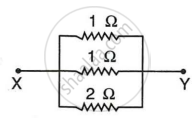
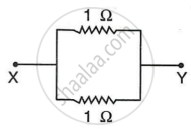
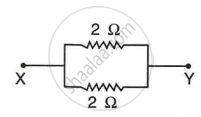
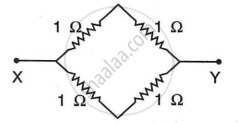
Which of the following combinations have the same equivalent resistance between X and Y?
विकल्प
Advertisements
उत्तर
Explanation:
1. In above first figure, the resistors are connected in parallel
Between X and Y.
Let Rp be their equivalent resistance.
Then,
`1/R_p=1/2+1/2`
`1/R_p=2/2`
Or, Rp = 1 Ω ...(i)
In the circuit there are three parts. In the first part two resistor of 1 Ω each are connected in series.
In series, the equivalent resistance is R'S, then
R'S = (1 + 1) Ω = 2 Ω
2. In the circuit, three resistors of 1 Ω, 1 Ω and 2 Ω are connected in parallel. In parallel, the equivalent resistance is RP, then
`1/"R"_"p" = 1/1 + 1/1 + 1/2`
`1/"R"_"p" = (2 + 2 + 1)/2`
`"R"_"p" = 2/5 Omega`
∴ RP = 0.4 Ω
Hence, RP = 0.4 Ω
3. In the circuit two resistors of 1 Ω each are connected in parallel. In parallel, the equivalent resistance is RP, then
`1/"R"_"p" = 1/1 + 1/1`
`1/"R"_"p" = (1 + 1)/1`
`1/"R"_"p" = 2/1`
`"R"_"p" = 1/2`
∴ RP = 0.5 Ω
Hence, RP = 0.5 Ω
4. In the circuit there are three parts. In the first part two resistor of 1 Ω each are connected in series. In series, the equivalent resistance is R'S, then
R''S = (1 + 1) Ω = 2 Ω
In the third part, R'S and R''S are in parallel, the equivalent resistance is RP, then
`1/R_p=1/2+1/2`
`1/R_p=2/2`
Or, Rp = 1 Ω
Hence, RP = 1 Ω
Therefore, on observing the values we can say that first and fourth have same equivalent resistances i.e., 1 Ω.
APPEARS IN
संबंधित प्रश्न
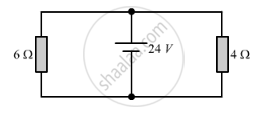
Find the current in each resistor in the circuit shown below:
Two resistors, with resistance 5 Ω and 10 Ω respectively are to be connected to a battery of emf 6 V so as to obtain:
(i) minimum current flowing
(ii) maximum current flowing
(a) How will you connect the resistances in each case?
(b) Calculate the strength of the total current in the circuit in the two cases.
A 4 Ω coil and a 2 Ω coil are connected in parallel. What is their combined resistance? A total current of 3 A passes through the coils. What current passes through the 2 Ω coil?
Show with the help of diagrams, how you would connect three resistors each of resistance 6 Ω, so that the combination has resistance of (i) 9 Ω (ii) 4 Ω.
A battery of e.m.f. 15 V and internal resistance 2 `Omega` is connected to two resistors of 4 ohm and 6 ohm joined.
(i) In series,
(ii) In parallel.
Find in each case the electrical energy spent per minute in 6 ohm resistor.
A particular resistance wire has a resistance of 3 ohm per meter. Find :
The total resistance of three lengths of this wire each 1.5 m long, in parallel.
Two resistors when connected in parallel give the resultant resistance of 2 ohms, but when connected in series the effective resistance becomes 9 ohms. Calculate the value of each resistance.
Assertion: When a battery is short circuited, the terminal voltage is zero.
Reason: In a short circuit, the current is zero.
You are given four ammeters A, B, C and D having the least counts mentioned below:
(I) Ammeter A with least count 0.25 A
(II) Ammeter B with least count 0.5 A
(III) Ammeter C with least count 0.05 A
(IV) Ammeter D with least count 0.1 A
Which of the ammeters would you prefer for doing an experiment to determine the equivalent resistance of two resistances most accurately, when connected in parallel?
Three resistors of 6Ω, 4Ω and 4Ω are connected together so that the total resistance is 8Ω. Draw a diagram to show this arrangement and give reason to justify your answer.
