Advertisements
Advertisements
प्रश्न
In parallel combination of resistances ______.
पर्याय
p.d. is same across each resistance
total resistance is increased
current is same in each resistance
all of the above are true
Advertisements
उत्तर
In parallel combination of resistances p.d. is same across each resistance.
Explanation:
In parallel combination, the ends of each resistor are connected to the ends of the same source of potential. Thus, the potential difference across each resistance is same and is equal to the potential difference across the terminals of the source (or battery).
APPEARS IN
संबंधित प्रश्न
Differentiate between resistances in series and parallel.
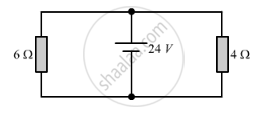
Find the current in each resistor in the circuit shown below:
A resistor has a resistance of 176 ohms. How many of these resistors should be connected in parallel so that their combination draws a current of 5 amperes from a 220 volt supply line?
In the circuit given below:
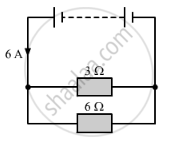
(a) What is the combined resistance?
(b) What is the p.d. across the combined resistor?
(c) What is the p.d. across the 3 Ω resistor?
(d) What is the current in the 3 Ω resistor?
(e) What is the current in the 6 Ω resistor?
In the diagram shown alongside, the cell and the ammeter both have negligible resistance. The resistors are identical.
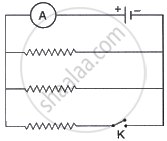
With the switch K open, the ammeter reads 0.6 A. What will be the ammeter reading when the switch is closed?
Two exactly similar electric lamps are arranged (i) in parallel, and (ii) in series. If the parallel and series combination of lamps are connected to 220 V supply line one by one, what will be the ratio of electric power consumed by them?
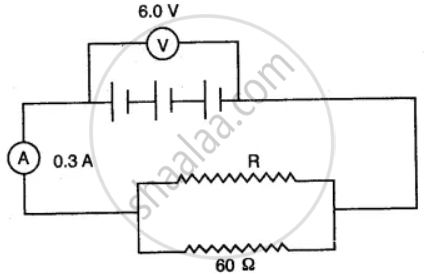
In the figure below, the ammeter A reads 0.3 A. Calculate:
(i) the total resistance of the circuit
(ii) the value of R
(iii) the current flowing through R.
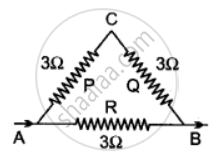
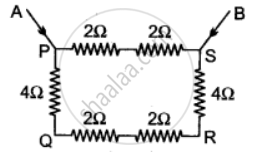
Calculate equivalent resistance in the following cases:
Two devices are connected between two points say A and B in parallel. The physical quantity that will remain the same between the two points is:
A coil in the heater consumes power P on passing current. If it is cut into halves and joined in parallel, it will consume power:
