Advertisements
Advertisements
Question
A cell of e.m.f. ε and internal resistance 𝔯 sends current 1.0 A when it is connected to an external resistance 1.9 Ω. But it sends current 0.5 A when it is connected to an external resistance 3.9 Ω. Calculate the values of ε and 𝔯.
Advertisements
Solution
In first case
I = 1 A, R = 1.9 ohm
ε = I (R + r)
= 1(1.9 + r)
ε = 1.9 + r ...(1)
In second case
I = 0.5 A, R = 3.9 ohm
ε = I(R + r)
= 0.5 (3.9 + r)
ε = 1.95 + 0.5r ...(2)
From eq. (1) and (2),
1.9 + r = 1.95 + 0.5r
r = `0.05/0.5`
r = 0.1 ohm
Substituting value of r
ε = 1.9 + r
= 1.9 + 0.1
= 2 V
APPEARS IN
RELATED QUESTIONS
What happens to the resistivity of semiconductor with the increase of temperature?
A cell of Emf 2 V and internal resistance 1.2 Ω is connected with an ammeter of resistance 0.8 Ω and two resistors of 4.5 Ω and 9 Ω as shown in the diagram below:
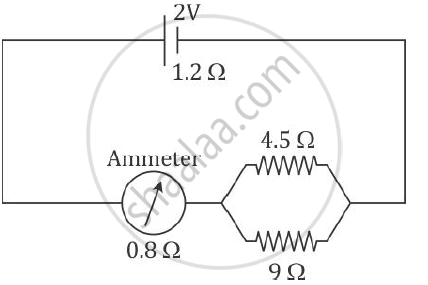
1) What would be the reading on the Ammeter?
2) What is the potential difference across the terminals of the cell?
A cell is used to send current to an external circuit.
- How does the voltage across its terminals compare with its e.m.f.?
- Under what condition is the e.m.f. of a cell equal to its terminal voltage?
A battery of e.m.f. 15 V and internal resistance 3 ohm is connected to two resistors of resistances 3 ohm and 6 ohm is series Find:
(a) the current through the battery
(b) the p.d. between the terminals of the battery.
What is the colour code for the insulation on the earth wire?
Four cells each of e.m.f. 2V and internal resistance 0.1 Ω are connected in series to an ammeter of negligible resistance, a 1.6 Ω resistor and an unknown resistor R1. The current in the circuit is 2A. Draw a labelled diagram and calculate:
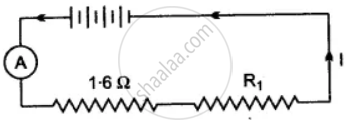
(i) Total resistance of the circuit,
(ii) Total e.m.f.
(iii) The value of R1 and
(iv) The p.d. across R1.
When a resistance of 3Ω is connected across a cell, the current flowing is 0.5 A. On changing the resistance to 7Ω, the current becomes 0.25A. Calculate the e.m.f. and the internal resistance of the cell.
(a) Calculate the total resistance across AB.
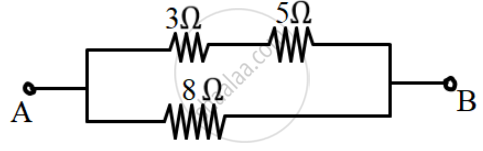
(b) If a cell of e.m.f 2.4 V with negligible internal resistance is connected across AB then calculate the current drawn from the cell.
Study the diagram:
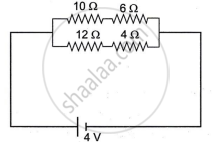
- Calculate the total resistance of the circuit.
- Calculate the current drawn from the cell.
- State whether the current through 10 Ω resistor is greater than, less than or equal to the current through the 12 Ω resistor.
A battery of e.m.f. 6.0 V supplies current through a circuit in which the resistance can be changed. A high resistance voltmeter is connected across the battery. When the current is 3 A, the voltmeter reads 5.4 V. Find the internal resistance of the battery.
