Advertisements
Advertisements
Question
Give one example to show how the resistance depends on the nature of material of the conductor.
Advertisements
Solution
APPEARS IN
RELATED QUESTIONS
If the equivalent resistance is to be increased, then the number of resistances should be connected in
- Series
- Parallel
- Mixed arrangement
- None of the above
(i) Two sets A and B, of three bulbs each, are glowing in two separate rooms. When one of the bulbs in set A is fused, the other two bulbs also cease to glow. But in set B, when one bulb fuses, the other two bulbs continue to glow. Explain why this phenomenon occurs.
(ii) Why do we prefer arrangements of Set B for house circuiting?
What possible values of resultant resistance one can get by combining two resistances, one of value 2 ohm and the other 6 ohm?
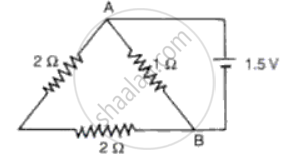
What is the equivalent resistance between A and B in the given circuit (Fig?)
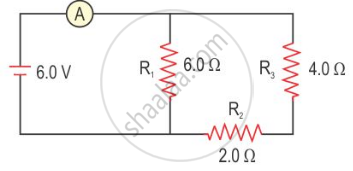
Three resistors of 6.0 Ω, 2.0 Ω and 4.0 Ω are joined to an ammeter A and a cell of emf 6.0 V as shown in the following figure. Calculate :
- the effective resistance of the circuit.
- the reading of ammeter.
When do you say that the resistors are connected in this way? Draw a circuit diagram.
Two bulbs of 100 W and 40 W are connected in series. The current through the 100 W bulb is 1 A. The current through the 40 W bulb will be ______.
Define the term resistivity and state its S.I. unit. Which will have higher resistivity a conductor or an insulator.
In the circuit shown below, calculate the equivalent resistance between the points (i) A and B, (ii) C and D.
A metal wire of resistance 6 Ω is stretched so that its length is increased to twice its original length. Calculate its new resistance.
Two resistors having 2Ω and 3Ω resistance are connected—(i) in series, and (ii) in parallel. Find the equivalent resistance in each case.
If the current I through a resistor is increased by 100% (assume that temperature remains unchanged), the increase in power dissipated will be:
Consider the following combinations of resistors:


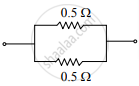
The combinations having equivalent resistance 1 Q is/are ______.
