Advertisements
Advertisements
Question
Two resistances X and Y are connected turn by turn:
- in parallel, and
- in series.
In which case the resultant resistance will be less than either of the individual resistances?
Advertisements
Solution
When two resistances, x and y, are connected:
i. In parallel:
The resultant resistance is given by:
`1/R_p = 1/x + 1/y`
Rp = `(x y)/(x + y)`
Since Rp is the reciprocal of the sum of reciprocals, it is always less than either x or y individually (provided both x and y are positive).
ii. In series:
The resultant resistance is given by:
Rs = x + y
This is always greater than either x or y individually.
∴ The resultant resistance will be less than either of the individual resistances when the resistors are connected in parallel.
APPEARS IN
RELATED QUESTIONS
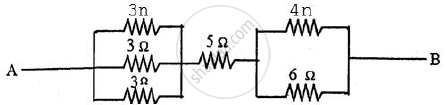
Find the equivalent resistance between points A and B
Name the material which is used for making the heating element of an electric iron.
Write down an expression for the resistance of a metallic wire in terms of the resistivity.
If five resistances, each of value 0.2 ohm, are connected in series, what will be the resultant resistance?
What possible values of resultant resistance one can get by combining two resistances, one of value 2 ohm and the other 6 ohm?
What is (a) highest, and (b)Ω lowest, resistance which can be obtained by combining four resistors having the following resistances?
4 Ω, 8 Ω, 12 Ω, 24 Ω
State how are the two resistors joined with a battery when equivalent resistance is more than either of the two resistances.
State how are the two resistors joined with a battery when same current flows in each resistor.
You have three resistors of values 2 `Omega`, 3 `Omega`, and 5 `Omega`. How will you join them so that the total resistance is less than 2 `Omega`?
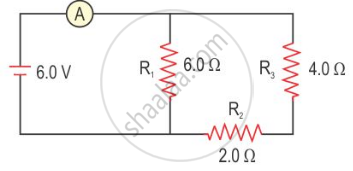
Three resistors of 6.0 Ω, 2.0 Ω and 4.0 Ω are joined to an ammeter A and a cell of emf 6.0 V as shown in the following figure. Calculate :
- the effective resistance of the circuit.
- the reading of ammeter.
Two bulbs of 100 W and 40 W are connected in series. The current through the 100 W bulb is 1 A. The current through the 40 W bulb will be ______.
Name the material of wire used for making standard resistances. Give a reason.
How does the resistivity of an alloy such as constantace depends on temperature.
Illustrate-combination of cells e.g., three cells, in parallel, explaining the combination briefly. Obtain an expression for current ‘i’ in the combination.
With the help of a circuit diagram derive the formula for the resultant resistance of three resistances connected:
- in series and
- in parallel
If R1 and R2 be the resistance of the filament of 40 W and 60 W respectively operating 220 V, then:
The resistance of the hot filament of the bulb is about 10 times the cold resistance. What will be the resistance of 100 W-220 V lamps, when not in use?
