Advertisements
Advertisements
Question
Classify the following elements into metals, non-metals and metalliods
As, C, Hg, Mg, S, Si
Advertisements
Solution
| Metals | Non-metals | Metalloids |
| Hg | C | Si |
| Mg | S | As |
APPEARS IN
RELATED QUESTIONS
Fill in the blank:
The formulae of chloride of metal M is MCl2. The metal M belongs to ……………. group.
The position of eight elements in the Modern Periodic Table is given below where atomic numbers of elements are given in the parenthesis.
| Period No. | ||
| 2 | Li(3) | Be(4) |
| 3 | Na(11) | Mg(12) |
| 4 | K(19) | Ca(20) |
| 5 | Rb(37) | Sr(38) |
(i) Write the electronic configuration of Ca.
(ii) Predict the number of valence electrons in Rb.
(iii) What is the number of shells in Sr?
(iv) Predict whether K is a metal or a non – metal.
(v) Which one of these elements has the largest atom in size?
(vi) Arrange Be, Ca, Mg and Rb in the increasing order of the size of their respective atoms.
Na, Mg and Al are the elements of the same period of Modern Periodic Table having, one, two and three valence electrons respectively. Which of these elements (i) has the largest atomic radius, (ii) is least reactive? Justify your answer stating reason for each case.
Write the atomic numbers of two elements 'X' and 'Y' having electronic configuration 2, 8, 2 and 2, 8, 6 respectively.
Which element has a total of two shells, with three electrons in its valence shell?
Which element has twice as many electrons in its second shell as in its first shell?
What happens to the metallic character of the elements as we go down in a group of the periodic table?
Arrange the following elements in the increasing order of their metallic character:
Mg, Ca, K, Ga
Rewrite the following statement after correction, if necessary:
Elements in the same period have equal valency
How does Chemical reactivity of elements change on going from left to right in a period of the periodic table?
Give example in support of your answer.
Why do elements in the same group show similar properties but the elements in different groups show different properties?
Which of the following set of elements is written correctly in the order of their increasing metallic character?
(a) Mg, Al, Si
(b) C, O, N
(c) Na, Li, K
(d) Be, Mg, Ca
An element A has atomic number 14. To which period does this element belong and how many elements are there in this period.
Complete the following sentences.
The properties of the elements are a periodic function of their …………… (atomic number, mass number, reative atomic mass).
Name the element in period 3 which does not form oxide.
First ionization enthalpy of two elements X and Y are 500 KJ mol-1 and 375 KJ mol-1 respectively. Comment about their relative position in a group as well as in a period.
F, Cl and Br are the elements each having seven valence electrons. Which of these (i) has the largest atomic radius, (ii) is most reactive? Justify your answer, stating the reason for each.
Study the extract of the Periodic Table given below and answer the questions that follow. Give the alphabet corresponding to the element in question. DO NOT repeat an element. 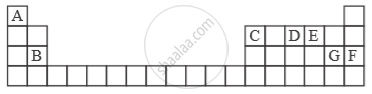
The ion of which element will migrate towards the cathode during electrolysis?
Study the extract of the Periodic Table given below and answer the questions that follow. Give the alphabet corresponding to the element in question. DO NOT repeat an element. 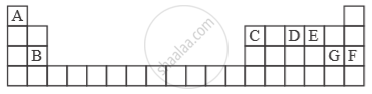
Which is an inert gas?
Select the correct answer
Number of shells in potassium are
How many elements are there in period 2?
Choose the most appropriate answer from the following list of oxides which fit the description.
An amphoteric oxide: Al2O3 (shows both acidic and basic properties)
Arrange the following as per instruction given in the bracket.
Li, K, Na, H ( decreasing order of their potential ionisation )
The elements of one short period of the periodic table are given below in order from left to right:
| Li | Be | B | C | O | F | Ne |
Which one of the above elements belongs to the halogen series?
The position of elements A, B, C, D and E in the periodic table are shown below:
|
Group 1 |
Group 2 |
Group 17 |
Group 18 |
|
|
|
|
D |
|
|
B |
C |
|
|
A |
|
|
E |
Which type of ion will be formed by elements A, B, and C.
Write the electronic configuration of element 17T35.
- What is the group number of T?
- What is the period number of T?
- How many valence electrons are there in an atom of T?
- What is the valency of T?
- Is it a metal or non-metal?
- State number of protons and neutrons in T.
An element belongs to the third period and Group IIIA (13) of the periodic table. State: the valency,
Name and state the following with reference to the elements of the first three periods of the periodic table.
Metalloid in Period 3.
Name and state the following with reference to the elements of the first three periods of the periodic table.
Valency of elements in Group 14 and 15.
Name and state the following with reference to the elements of the first three periods of the periodic table.
Non-metallic elements present in Period 3 of Groups 15 and 16.
State the nature of compounds formed when group 17 elements combine with (i) metals (ii) non-metals.
An element A has 2 electrons in its fourth shell. State:
is it an oxidising or reducing agent
Answer the following question:
State the four blocks of the modern periodic table based on the electronic configuration of elements.
The position of certain elements in the Modern Periodic Table is shown below:
| Group → Period ↓ |
1 | 2 | 3 to 12 | 13 | 14 | 15 | 16 | 17 | 18 |
| 1 | G | H | |||||||
| 2 | A | I | B | C | |||||
| 3 | D | E | F |
Using the above table answer the following questions giving reasons in each case:
- Which element will form only covalent compounds?
- Which element is a non-metal with valency 2?
- Which element is a metal with valency 2?
- Out of H, C, and F which has the largest atomic size?
- To which family does H, C, and F belong?
What is meant by a Group in the Periodic Table?
Name the period which is the shortest period of the periodic table.
Name or state following with reference to the elements of the first three periods of the periodic table.
A metalloid in period 2 and in period 3.
Complete the table pertaining to the following elements given in Column I.
| Column I Elements | Atomic Number | Electronic Configuration | Underline the element present in that group |
| 1. Hydrogen | 1 | ______ | Be/Na/Ca |
| 2. Carbon | 6 | ______, ______ | N/P/Si |
| 3. Nitrogen | 7 | _______, ______ | C/P/S |
| 4. Oxygen | 8 | _______, ______ | N/S/Cl |
| 5. Sulphur | 16 | _____, ______, _______ | O/N/F |
| 6. Chlorine | 17 | _____, ______, ______ | I/O/S |
Which of the following would weigh the least?
(Atomic masses C = 12, 0 = 16, Na = 23)
