Advertisements
Advertisements
प्रश्न
Classify the following elements into metals, non-metals and metalliods
As, C, Hg, Mg, S, Si
Advertisements
उत्तर
| Metals | Non-metals | Metalloids |
| Hg | C | Si |
| Mg | S | As |
APPEARS IN
संबंधित प्रश्न
Elements in the same group show the same valency. Give scientific reason.
Given below are some elements of the modern periodic table. Atomic number of the element is given in parentheses.
A(4), B(9), C(14), D(19), E(20)
(a) Select the element that has one electron in the outermost shell. Also, write the electronic configuration of this element.
(b) Which two elements amongst these belong to the same group? Give reasons for your answer.
(c) Which two elements amongst these belong to the same period? Which one of the two has bigger atomic radius?
Study the following table in which positions of six elements A, B, C, D, E and F are shown as they are in the modern periodic table:
|
Group→
Period↓ |
1
|
2
|
3-12
|
13
|
14
|
15
|
16
|
17
|
18
|
| 2 | A | B | C | ||||||
| 3 | D | E | F |
On the basis of the above table, answer the following questions:-
(i) Name the element which forms only covalent compounds.
(ii) Name the element which is a metal with valency three.
(iii) Name the element which is a non-metal with valency three.
(iv) Out of D and E, which is bigger in size and why?
(v) Write the common name for the family to which the elements C and F belong.
An element 'M' with electronic configuration (2, 8, 2) combines separately with (NO3)–, (SO4)2– and (PO4)3– radicals. Write the formula of the three compounds so formed. To which group and period of the Modern Periodic Table does the element 'M' belong? Will 'M' form covalent or ionic compounds? Give reason to justify your answer.
Name any two elements of group one and write their electronic configurations. What similarity do you observe in their electronic configurations? Write the formula of oxide of any of the aforesaid elements.
The elements 4Be, 12Mg and 20Ca, each having two valence electrons in their valence shells, are in periods 2, 3 and 4 respectively of the modern periodic table. Answer the following questions associated with these elements, giving reason in each case:
(a) In which group should they be?
(b) Which one of them is least reactive?
(c) Which one of them has the largest atomic size?
Write the number of vertical columns in the modern periodic table. What are these columns called?
Define the term : Atomic size
Write any one difference in the electronic configurations of group-1 and group-2 elements ?
Which element has a total of three shells, with four electrons in its valence shell?
Which element has twice as many electrons in its second shell as in its first shell?
In the following set of elements, one element does not belong to the set. Select this element and state why it does not belong:
Oxygen, Nitrogen, Carbon, Chlorine, Fluorine
How does the atomic size vary on going down from top to bottom in a group of the periodic table? Why does it vary this way?
Explain why, the properties of elements are repeated after 2, 8, 18 and 32 elements in the periodic table.
Given alongside is a part of the periodic table. As we move vertically downward from Li to Fr:
| Li | Be |
| Na | |
| K | |
| Rb | |
| Cs | |
| Fr | Ra |
What happens to their metallic character?
The correct increasing order of the atomic radii of the elements oxygen, fluorine and nitrogen is:
(a) O, F, N
(b) N, F, O
(c) O, N, F
(d) F, O, N
Periodicity is observed due to the similar ______.
An element X belong to 4th period and 17th group, state.
name of the element.
Name the element which has the electronic configuration 2, 8, 3?
Chorine in the periodic table is surrounded by the elements with atomic number 9, 16, 18 and 35.
Which is more electronegative than chlorine?
First ionization enthalpy of two elements X and Y are 500 KJ mol-1 and 375 KJ mol-1 respectively. Comment about their relative position in a group as well as in a period.
What will be the valency of an element of atomic number 9 (nine)?
Study the extract of the Periodic Table given below and answer the questions that follow. Give the alphabet corresponding to the element in question. DO NOT repeat an element. 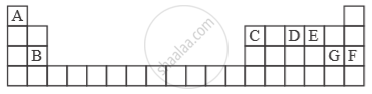
Which is an inert gas?
Fill in the blank
Oxidising property ________from fluroine to iodine because the power to accpet electron decreases.
State whether the following statement is true or false
On moving horizontally across a period, number of valence electrons increases from one to eight.
Arrange the following as per instruction given in the bracket.
K, Pb, Ca, Zn (increasing reactivity)
Arrange the following in order of increasing radii:
Mg2+, Mg, Mg+
The elements of one short period of the periodic table are given below in order from left to right:
| Li | Be | B | C | O | F | Ne |
One element of this period is missing. Which is the missing element and where should it be placed?
An element belongs to the third period and Group IIIA (13) of the periodic table. State: if it is a metal or non-metal?
Name and state the following with reference to the elements of the first three periods of the periodic table.
Alkaline earth metal in period 3.
State the nature of compounds formed when group 17 elements combine with (i) metals (ii) non-metals.
Going across a period left to right, atomic size _____.
Based on the group valency of element write the molecular formula of the following compound giving justification:
Halide of the elements of group thirteen
Based on the group valency of element write the molecular formula of the following compound giving justification:
Compound formed when an element A of group 2 combines with an element B of group seventeen.
Write the electronic configuration of two elements A and B whose atomic numbers are 20 and 17 respectively. Write the molecular formula of the compound formed when element A reacts with element B. State whether this compound is acidic, basic or neutral. Give a reason to justify your answer.
Name or state following with reference to the elements of the first three periods of the periodic table.
A metalloid in period 2 and in period 3.
Name or state following with reference to the element of the first three periods of the periodic table.
The valency of the element in period 3 having atomic number 17.
Name or state following with reference to the element of the first three periods of the periodic table.
A non-metal in period 2 which is tetravalent.
Select the correct answer from the options given below.
Is the group number of the element whose atomic number is 4.
Electron Affinity is maximum in ______.
