Advertisements
Advertisements
प्रश्न
Fill in the blank and rewrite the completed statement:
________ group in the periodic table contains elements that are all gases at room temperature.
Advertisements
उत्तर
The 18th group in the periodic table contains elements that are all gases at room temperature.
APPEARS IN
संबंधित प्रश्न
The atomic masses of three elements A, B and C having similar chemical properties are 7, 23 and 39, respectively.
- Calculate the average atomic mass of elements A and C.
- Compare the average atomic mass with atomic mass of B.
- What could the elements A, B and C be?
An element 'M' with electronic configuration (2, 8, 2) combines separately with (NO3)–, (SO4)2– and (PO4)3– radicals. Write the formula of the three compounds so formed. To which group and period of the Modern Periodic Table does the element 'M' belong? Will 'M' form covalent or ionic compounds? Give reason to justify your answer.
The electrons in the atoms of four elements A, B, C and D are distributed in three shells having 1, 3, 5 and 7 electrons in the outermost shell respectively. State the period in which these elements can be placed in the modern periodic table. Write the electronic configuration of the atoms of A and D and the molecular formula of the compound formed when A and D combine.
Define the term : Atomic size
Consider two elements 'X' (Atomic number 17) and 'Y' (Atomic number 20)
(i) Write the positions of these elements in the modern periodic table giving justification.
(ii) Write the formula of the compound formed by the combination of 'X' and 'Y'.
(iii) Draw the electron-dot structure of the compound formed and state the nature of the bond formed between the two elements ?
Match the atomic number 2, 4, 8, 15 and 19 with each of the following:
- A solid non-metal belonging to the third period.
- A metal of valency 1.
- A gaseous element with valency 2.
- An element belonging to Group 2.
- A rare gas.
The following table shows the electronic configuration of the elements W, X, Y, Z:
| Element | w | x | y | z |
| Electronic configurations |
2, 8, 1 | 2, 8, 7 | 2, 5 | 1 |
Answer the following questions based on the table above:
1) What type of Bond is formed between :
a) W and X
b) Y and Z
2) What is the formula of the compound formed between :
a) X and Z
b) W and X
How does the valency of elements change of moving from left to right in the third period of the periodic table?
Fill in the blank in the following statement:
In going across a period (right to left) in periodic table, the atomic size of the atom ...............
Nitrogen (atomic number 7) and phosphorus (atomic number 15) belong to group 15 of the periodic table. Write the electronic configuration of these two elements. Which of these will be more electronegative? Why?
Five elements A, B, C, D and E have atomic numbers of 2, 3, 7, 10 and 18 respectively. The elements which belong to the same period of the periodic table are:
(a) A, B, C
(b) B, C, D
(c) A, D, E
(d) B, D, E
Which of the following element would lose an electron easily?
(a) Mg
(b) Na
(c) K
(d) Ca
The atomic numbers of the elements Na, Mg, K and Ca are 11, 12, 19 and 20 respectively. The element having the largest atomic radius is:
(a) Mg
(b) Na
(c) K
(d) Ca
In each of the following pair, choose the atom having the bigger size:
(a) Mg (At. No.12) or Cl (At. No.17)
Correct the statements.
Elements in the same periods have equal valency.
Name two elements you would expect to show chemical reactions similar to calcium. What is the basis of your choice?
State the valency of the elements of periods 3 and write the formula of their oxides.
An element X belong to 4th period and 17th group, state.
name the family to which it belong.
Name the element which has the electronic configuration 2, 8, 3?
First ionization enthalpy of two elements X and Y are 500 KJ mol-1 and 375 KJ mol-1 respectively. Comment about their relative position in a group as well as in a period.
Study the extract of the Periodic Table given below and answer the questions that follow. Give the alphabet corresponding to the element in question. DO NOT repeat an element. 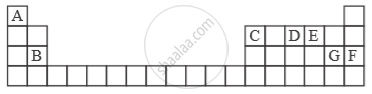
The ion of which element will migrate towards the cathode during electrolysis?
Study the extract of the Periodic Table given below and answer the questions that follow. Give the alphabet corresponding to the element in question. DO NOT repeat an element. 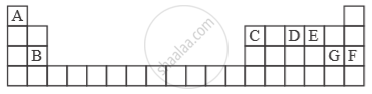
Which is an inert gas?
State whether the following statement is true or false
On moving horizontally across a period, number of valence electrons increases from one to eight.
Explain
Size of atom changes when it loses or gain electron
Name the elements in period 1.
What is meant by a group in the periodic table?
How many elements are there in period 2?
Choose the most appropriate answer from the following list of oxides which fit the description.
A basic oxide.
Arrange the following as per instruction given in the bracket.
Cs, Na, Li, K, Rb (decreasing electronegativity)
The electronic configuration of an element is 2, 8, 4. State it:
name and write its one physical property.
Based on the group valency of element write the molecular formula of the following compound giving justification:
Halide of the elements of group thirteen
State the property trends in general of elements on moving down in a group of the periodic table.
Name or state following with reference to the element of the first three periods of the periodic table.
The valency of elements in group 1 [I–A].
Name or state following with reference to the element of the first three periods of the periodic table.
A metal in period 3 having valency 3.
Name or state following with reference to the element of the first three periods of the periodic table.
The valency of the element in period 3 having atomic number 17.
Name or state following with reference to the element of the first three periods of the periodic table.
A non-metal in period 2 which is tetravalent.
