Advertisements
Advertisements
प्रश्न
Name or state following with reference to the element of the first three periods of the periodic table.
The formula of the hydroxide of the element having electronic configuration 2, 8, 2.
Advertisements
उत्तर
Hydroxide of element [2, 8, 2] is Mg [OH], where Mg is the element.
APPEARS IN
संबंधित प्रश्न
Calculate the number of gram atoms in 4.6 grams of sodium (Na = 23)
The following table shows the electronic configuration of the elements W, X, Y, Z:
| Element | w | x | y | z |
| Electronic configurations |
2, 8, 1 | 2, 8, 7 | 2, 5 | 1 |
Answer the following questions based on the table above:
1) What type of Bond is formed between :
a) W and X
b) Y and Z
2) What is the formula of the compound formed between :
a) X and Z
b) W and X
How do electronic configurations of elements change in second period of periodic table with increase in atomic numbers?
The electronic configuration of the atom of an element X is 2, 8, 4. In modern periodic table, the element X is places in :
(a) 2nd group
(b) 4th group
(c) 14th group
(d) 8th group
Arrange the following according to the instruction given in the bracket:
K, Pb, Ca, Zn (in the increasing order of the reactivity).
Study the extract of the Periodic Table given below and answer the questions that follow. Give the alphabet corresponding to the element in question. DO NOT repeat an element. 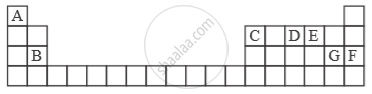
The ion of which element will migrate towards the cathode during electrolysis?
Select the correct answer
Most reactive character among the elements given below is found in
The elements of one short period of the periodic table are given below in order from left to right:
Li Be B C O F Ne
(a) To which period do these elements belong?
(b) One element of this period is missing. Which is the missing element and where should it be placed?
(c) Place the three elements, fluorine, beryllium and nitrogen, in the order of increasing electro negativity.
(d) Which one of the above elements belongs to the halogen series?
Arrange the following as per instruction given in the bracket.
Li, K, Na, H ( decreasing order of their potential ionisation )
Atomic numbers of elements A, B, C, D, E, F are 8, 7, 11, 12, 13 and 9 respectively. State the type of ions they form.
