Advertisements
Advertisements
प्रश्न
What is the common feature of the electronic configuration of the elements at the end of Period 2 and Period 3?
Advertisements
उत्तर
The elements at the end of the period have 8 electrons in the valence shell.
Ne = 2, 8
Ar = 2, 8, 8
संबंधित प्रश्न
Choose the most appropriate answer of the following:
Which of the following would weigh the least?
(A) 2-gram atoms of Nitrogen.
(B) 1mole of Silver
(C) 22.4 liters of oxygen gas at 1 atmospheric pressure and 273K
(D) 6.02 x 10²³ atoms of carbon.
[Atomic masses: Ag=108, N=14, O=16, C=12]
Rewrite the following statement after correction, if necessary:
The metallic character of elements in a period increases gradually on moving from left to right.
An element X belongs to group 2 and another element Y belongs to group 15 of the periodic table:
(a) What is the number of valence electron in X?
(b) What is the valency of X?
(c) What is the number of valence electrons in Y?
(d) What is the valency of Y?
Explain how you have arrived at your answers.
On moving from left to right in a period of the periodic table, the atomic number of elements increases. What happens to the size of atoms of elements on moving from left to right in a period?
(a) increases
(b) decreases
(c) remain the same
(d) first increases then decreases
Correct the statements.
Elements in the same periods have equal valency.
Study the extract of the Periodic Table given below and answer the questions that follow. Give the alphabet corresponding to the element in question. DO NOT repeat an element. 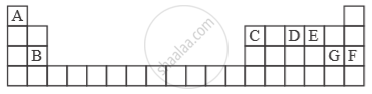
Which is an inert gas?
How many groups and periods are there in the modern periodic table?
Arrange the following in increasing order of property indicated
SiO2, P2O5, SO3, Cl2O7 (acidic nature)
Consider the section of the periodic table given below:
| Group numbers | IA | IIA | IIIA | IVA | VA | VIA | VIIA | 0 |
| 1 | 2 | 13 | 14 | 15 | 16 | 17 | 18 | |
| Li | D | O | J | Ne | ||||
| A | Mg | E | Si | H | K | |||
| B | C | F | G | L |
Note: In this table B does not represent boron
C does not represent carbon
F does not represent fluorine
H does not represent hydrogen
K does not represent potassium
You must see the position of the element in the periodic table.
Some elements are given in their own symbol and position in the periodic table, while others are shown with a letter. With reference to the table answer the following:
- Which is the most electronegative?
- How many valence electrons are present in G?
- Write the formula of the compound between B and H.
- In the compound between F and J, what type of bond will be formed?
- Draw the electron dot structure for the compound formed between C and K.
The elements of one short period of the periodic table are given below in order from left to right:
| Li | Be | B | C | O | F | Ne |
Which one of the above elements belongs to the halogen series?
