Advertisements
Advertisements
Question
Name or state following with reference to the element of the first three periods of the periodic table.
The valency of elements in group 1 [I–A].
Advertisements
Solution
Valency of elements in group [I–A] is +1
APPEARS IN
RELATED QUESTIONS
Write the electronic configuration of K and Ne.
An element 'X' belong to 3rd period and group 13 of the Modern Periodic Table.
(a) Determine the valence electrons and the valency of 'X'.
(b) Molecular formula of the compound formed when 'X' reacts with an element 'Y' (atomic number = 8).
(c) Write the name and formula of the compound formed when 'X' combines with chlorine
Name two properties of elements whose magnitudes change when going from top to bottom in a group of the periodic table. In what manner do they change?
Name the non-metals present in period 2 and metals in period 3.
First ionization enthalpy of two elements X and Y are 500 KJ mol-1 and 375 KJ mol-1 respectively. Comment about their relative position in a group as well as in a period.
In the following table, the positions of six elements A, B, C, D, E and F are given as they are in the Modern Periodic Table :
 |
1 | 2 | 3-12 | 13 | 14 | 15 | 16 | 17 | 18 |
| 2 | A | B | C | D | |||||
| 3 | E | F |
On the basis of the above table, answer the following questions :
(i) Name the element which forms only covalent compounds.
(ii) Name the element which is a metal with valency three.
(iii) Name the element which is a non-metal with valency three.
(iv) Out of B and C, whose atomic radius is bigger and why ?
(v) Write the common name for the family to which the elements D and F belong.
Atomic number of metal ‚A‛ is 11, while atomic number of metal ‚B‛ is 20. Which of them will be more reactive? Write the chemical reaction of dilute HCl with metal ‚A‛.
Study the extract of the Periodic Table given below and answer the questions that follow. Give the alphabet corresponding to the element in question. DO NOT repeat an element. 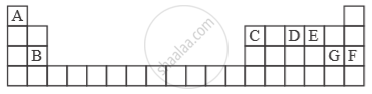
Which is an inert gas?
An element A has 2 electrons in its fourth shell. State:
is it an oxidising or reducing agent
Fill in the blanks from the words A to F given below.
A: Decreases
B: Increases
C: Remains same
D: Increases by one
E: Electropositive
F: Electronegative
Down a group in the Modern Periodic Table.
No. of electron shells __________; No. of valence electrons ________; Electronegativity ________ Character of elements changes from _________ to ____________.
