Advertisements
Advertisements
Question
To increase the effective resistance in a circuit, the resistors are connected in _______________ .
Advertisements
Solution
To increase the effective resistance in a circuit, the resistors are connected in series.
APPEARS IN
RELATED QUESTIONS
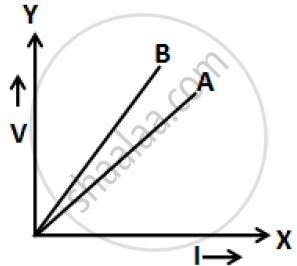
The V-I graph for a series combination and for a parallel combination of two resistors is shown in the figure below. Which of the two A or B. represents the parallel combination? Give reasons for your answer.
Name the material which is the best conductor of electricity.
How does the resistance of a pure metal change if its temperature decreases?
Calculate the resistance of an aluminium cable of length 10 km and diameter 2.0 mm if the resistivity of aluminium is 27 × 10−8 Ωm.
Calculate the combined resistance in the given case:

The diagram below shows part of a circuit:
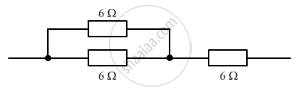
If this arrangement of three resistors was to be replaced by a single resistor, its resistance should be:
(a) 9 Ω
(b) 4 Ω
(c) 6 Ω
(d) 18 Ω
Draw a V-I graph for a conductor at two different temperatures. What conclusion do you draw from your graph for the variation of resistance of conductor with temperature?
What potential difference is needed to drive a current o f 1 A through a 5 Ω resistor?
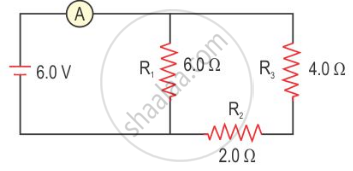
Three resistors of 6.0 Ω, 2.0 Ω and 4.0 Ω are joined to an ammeter A and a cell of emf 6.0 V as shown in the following figure. Calculate :
- the effective resistance of the circuit.
- the reading of ammeter.
What do you mean by power rating of an electrical appliance? How do you use it to calculate
(a) the resistance of the appliance and
(b) the safe limit of the current in it, while in use?
What material is used for making wire to prepare heating coils? Give a reason.
Define the term resistivity and state its S.I. unit. Which will have higher resistivity a conductor or an insulator.
In the circuit shown below, calculate the equivalent resistance between the points (i) A and B, (ii) C and D.
What should be the length of a nickel wire of area of cross-section 3 mm2 used for making a rheostat of 750 ohm? (ρ of nickle = 0.069 Ohm mm2/m)
The resistance of two resistors joined in series is 8Ω and in parallel is 1.5Ω. Find the value of the two resistances.
