Advertisements
Advertisements
Question
Advertisements
Solution
APPEARS IN
RELATED QUESTIONS
Name the quantity whose unit is kilowatt?
A bulb is rated as 250 V; 0.4 A. Find its : (i) power, and (ii) resistance.
Calculate the cost of operating a heater of 500 W for 20 hours at the rate of Rs 3.90 per unit.
The table below shows the current in three different electrical appliances when connected to the 240 V mains supply:
| Appliance | Current |
| Kettle | 8.5 A |
| Lamp | 0.4 A |
| toaster | 4.8 A |
- Which appliance has the greatest electrical resistance? How does the data show this?
- The lamp is connected to the main supply by using a thin, twin-cored cable consisting of live and natural wires. State two reasons why this cable should not be used for connecting the kettle to the mains supply.
- Calculate the power rating of the kettle when it is operated from the 240 V mains supply.
- A main takes the kettle abroad where the mains supply is 120 V. What is the current is the kettle when it is operated from the 120 V supply?
A geyser is rated 1500 W, 250 V. This geyer is connected to 250 V mains. Calculate:
(i) the current drawn
(ii) the energy consumed in 50 hours, and
(iii) the cost of energy consumed at Rs. 4.20 per kWh
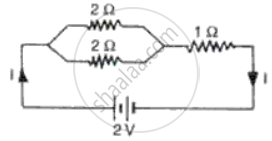
What is the current in the circuit shown (Fig. )
Why is a concave reflector placed behind the heating element in a room heater.
Give two precautious that you would take while putting off an electric switch.
An electric bulb is rated 240V-60W and is working at 100% efficiency.
(i) Calculate the resistance of bulb.
(ii) (a) Draw the circuit diagram.
(b) What is the rate of conversion of energy in each bulb?
(c) Total power used by the bulbs.
