Advertisements
Advertisements
Question
Connect a 1.5 V dry cell to a resistor (low resistance), an ammeter and a key in series as shown in Fig. Record the electric current shown by the ammeter. Replace the single cell by 2, 3, … cells. For the number of cells, record the electric current as is done for you in the table given below:
| S.No. | P.d. (V) (in volts) |
Electric current (in amperes) |
V / I |
|---|---|---|---|
| 1. | 1.5 | 3 | ... |
| 2. | 3.0 | 6 | ... |
| 3. | 4.5 | 9 | ... |
| 4. | ... | ... | ... |
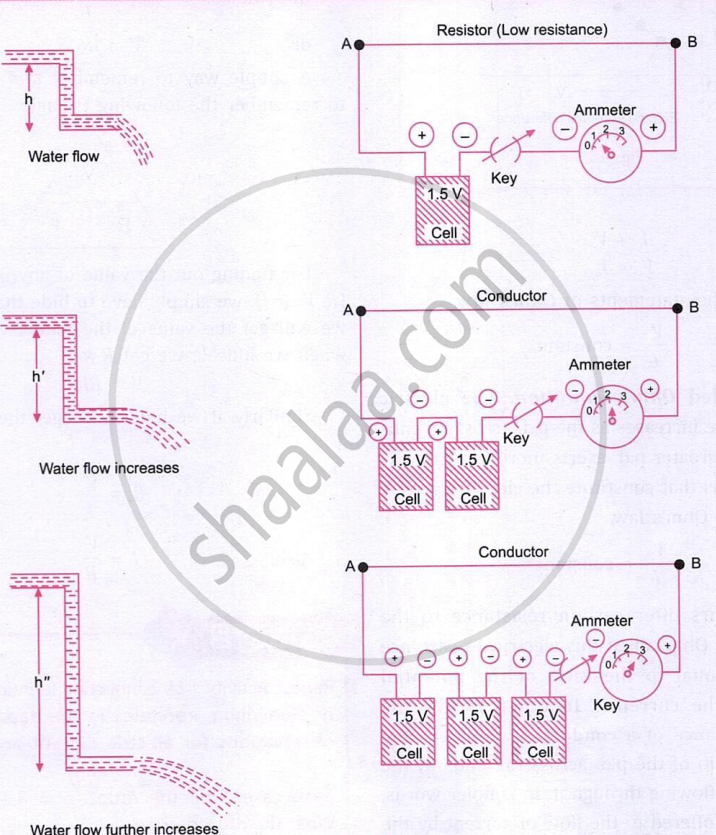
By connecting identical conductors of aluminium, iron, etc., in the gap. Record your observations for electric current and voltage in each case. Find the ratio \(\dfrac{V}{I}=R\) in each case. What do you observe?
Advertisements
Solution
Aim
To study the relationship between potential difference (\(V\)) and electric current (\(I\)) for identical conductors made of different metals and determine their resistance.
Apparatus Required
Battery, ammeter, voltmeter, key, rheostat, connecting wires, and identical wires of aluminium, iron, copper and constantan.
Procedure
-
Connect a battery, ammeter, key and conductor in series. Connect a voltmeter in parallel across the conductor.
-
Close the key and record the potential difference (\(V\)) and current (\(I\)).
-
Change the potential difference and record the corresponding current.
-
Calculate the ratio \(\dfrac{V}{I}\) for each reading.
-
Repeat the experiment using identical wires of aluminium, iron, copper and constantan.
-
Keep the temperature constant throughout the experiment.
Observation Table
The following are illustrative values, not actual experimental readings. The wires are assumed to have equal length and cross-sectional area.
|
Conductor |
Potential difference \(V\) (V) |
Current \(I\) (A) |
Resistance \(\dfrac{V}{I}\) (Ω) |
|---|---|---|---|
|
Copper |
\(2\) |
\(4.0\) |
\(0.5\) |
|
Copper |
\(4\) |
\(8.0\) |
\(0.5\) |
|
Aluminium |
\(2\) |
\(2.5\) |
\(0.8\) |
|
Aluminium |
\(4\) |
\(5.0\) |
\(0.8\) |
|
Iron |
\(2\) |
\(0.8\) |
\(2.5\) |
|
Iron |
\(4\) |
\(1.6\) |
\(2.5\) |
|
Constantan |
\(2\) |
\(0.2\) |
\(10\) |
|
Constantan |
\(4\) |
\(0.4\) |
\(10\) |
Calculation
According to Ohm’s law,
Therefore,
For example, for copper:
Observation
-
The ratio \(\dfrac{V}{I}\) remains constant for a particular conductor at constant temperature.
-
Different conductors have different resistances, even when their lengths and cross-sectional areas are equal.
-
Copper offers the least resistance among the four materials, while constantan offers the greatest resistance.
-
The \(V-I\) graph is a straight line passing through the origin for each conductor.
Result/Conclusion
The electric current flowing through a conductor is directly proportional to the potential difference across its ends, provided its temperature remains constant.
For identical conductors:
