Advertisements
Advertisements
Question
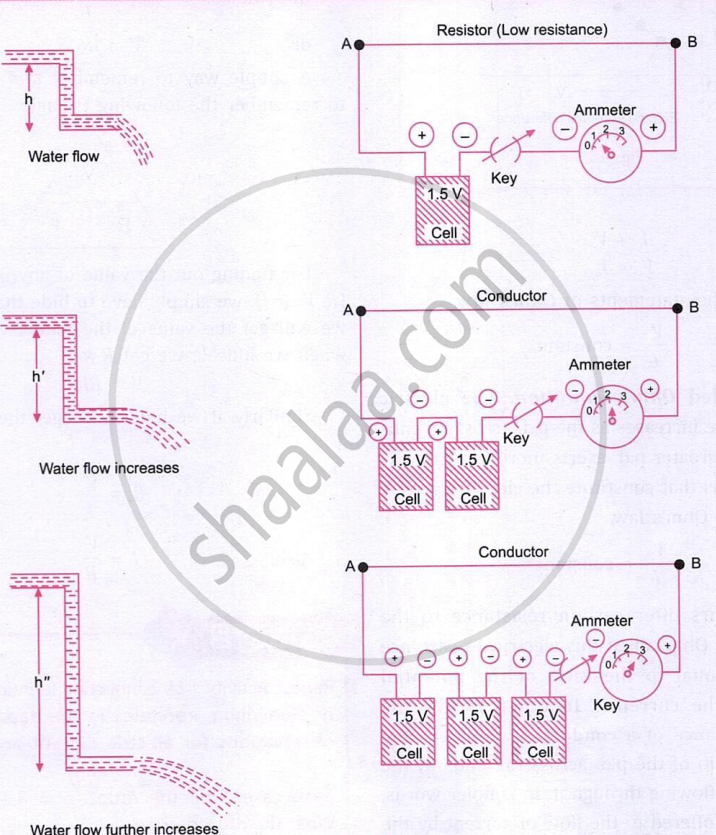
Connect a 1.5 V dry cell to a resistor (low resistance), an ammeter and a key in series as shown in Fig. Record the electric current shown by the ammeter. Replace the single cell by 2, 3, … cells. For the number of cells, record the electric current as is done for you in the table given below:
| S.No. | P.d. (V) (in volts) |
Electric current (in amperes) |
V / I |
|---|---|---|---|
| 1. | 1.5 | 3 | ... |
| 2. | 3.0 | 6 | ... |
| 3. | 4.5 | 9 | ... |
| 4. | ... | ... | ... |
Advertisements
Solution
Aim:
To verify Ohm’s law, i.e., to show that the electric current flowing through a conductor is directly proportional to the potential difference across its ends, at constant temperature.
Apparatus Required:
A dry cell (1.5 V), a low-resistance resistor, an ammeter, a key (switch), connecting wires and a voltmeter.
Procedure:
- Connect a single 1.5 V dry cell, the low-resistance resistor, the ammeter and the key in series as shown in Fig.
- Close the key and record the ammeter reading (electric current) and the potential difference across the resistor.
- Replace the single cell by 2 cells, then 3 cells, then 4 cells, and so on.
- Each time note the potential difference (p.d.) and the corresponding electric current.
- Compute \[ V/I \] for each observation and record it in the table.
Observation Table:
| S.No. | P.d. (V) (in volts) | Electric current (I) (in amperes) | (V / I) \((\Omega)\) |
|---|---|---|---|
| 1. | 1.5 | 3 | \[0.5\ \Omega\] |
| 2. | 3.0 | 6 | \[0.5\ \Omega\] |
| 3. | 4.5 | 9 | \[0.5\ \Omega\] |
| 4. | 6.0 | 12 | \[0.5\ \Omega\] |
Calculation of (V/I) in Each Case:
\[ \frac{V}{I} = \frac{1.5}{3} = 0.5\ \Omega \]
\[ \frac{V}{I} = \frac{3.0}{6} = 0.5\ \Omega \]
\[ \frac{V}{I} = \frac{4.5}{9} = 0.5\ \Omega \]
\[ \frac{V}{I} = \frac{6.0}{12} = 0.5\ \Omega \]
Observations and Conclusion:
- The ratio \[V/I\] remains constant (equal to \(0.5\ \Omega)\) in every observation, even though (V) and (I) both change.
- When the p.d. is doubled (from 1.5 V to 3.0 V), the current also doubles (from 3 A to 6 A). When the p.d. becomes three times, the current also becomes three times.
- Hence, \[\ I \propto V \] or \[\ V \propto I \], which verifies Ohm’s law.
- A graph of (I) against (V) is a straight line passing through the origin, confirming a direct relationship between current and potential difference.
Precautions:
- The key should be closed only while taking the readings to avoid unnecessary heating of the resistor.
- The ammeter must be connected in series and the voltmeter in parallel across the resistor.
- The temperature of the conductor should remain constant throughout the experiment.
