Advertisements
Online Mock Tests
Chapters
▶ 2: Functions
3: Binary Operations
4: Inverse Trigonometric Functions
5: Algebra of Matrices
6: Determinants
7: Adjoint and Inverse of a Matrix
8: Solution of Simultaneous Linear Equations
9: Continuity
10: Differentiability
11: Differentiation
12: Higher Order Derivatives
13: Derivative as a Rate Measurer
14: Differentials, Errors and Approximations
15: Mean Value Theorems
16: Tangents and Normals
17: Increasing and Decreasing Functions
18: Maxima and Minima
19: Indefinite Integrals
20: Definite Integrals
21: Areas of Bounded Regions
22: Differential Equations
23: Algebra of Vectors
24: Scalar Or Dot Product
25: Vector or Cross Product
26: Scalar Triple Product
27: Direction Cosines and Direction Ratios
28: Straight Line in Space
29: The Plane
30: Linear programming
31: Probability
32: Mean and Variance of a Random Variable
33: Binomial Distribution
![RD Sharma solutions for Mathematics [English] Class 12 chapter 2 - Functions - Shaalaa.com](/images/mathematics-english-class-12_6:be05c27f33094688837f0fdb2cb69ac3.jpg "RD Sharma solutions for Mathematics [English] Class 12 chapter 2 - Functions")
Advertisements
Solutions for Chapter 2: Functions
Below listed, you can find solutions for Chapter 2 of CBSE, Karnataka Board PUC RD Sharma for Mathematics [English] Class 12.
RD Sharma solutions for Mathematics [English] Class 12 2 Functions Exercise 2.1 [Pages 31 - 32]
Give an example of a function which is one-one but not onto ?
Give an example of a function which is not one-one but onto ?
Give an example of a function which is neither one-one nor onto ?
Which of the following functions from A to B are one-one and onto?
f1 = {(1, 3), (2, 5), (3, 7)} ; A = {1, 2, 3}, B = {3, 5, 7}
Which of the following functions from A to B are one-one and onto?
f2 = {(2, a), (3, b), (4, c)} ; A = {2, 3, 4}, B = {a, b, c}
Which of the following functions from A to B are one-one and onto ?
f3 = {(a, x), (b, x), (c, z), (d, z)} ; A = {a, b, c, d,}, B = {x, y, z}.
Prove that the function f : N → N, defined by f(x) = x2 + x + 1, is one-one but not onto
Let A = {−1, 0, 1} and f = {(x, x2) : x ∈ A}. Show that f : A → A is neither one-one nor onto.
Classify the following function as injection, surjection or bijection : f : N → N given by f(x) = x2
Classify the following function as injection, surjection or bijection : f : Z → Z given by f(x) = x2
Classify the following function as injection, surjection or bijection : f : N → N given by f(x) = x3
Classify the following function as injection, surjection or bijection : f : Z → Z given by f(x) = x3
Classify the following function as injection, surjection or bijection :
f : R → R, defined by f(x) = |x|
Classify the following function as injection, surjection or bijection :
f : Z → Z, defined by f(x) = x2 + x
Classify the following function as injection, surjection or bijection :
f : Z → Z, defined by f(x) = x − 5
Classify the following function as injection, surjection or bijection :
f : R → R, defined by f(x) = sinx
Classify the following function as injection, surjection or bijection :
f : R → R, defined by f(x) = x3 + 1
Classify the following function as injection, surjection or bijection :
f : R → R, defined by f(x) = x3 − x
Classify the following function as injection, surjection or bijection :
f : R → R, defined by f(x) = sin2x + cos2x
Classify the following function as injection, surjection or bijection :
f : Q − {3} → Q, defined by `f (x) = (2x +3)/(x-3)`
Classify the following function as injection, surjection or bijection :
f : Q → Q, defined by f(x) = x3 + 1
Classify the following function as injection, surjection or bijection :
f : R → R, defined by f(x) = 5x3 + 4
Classify the following function as injection, surjection or bijection :
f : R → R, defined by f(x) = 3 − 4x
Classify the following function as injection, surjection or bijection :
f : R → R, defined by f(x) = 1 + x2
Classify the following function as injection, surjection or bijection :
f : R → R, defined by f(x) = `x/(x^2 +1)`
If f : A → B is an injection, such that range of f = {a}, determine the number of elements in A.
Show that the function f : R − {3} → R − {2} given by f(x) = `(x-2)/(x-3)` is a bijection.
Let A = [-1, 1]. Then, discuss whether the following function from A to itself is one-one, onto or bijective : `f (x) = x/2`
Let A = [-1, 1]. Then, discuss whether the following function from A to itself is one-one, onto or bijective : g(x) = |x|
Let A = [-1, 1]. Then, discuss whether the following functions from A to itself is one-one, onto or bijective : h(x) = x2
Set of ordered pair of a function? If so, examine whether the mapping is injective or surjective :{(x, y) : x is a person, y is the mother of x}
Set of ordered pair of a function ? If so, examine whether the mapping is injective or surjective :{(a, b) : a is a person, b is an ancestor of a}
Let A = {1, 2, 3}. Write all one-one from A to itself.
If f : R → R be the function defined by f(x) = 4x3 + 7, show that f is a bijection.
Show that the exponential function f : R → R, given by f(x) = ex, is one-one but not onto. What happens if the co-domain is replaced by`R0^+` (set of all positive real numbers)?
Show that the logarithmic function f : R0+ → R given by f (x) loga x ,a> 0 is a bijection.
If A = {1, 2, 3}, show that a one-one function f : A → A must be onto.
If A = {1, 2, 3}, show that a onto function f : A → A must be one-one.
Find the number of all onto functions from the set A = {1, 2, 3, ..., n} to itself.
Give examples of two one-one functions f1 and f2 from R to R, such that f1 + f2 : R → R. defined by (f1 + f2) (x) = f1 (x) + f2 (x) is not one-one.
Give examples of two surjective functions f1 and f2 from Z to Z such that f1 + f2 is not surjective.
Show that if f1 and f2 are one-one maps from R to R, then the product f1 × f2 : R → R defined by (f1 × f2) (x) = f1 (x) f2 (x) need not be one - one.
Suppose f1 and f2 are non-zero one-one functions from R to R. Is `f_1 / f^2` necessarily one - one? Justify your answer. Here,`f_1/f_2 : R → R is given by (f_1/f_2) (x) = (f_1(x))/(f_2 (x)) for all x in R .`
Given A = {2, 3, 4}, B = {2, 5, 6, 7}. Construct an example of each of the following:
(i) an injective map from A to B
(ii) a mapping from A to B which is not injective
(iii) a mapping from A to B.
Show that f : R→ R, given by f(x) = x — [x], is neither one-one nor onto.
Let f : N → N be defined by
`f(n) = { (n+ 1, if n is odd),( n-1 , if n is even):}`
Show that f is a bijection.
[CBSE 2012, NCERT]
RD Sharma solutions for Mathematics [English] Class 12 2 Functions Exercise 2.2 [Page 46]
Find gof and fog when f : R → R and g : R → R is defined by f(x) = 2x + 3 and g(x) = x2 + 5 .
Find fog and gof if : f (x) = x2 g(x) = cos x .
Find gof and fog when f : R → R and g : R → R is defined by f(x) = 2x + x2 and g(x) = x3
Find gof and fog when f : R → R and g : R → R is defined by f(x) = x2 + 8 and g(x) = 3x3 + 1 .
Find gof and fog when f : R → R and g : R → R is defined by f(x) = x and g(x) = |x| .
Find fog and gof if : f (x) = ex g(x) = loge x .
Find gof and fog when f : R → R and g : R → R is defined by f(x) = x2 + 2x − 3 and g(x) = 3x − 4 .
Find gof and fog when f : R → R and g : R → R is defined by f(x) = 8x3 and g(x) = x1/3.
Let f = {(3, 1), (9, 3), (12, 4)} and g = {(1, 3), (3, 3) (4, 9) (5, 9)}. Show that gof and fog are both defined. Also, find fog and gof.
Let f = {(1, −1), (4, −2), (9, −3), (16, 4)} and g = {(−1, −2), (−2, −4), (−3, −6), (4, 8)}. Show that gof is defined while fog is not defined. Also, find gof.
Let A = {a, b, c}, B = {u v, w} and let f and g be two functions from A to B and from B to A, respectively, defined as :
f = {(a, v), (b, u), (c, w)}, g = {(u, b), (v, a), (w, c)}.
Show that f and g both are bijections and find fog and gof.
Find fog (2) and gof (1) when : f : R → R ; f(x) = x2 + 8 and g : R → R; g(x) = 3x3 + 1.
Let R+ be the set of all non-negative real numbers. If f : R+ → R+ and g : R+ → R+ are defined as `f(x)=x^2` and `g(x)=+sqrtx` , find fog and gof. Are they equal functions ?
Let f : R → R and g : R → R be defined by f(x) = x2 and g(x) = x + 1. Show that fog ≠ gof.
Let f : R → R and g : R → R be defined by f(x) = x + 1 and g (x) = x − 1. Show that fog = gof = IR.
Verify associativity for the following three mappings : f : N → Z0 (the set of non-zero integers), g : Z0 → Q and h : Q → R given by f(x) = 2x, g(x) = 1/x and h(x) = ex.
Consider f : N → N, g : N → N and h : N → R defined as f(x) = 2x, g(y) = 3y + 4 and h(z) = sin z for all x, y, z ∈ N. Show that ho (gof) = (hog) of.
Give examples of two functions f : N → N and g : N → N, such that gof is onto but f is not onto.
Give examples of two functions f : N → Z and g : Z → Z, such that gof is injective but gis not injective.
If f : A → B and g : B → C are one-one functions, show that gof is a one-one function.
If f : A → B and g : B → C are onto functions, show that gof is a onto function.
RD Sharma solutions for Mathematics [English] Class 12 2 Functions Exercise 2.3 [Pages 54 - 55]
Find fog and gof if : f (x) = |x|, g (x) = sin x .
Find fog and gof if : f (x) = x+1, g(x) = `e^x`
.
Find fog and gof if : f(x) = sin−1 x, g(x) = x2
Find fog and gof if : f (x) = x+1, g (x) = sin x .
Find fog and gof if : f(x)= x + 1, g (x) = 2x + 3 .
Find fog and gof if : f(x) = c, c ∈ R, g(x) = sin `x^2`
Find fog and gof if : f(x) = `x^2` + 2 , g (x) = 1 − `1/ (1-x)`.
Let f(x) = x2 + x + 1 and g(x) = sin x. Show that fog ≠ gof.
If f(x) = |x|, prove that fof = f.
If f(x) = 2x + 5 and g(x) = x2 + 1 be two real functions, then describe each of the following functions:
(1) fog
(2) gof
(3) fof
(4) f2
Also, show that fof ≠ f2
If f(x) = sin x and g(x) = 2x be two real functions, then describe gof and fog. Are these equal functions?
Let f, g, h be real functions given by f(x) = sin x, g (x) = 2x and h (x) = cos x. Prove that fog = go (fh).
Let f be any real function and let g be a function given by g(x) = 2x. Prove that gof = f + f.
if `f (x) = sqrt(1-x)` and g(x) = `log_e` x are two real functions, then describe functions fog and gof.
` if f : (-π/2 , π/2)` → R and g : [−1, 1]→ R be defined as f(x) = tan x and g(x) = `sqrt(1 - x^2)` respectively, describe fog and gof.
if f (x) = `sqrt (x +3) and g (x) = x ^2 + 1` be two real functions, then find fog and gof.
Let f be a real function given by f (x)=`sqrt (x-2)`
Find each of the following:
(i) fof
(ii) fofof
(iii) (fofof) (38)
(iv) f2
Also, show that fof ≠ `f^2` .
Let
f (x) =`{ (1 + x, 0≤ x ≤ 2) , (3 -x , 2 < x ≤ 3):}`
Find fof.
If f, g : R → R be two functions defined as f(x) = |x| + x and g(x) = |x|- x, ∀x∈R" .Then find fog and gof. Hence find fog(–3), fog(5) and gof (–2).
RD Sharma solutions for Mathematics [English] Class 12 2 Functions Exercise 2.4 [Pages 68 - 69]
State with reason whether the following functions have inverse :
f : {1, 2, 3, 4} → {10} with f = {(1, 10), (2, 10), (3, 10), (4, 10)}
State with reason whether the following functions have inverse :
g : {5, 6, 7, 8} → {1, 2, 3, 4} with g = {(5, 4), (6, 3), (7, 4), (8, 2)}
State with reason whether the following functions have inverse:
h : {2, 3, 4, 5} → {7, 9, 11, 13} with h = {(2, 7), (3, 9), (4, 11), (5, 13)}
Find f −1 if it exists : f : A → B, where A = {0, −1, −3, 2}; B = {−9, −3, 0, 6} and f(x) = 3 x.
Find f −1 if it exists : f : A → B, where A = {1, 3, 5, 7, 9}; B = {0, 1, 9, 25, 49, 81} and f(x) = x2
Consider f : {1, 2, 3} → {a, b, c} and g : {a, b, c} → {apple, ball, cat} defined as f (1) = a, f (2) = b, f (3) = c, g (a) = apple, g (b) = ball and g (c) = cat. Show that f, g and gof are invertible. Find f−1, g−1 and gof−1and show that (gof)−1 = f −1o g−1
Let A = {1, 2, 3, 4}; B = {3, 5, 7, 9}; C = {7, 23, 47, 79} and f : A → B, g : B → C be defined as f(x) = 2x + 1 and g(x) = x2 − 2. Express (gof)−1 and f−1 og−1 as the sets of ordered pairs and verify that (gof)−1 = f−1 og−1.
Show that the function f : Q → Q, defined by f(x) = 3x + 5, is invertible. Also, find f−1
Consider f : R → R given by f(x) = 4x + 3. Show that f is invertible. Find the inverse of f.
Consider f : R → R+ → [4, ∞) given by f(x) = x2 + 4. Show that f is invertible with inverse f−1 of f given by f−1 `(x)= sqrt (x-4)` where R+ is the set of all non-negative real numbers.
If `f(x) = (4x + 3)/(6x - 4), x ≠ 2/3` show that fof(x) = x, for all `x ≠ 2/3`. What is the inverse of f?
Consider f : R+ → [−5, ∞) given by f(x) = 9x2 + 6x − 5. Show that f is invertible with `f^-1 (x) = (sqrt (x +6)-1)/3 .`
If f : R → R be defined by f(x) = x3 −3, then prove that f−1 exists and find a formula for f−1. Hence, find f−1(24) and f−1 (5).
A function f : R → R is defined as f(x) = x3 + 4. Is it a bijection or not? In case it is a bijection, find f−1 (3).
If f : Q → Q, g : Q → Q are two functions defined by f(x) = 2 x and g(x) = x + 2, show that f and g are bijective maps. Verify that (gof)−1 = f−1 og −1.
Let A = R - {3} and B = R - {1}. Consider the function f : A → B defined by f(x) = `(x-2)/(x-3).`Show that f is one-one and onto and hence find f-1.
[CBSE 2012, 2014]
Consider the function f : R+ → [-9 , ∞ ]given by f(x) = 5x2 + 6x - 9. Prove that f is invertible with f -1 (y) = `(sqrt(54 + 5y) -3)/5` [CBSE 2015]
Let f : N→N be a function defined as f(x)=`9x^2`+6x−5. Show that f : N→S, where S is the range of f, is invertible. Find the inverse of f and hence find `f^-1`(43) and` f^−1`(163).
Let f : R `{- 4/3} `- 43 →">→ R be a function defined as f(x) = `(4x)/(3x +4)` . Show that f : R - `{-4/3}`→ Rang (f) is one-one and onto. Hence, find f -1.
If f : R → (−1, 1) defined by `f (x) = (10^x- 10^-x)/(10^x + 10 ^-x)` is invertible, find f−1.
If f : R → (0, 2) defined by `f (x) =(e^x - e^(x))/(e^x +e^(-x))+1`is invertible , find f-1.
Let f : [−1, ∞) → [−1, ∞) be given by f(x) = (x + 1)2 − 1, x ≥ −1. Show that f is invertible. Also, find the set S = {x : f(x) = f−1 (x)}.
Let A = {x &epsis; R | −1 ≤ x ≤ 1} and let f : A → A, g : A → A be two functions defined by f(x) = x2 and g(x) = sin (π x/2). Show that g−1 exists but f−1 does not exist. Also, find g−1.
Let f be a function from R to R, such that f(x) = cos (x + 2). Is f invertible? Justify your answer.
If A = {1, 2, 3, 4} and B = {a, b, c, d}, define any four bijections from A to B. Also give their inverse functions.
Let A and B be two sets, each with a finite number of elements. Assume that there is an injective map from A to B and that there is an injective map from B to A. Prove that there is a bijection from A to B.
If f : A → A, g : A → A are two bijections, then prove that fog is an injection ?
If f : A → A, g : A → A are two bijections, then prove that fog is a surjection ?
RD Sharma solutions for Mathematics [English] Class 12 2 Functions Exercise 2.5 [Pages 72 - 74]
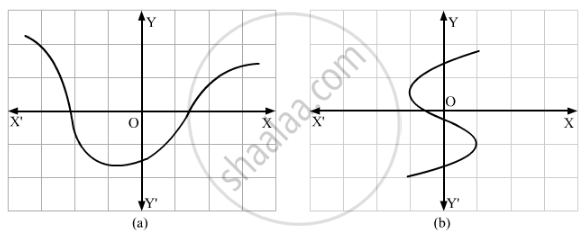
Which one of the following graphs represents a function?
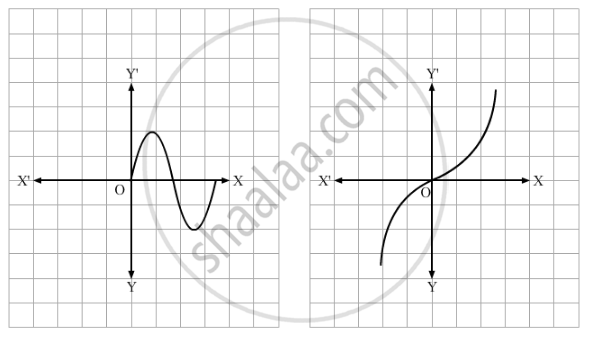
Which of the following graphs represents a one-one function?
If A = {1, 2, 3} and B = {a, b}, write the total number of functions from A to B.
If A = {a, b, c} and B = {−2, −1, 0, 1, 2}, write the total number of one-one functions from A to B.
Write the total number of one-one functions from set A = {1, 2, 3, 4} to set B = {a, b, c}.
If f : R → R is defined by f(x) = x2, write f−1 (25)
If f : C → C is defined by f(x) = x2, write f−1 (−4). Here, C denotes the set of all complex numbers.
If f : R → R is given by f(x) = x3, write f−1 (1).
Let C denote the set of all complex numbers. A function f : C → C is defined by f(x) = x3. Write f−1(1).
Let f be a function from C (set of all complex numbers) to itself given by f(x) = x3. Write f−1 (−1).
If f : C → C is defined by f(x) = x4, write f−1 (1).
If f : R → R is defined by f(x) = x2, find f−1 (−25).
If f : C → C is defined by f(x) = (x − 2)3, write f−1 (−1).
If f : R → R is defined by f(x) = 10 x − 7, then write f−1 (x).
Let \[f : \left( - \frac{\pi}{2}, \frac{\pi}{2} \right) \to R\] be a function defined by f(x) = cos [x]. Write range (f).
If f : R → R defined by f(x) = 3x − 4 is invertible, then write f−1 (x).
If f : R → R, g : R → are given by f(x) = (x + 1)2 and g(x) = x2 + 1, then write the value of fog (−3).
Let A = {x ∈ R : −4 ≤ x ≤ 4 and x ≠ 0} and f : A → R be defined by \[f\left( x \right) = \frac{\left| x \right|}{x}\]Write the range of f.
Let \[f : \left[ - \frac{\pi}{2}, \frac{\pi}{2} \right] \to\] A be defined by f(x) = sin x. If f is a bijection, write set A.
Let f : R → R+ be defined by f(x) = ax, a > 0 and a ≠ 1. Write f−1 (x).
Let f : R − {−1} → R − {1} be given by\[f\left( x \right) = \frac{x}{x + 1} . \text{Write } f^{- 1} \left( x \right)\]
Let `f : R - {- 3/5}` → R be a function defined as `f (x) = (2x)/(5x +3).`
f-1 : Range of f → `R -{-3/5}`.
Let f : R → R, g : R → R be two functions defined by f(x) = x2 + x + 1 and g(x) = 1 − x2. Write fog (−2).
Let f : R → R be defined as `f (x) = (2x - 3)/4.` write fo f-1 (1) .
Let f be an invertible real function. Write ( f-1 of ) (1) + ( f-1 of ) (2) +..... +( f-1 of ) (100 )
Let A = {1, 2, 3, 4} and B = {a, b} be two sets. Write the total number of onto functions from A to B.
Write the domain of the real function
`f (x) = sqrtx - [x] .`
Write the domain of the real function
`f (x) = sqrt([x] - x) .`
Write the domain of the real function
`f (x) = 1/(sqrt([x] - x)`.
Write whether f : R → R, given by `f(x) = x + sqrtx^2` is one-one, many-one, onto or into.
If f(x) = x + 7 and g(x) = x − 7, x ∈ R, write fog (7).
What is the range of the function
`f (x) = ([x - 1])/(x -1) ?`
If f : R → R be defined by f(x) = (3 − x3)1/3, then find fof (x).
If f : R → R is defined by f(x) = 3x + 2, find f (f (x)).
Let A = {1, 2, 3}, B = {4, 5, 6, 7} and let f = {(1, 4), (2, 5), (3, 6)} be a function from A to B. State whether f is one-one or not.
If f : {5, 6} → {2, 3} and g : {2, 3} → {5, 6} are given by f = {(5, 2), (6, 3)} and g = {(2, 5), (3, 6)}, then find fog. [NCERT EXEMPLAR]
Let f : R → R be the function defined by f(x) = 4x − 3 for all x ∈ R Then write f . [NCERT EXEMPLAR]
Which one the following relations on A = {1, 2, 3} is a function?
f = {(1, 3), (2, 3), (3, 2)}, g = {(1, 2), (1, 3), (3, 1)} [NCERT EXEMPLAR]
Write the domain of the real function f defined by f(x) = `sqrt (25 -x^2)` [NCERT EXEMPLAR]
Let A = {a, b, c, d} and f : A → A be given by f = {( a,b ),( b , d ),( c , a ) , ( d , c )} write `f^-1`. [NCERT EXEMPLAR]
Let f, g : R → R be defined by f(x) = 2x + l and g(x) = x2−2 for all x
∈ R, respectively. Then, find gof. [NCERT EXEMPLAR]
If the mapping f : {1, 3, 4} → {1, 2, 5} and g : {1, 2, 5} → {1, 3}, given by f = {(1, 2), (3, 5), (4, 1)} and g = {(2, 3), (5, 1), (1, 3)}, then write fog. [NCERT EXEMPLAR]
If a function g = {(1, 1), (2, 3), (3, 5), (4, 7)} is described by g(x) = \[\alpha x + \beta\] then find the values of \[\alpha\] and \[ \beta\] . [NCERT EXEMPLAR]
If f(x) = 4 −( x - 7)3 then write f-1 (x).
RD Sharma solutions for Mathematics [English] Class 12 2 Functions Exercise 2.6 [Pages 75 - 79]
Let\[A = \left\{ x \in R : - 1 \leq x \leq 1 \right\} = \text{B and C} = \left\{ x \in R : x \geq 0 \right\} and\]\[S = \left\{ \left( x, y \right) \in A \times B : x^2 + y^2 = 1 \right\} \text{and } S_0 = \left\{ \left( x, y \right) \in A \times C : x^2 + y^2 = 1 \right\}\]
Then,
S defines a function from A to B
`S_0` defines a function from A to C
S0 defines a function from A to B
S defines a function from A to C
\[f : R \to R \text{given by} f\left( x \right) = x + \sqrt{x^2} \text{ is }\]
injective
surjective
bijective
None of these
\[f : A \to \text{B given by } 3^{ f\left( x \right)} + 2^{- x} = 4\] is a bijection, then
\[A = \left\{ x \in R : - 1 < x < \infty \right\}, B = \left\{ x \in R : 2 < x < 4 \right\}\]
\[A = \left\{ x \in R : - 3 < x < \infty \right\}, B = \left\{ x \in R : 2 < x < 4 \right\}\]
\[A = \left\{ x \in R : - 3 < x < \infty \right\}, B = \left\{ x \in R : 2 < x < 4 \right\}\]
None of these
The function f : R → R defined by
`f (x) = 2^x + 2^(|x|)` is
one-one and onto
many-one and onto
one-one and into
many-one and into
Let the function
\[f : R - \left\{ - b \right\} \to R - \left\{ 1 \right\}\]
\[f\left( x \right) = \frac{x + a}{x + b}, a \neq b .\text{Then},\]
f is one-one but not onto
f is onto but not one-one
f is both one-one and onto
None of these
The function
f : A → B defined by
f (x) = - x2 + 6x - 8 is a bijection if
A = (- ∞ , 3] and B = ( - ∞, 1 ]
A = [- 3 , ∞) and B = ( - ∞, 1 ]
A = (- ∞ , 3] and B = [ 1 ,∞)
A = [3 ,∞ ) and B = [ 1 ,∞ )
Let
\[A = \left\{ x \in R : - 1 \leq x \leq 1 \right\} = B\] Then, the mapping\[f : A \to \text{B given by} f\left( x \right) = x\left| x \right|\] is
injective but not surjective
surjective but not injective
bijective
none of these
Let
f : R → R be given by
\[f\left( x \right) = \left[ x^2 \right] + \left[ x + 1 \right] - 3\]
where [x] denotes the greatest integer less than or equal to x. Then, f(x) is
(d) one-one and onto
many-one and onto
many-one and into
one-one and into
one-one and onto
Let M be the set of all 2 × 2 matrices with entries from the set R of real numbers. Then, the function f : M→ R defined by f(A) = |A| for every A ∈ M, is
one-one and onto
neither one-one nor onto
one-one but-not onto
onto but not one-one
The function \[f : [0, \infty ) \to \text {R given by } f\left( x \right) = \frac{x}{x + 1} is\]
one-one and onto
one-one but not onto
onto but not one-one
onto but not one-one
The range of the function
\[f\left( x \right) =^{7 - x} P_{x - 3}\]
{1, 2, 3, 4, 5}
{1, 2, 3, 4, 5, 6}
{1, 2, 3, 4}
{1, 2, 3}
A function f from the set of natural numbers to integers defined by
`{([n-1]/2," when n is odd" is ),(-n/2,when n is even ) :}`
neither one-one nor onto
one-one but not onto
onto but not one-one
one-one and onto both
Let f be an injective map with domain {x, y, z} and range {1, 2, 3}, such that exactly one of the following statements is correct and the remaining are false.
\[f\left( x \right) = 1, f\left( y \right) \neq 1, f\left( z \right) \neq 2 .\]
The value of
\[f^{- 1} \left( 1 \right)\] is
x
y
z
none of these
Which of the following functions form Z to itself are bijections?
\[f\left( x \right) = x^3\]
\[f\left( x \right) = x + 2\]
\[f\left( x \right) = 2x + 1\]
\[f\left( x \right) = x^2 + x\]
Which of the following functions from
to itself are bijections?
\[f\left( x \right) = \frac{x}{2}\]
\[g\left( x \right) = \sin\left( \frac{\pi x}{2} \right)\]
\[h\left( x \right) = |x|\]
\[k\left( x \right) = x^2\]
Let
\[A = \left\{ x : - 1 \leq x \leq 1 \right\} \text{and} f : A \to \text{A such that f}\left( x \right) = x|x|\]
a bijection
injective but not surjective
surjective but not injective
neither injective nor surjective
If the function\[f : R \to \text{A given by} f\left( x \right) = \frac{x^2}{x^2 + 1}\] is a surjection, then A =
R
[0, 1]
[0, 1]
[0, 1]
If a function\[f : [2, \infty )\text{ to B defined by f}\left( x \right) = x^2 - 4x + 5\] is a bijection, then B =
R
[1, ∞)
[4, ∞)
[5, ∞)
The function
\[f : R \to R\] defined by\[f\left( x \right) = \left( x - 1 \right) \left( x - 2 \right) \left( x - 3 \right)\]
(a) one-one but not onto
(b) onto but not one-one
(c) both one and onto
(d) neither one-one nor onto
one-one but not onto
onto but not one-one
both one and onto
neither one-one nor onto
The function f : [-1/2, 1/2, 1/2] → [-π /2,π/2], defined by f (x) = `sin^-1` (3x - `4x^3`), is
bijection
injection but not a surjection
surjection but not an injection
neither an injection nor a surjection
Let
\[f : R \to R\] be a function defined by
f is a bijection
f is an injection only
f is surjection on only
f is neither an injection nor a surjection
Let
\[f : R - \left\{ n \right\} \to R\]
f is one-one onto
f is one-one into
f is many one onto
f is many one into
Let
one-one but not onto
one-one and onto
onto but not one-one
neither one-one nor onto
\[f : R \to R\] is defined by
\[f\left( x \right) = \frac{e^{x^2} - e^{- x^2}}{e^{x^2 + e^{- x^2}}} is\]
one-one but not onto
many-one but onto
one-one and onto
neither one-one nor onto
The function
injective but not surjective
surjective but not injective
injective as well as surjective
neither injective nor surjective
A function f from the set of natural numbers to the set of integers defined by
\[f\left( n \right)\begin{cases}\frac{n - 1}{2}, & \text{when n is odd} \\ - \frac{n}{2}, & \text{when n is even}\end{cases}\]
neither one-one nor onto
one-one but not onto
onto but not one-one
one-one and onto
Which of the following functions from
\[A = \left\{ x \in R : - 1 \leq x \leq 1 \right\}\]
\[f\left( x \right) = |x|\]
\[f\left( x \right) = \sin\frac{\pi x}{2}\]
\[f\left( x \right) = \sin\frac{\pi x}{4}\]
None of these
\[f : Z \to Z\] be given by
` f (x) = {(x/2, ", if x is even" ) ,(0 , ", if x is odd "):}`
Then, f is
onto but not one-one
one-one but not onto
one-one and onto
neither one-one nor onto
The function \[f : R \to R\] defined by
\[f\left( x \right) = 6^x + 6^{|x|}\] is
one-one and onto
many one and onto
one-one and into
many one and into
Let \[f\left( x \right) = x^2 and g\left( x \right) = 2^x\] Then, the solution set of the equation
R
{0}
{0, 2}
none of these
If \[f : R \to R is given by f\left( x \right) = 3x - 5, then f^{- 1} \left( x \right)\]
is given by \[\frac{1}{3x - 5}\]
is given by \[\frac{x + 5}{3}\]
does not exist because f is not one-one
does not exist because f is not onto
If \[g \left( f \left( x \right) \right) = \left| \sin x \right| \text{and} f \left( g \left( x \right) \right) = \left( \sin \sqrt{x} \right)^2 , \text{then}\]
\[f\left( x \right) = \sin^2 x, g\left( x \right) = \sqrt{x}\]
\[f\left( x \right) = \sin x, g\left( x \right) = |x|\]
\[f\left( x \right) = x^2 , g\left( x \right) = \sin \sqrt{x}\]
f and g cannot be determied
The inverse of the function
\[f : R \to \left\{ x \in R : x < 1 \right\}\] given by
\[f\left( x \right) = \frac{e^x - e^{- x}}{e^x + e^{- x}}\] is
\[\frac{1}{2} \log \frac{1 + x}{1 - x}\]
\[\frac{1}{2} \log \frac{2 + x}{2 - x}\]
\[\frac{1}{2} \log \frac{1 - x}{1 + x}\]
none of these
Let
\[A = \left\{ x \in R : x \geq 1 \right\}\] The inverse of the function,
\[f : A \to A\] given by
\[f\left( x \right) = 2^{x \left( x - 1 \right)} , is\]
\[\left( \frac{1}{2} \right)^{x \left( x - 1 \right)}\]
\[\frac{1}{2} \left\{ 1 + \sqrt{1 + 4 \log_2 x} \right\}\]
\[\frac{1}{2} \left\{ 1 - \sqrt{1 + 4 \log_2 x} \right\}\]
not defined
Let
\[A = \left\{ x \in R : x \leq 1 \right\} and f : A \to A\] be defined as
\[f\left( x \right) = x \left( 2 - x \right)\] Then,
\[f^{- 1} \left( x \right)\] is
\[1 + \sqrt{1 - x}\]
\[1 - \sqrt{1 - x}\]
\[\sqrt{1 - x}\]
\[1 \pm \sqrt{1 - x}\]
Let \[f\left( x \right) = \frac{1}{1 - x} . \text{Then}, \left\{ f o \left( fof \right) \right\} \left( x \right)\]
\[\text{x for all x} \in R\]
\[\text{x for all x} \in R - \left\{ 1 \right\}\]
\[\text{x for all x} \in R - \left\{ 0, 1 \right\}\]
none of these
If the function
\[f : R \to R\] be such that
\[f\left( x \right) = x - \left[ x \right]\] where [x] denotes the greatest integer less than or equal to x, then \[f^{- 1} \left( x \right)\]
\[\frac{1}{x - \left[ x \right]}\]
[x] − x
not defined
none of these
If \[F : [1, \infty ) \to [2, \infty )\] is given by
\[f\left( x \right) = x + \frac{1}{x}, then f^{- 1} \left( x \right)\]
\[\frac{x + \sqrt{x^2 - 4}}{2}\]
\[\frac{x}{1 + x^2}\]
\[\frac{x - \sqrt{x^2 - 4}}{2}\]
\[1 + \sqrt{x^2 - 4}\]
x
1
f(x)
g(x)
Let \[f\left( x \right) = \frac{\alpha x}{x + 1}, x \neq - 1\] Then, for what value of α is \[f \left( f\left( x \right) \right) = x?\]
\[\sqrt{2}\]
\[- \sqrt{2}\]
1
-1
The distinct linear functions that map [−1, 1] onto [0, 2] are
\[f\left( x \right) = x + 1, g\left( x \right) = - x + 1\]
\[f\left( x \right) = x - 1, g\left( x \right) = x + 1\]
\[f\left( x \right) = - x - 1, g\left( x \right) = x - 1\]
None of these
Let
\[f : [2, \infty ) \to X\] be defined by
\[f\left( x \right) = 4x - x^2\] Then, f is invertible if X =
\[[2, \infty )\]
\[( - \infty , 2]\]
\[( - \infty , 4]\]
\[[4, \infty )\]
If \[f : R \to \left( - 1, 1 \right)\] is defined by
\[f\left( x \right) = \frac{- x|x|}{1 + x^2}, \text{ then } f^{- 1} \left( x \right)\] equals
\[\sqrt{\frac{\left| x \right|}{1 - \left| x \right|}}\]
\[\text{ Sgn } \left( x \right) \sqrt{\frac{\left| x \right|}{1 - \left| x \right|}}\]
\[- \sqrt{\frac{x}{1 - x}}\]
None of these
Let [x] denote the greatest integer less than or equal to x. If \[f\left( x \right) = \sin^{- 1} x, g\left( x \right) = \left[ x^2 \right]\text{ and } h\left( x \right) = 2x, \frac{1}{2} \leq x \leq \frac{1}{\sqrt{2}}\]
\[\text{fogoh}\left( x \right) = \frac{\pi}{2}\]
fogoh (x) = π
\[\text{ho f og = hogo f}\]
\[\text{ho f og ≠ hogo f}\]
If \[g\left( x \right) = x^2 + x - 2\text{ and} \frac{1}{2} gof\left( x \right) = 2 x^2 - 5x + 2\] is equal to
\[2 x - 3\]
\[2 x + 3\]
\[2 x^2 + 3x + 1\]
2 \[x^2 - 3x - 1\]
If \[f\left( x \right) = \sin^2 x\] and the composite function \[g\left( f\left( x \right) \right) = \left| \sin x \right|\] then g(x) is equal to
\[\sqrt{x - 1}\]
\[\sqrt{x}\]
\[\sqrt{x + 1}\]
\[- \sqrt{x}\]
If \[f : R \to R\] is given by \[f\left( x \right) = x^3 + 3, \text{then} f^{- 1} \left( x \right)\] is equal to
\[x^{1/3} - 3\]
\[x^{1/3} + 3\]
\[\left( x - 3 \right)^{1/3}\]
\[x + 3^{1/3}\]
Let \[f\left(x\right) = x^3\] be a function with domain {0, 1, 2, 3}. Then domain of \[f^{-1}\] is ______.
{3, 2, 1, 0}
{0, −1, −2, −3}
{0, 1, 8, 27}
{0, −1, −8, −27}
Let
\[f : R \to R\] be given by \[f\left( x \right) = x^2 - 3\] Then, \[f^{- 1}\] is given by
\[\sqrt{x + 3}\]
\[\sqrt{x} + 3\]
\[x + \sqrt{3}\]
None of these
Mark the correct alternative in the following question:
Let f : R → R be given by f(x) = tanx. Then, f-1(1) is
\[\frac{\pi}{4}\]
\[\left\{ n\pi + \frac{\pi}{4}: n \in Z \right\}\]
does not exist
none of these
Mark the correct alternative in the following question:
Let f : R→ R be defined as, f(x) = \[\begin{cases}2x, if x > 3 \\ x^2 , if 1 < x \leq 3 \\ 3x, if x \leq 1\end{cases}\]
Then, find f( \[-\]1) + f(2) + f(4)
9
14
5
none of these
Mark the correct alternative in the following question:
Let A = {1, 2, ... , n} and B = {a, b}. Then the number of subjections from A into B is
nP2
2n - 2
2n - 1
nC2
Mark the correct alternative in the following question:
If the set A contains 5 elements and the set B contains 6 elements, then the number of one-one and onto mappings from A to B is
720
120
0
none of these
Mark the correct alternative in the following question:
If the set A contains 7 elements and the set B contains 10 elements, then the number one-one functions from A to B is
10C7
10C7\[\times\] 7!
710
107
Mark the correct alternative in the following question:
Let f : R \[-\] \[\left\{ \frac{3}{5} \right\}\] \[\to\] R be defined by f(x) = \[\frac{3x + 2}{5x - 3}\] Then,
f-1 (x) = f (x)
`f^-1 (x) = - f(x)`
fo f(x) = - x
`f^-1(x) = 1/19f(x)`
Solutions for 2: Functions
RD Sharma solutions for Mathematics [English] Class 12 chapter 2 - Functions
Shaalaa.com has the CBSE, Karnataka Board PUC Mathematics Mathematics [English] Class 12 CBSE, Karnataka Board PUC solutions in a manner that help students grasp basic concepts better and faster. The detailed, step-by-step solutions will help you understand the concepts better and clarify any confusion. RD Sharma solutions for Mathematics Mathematics [English] Class 12 CBSE, Karnataka Board PUC 2 (Functions) include all questions with answers and detailed explanations. This will clear students' doubts about questions and improve their application skills while preparing for board exams.
Further, we at Shaalaa.com provide such solutions so students can prepare for written exams. RD Sharma textbook solutions can be a core help for self-study and provide excellent self-help guidance for students.
Concepts covered in Mathematics [English] Class 12 chapter 2 Functions are Basics of Relations & Functions, Types of Relations, Types of Functions, Overview of Relations and Functions, Equivalence Class and Relation, Composition of Functions, Invertible Functions.
Using RD Sharma Mathematics [English] Class 12 solutions Functions exercise by students is an easy way to prepare for the exams, as they involve solutions arranged chapter-wise and also page-wise. The questions involved in RD Sharma Solutions are essential questions that can be asked in the final exam. Maximum CBSE, Karnataka Board PUC Mathematics [English] Class 12 students prefer RD Sharma Textbook Solutions to score more in exams.
Get the free view of Chapter 2, Functions Mathematics [English] Class 12 additional questions for Mathematics Mathematics [English] Class 12 CBSE, Karnataka Board PUC, and you can use Shaalaa.com to keep it handy for your exam preparation.
