Advertisements
Advertisements
Question
Let\[A = \left\{ x \in R : - 1 \leq x \leq 1 \right\} = \text{B and C} = \left\{ x \in R : x \geq 0 \right\} and\]\[S = \left\{ \left( x, y \right) \in A \times B : x^2 + y^2 = 1 \right\} \text{and } S_0 = \left\{ \left( x, y \right) \in A \times C : x^2 + y^2 = 1 \right\}\]
Then,
Options
S defines a function from A to B
`S_0` defines a function from A to C
S0 defines a function from A to B
S defines a function from A to C
Advertisements
Solution
(a) S defines a function from A to B
\[\text{Let x} \in A\]
\[ \Rightarrow - 1 \leq x \leq 1\]
\[\text{Now}, x^2 + y^2 = 1\]
\[ \Rightarrow y^2 = 1 - x^2 \]
\[ \Rightarrow y = \pm \sqrt{1 - x^2}\]
\[ \Rightarrow - 1 \leq y \leq 1\]
\[ \therefore y \in B\]
\[\text{Thus, S defines a function from A to B} . \]
APPEARS IN
RELATED QUESTIONS
Let A = R – {3} and B = R – {1}. Consider the function f : A → B defined by f(x) = `((x - 2)/(x - 3))`. Is f one-one and onto? Justify your answer.
Give examples of two functions f: N → Z and g: Z → Z such that g o f is injective but gis not injective.
(Hint: Consider f(x) = x and g(x) =|x|)
If the function `f(x) = sqrt(2x - 3)` is invertible then find its inverse. Hence prove that `(fof^(-1))(x) = x`
Give an example of a function which is not one-one but onto ?
Classify the following function as injection, surjection or bijection : f : Z → Z given by f(x) = x3
Classify the following function as injection, surjection or bijection :
f : Z → Z, defined by f(x) = x2 + x
Classify the following function as injection, surjection or bijection :
f : R → R, defined by f(x) = 1 + x2
If A = {1, 2, 3}, show that a one-one function f : A → A must be onto.
If A = {1, 2, 3}, show that a onto function f : A → A must be one-one.
Find gof and fog when f : R → R and g : R → R is defined by f(x) = 8x3 and g(x) = x1/3.
Let f = {(1, −1), (4, −2), (9, −3), (16, 4)} and g = {(−1, −2), (−2, −4), (−3, −6), (4, 8)}. Show that gof is defined while fog is not defined. Also, find gof.
Find fog and gof if : f (x) = x+1, g(x) = `e^x`
.
Find fog and gof if : f(x)= x + 1, g (x) = 2x + 3 .
Find fog and gof if : f(x) = c, c ∈ R, g(x) = sin `x^2`
if `f (x) = sqrt(1-x)` and g(x) = `log_e` x are two real functions, then describe functions fog and gof.
State with reason whether the following functions have inverse :
f : {1, 2, 3, 4} → {10} with f = {(1, 10), (2, 10), (3, 10), (4, 10)}
If f : R → (−1, 1) defined by `f (x) = (10^x- 10^-x)/(10^x + 10 ^-x)` is invertible, find f−1.
Which of the following graphs represents a one-one function?
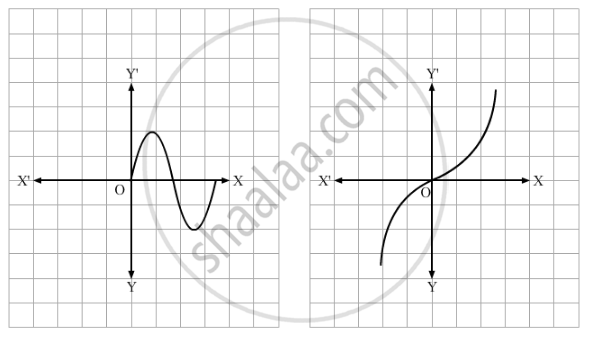
If f : C → C is defined by f(x) = x4, write f−1 (1).
Let \[f : \left( - \frac{\pi}{2}, \frac{\pi}{2} \right) \to R\] be a function defined by f(x) = cos [x]. Write range (f).
Let \[f : \left[ - \frac{\pi}{2}, \frac{\pi}{2} \right] \to\] A be defined by f(x) = sin x. If f is a bijection, write set A.
Let f be an invertible real function. Write ( f-1 of ) (1) + ( f-1 of ) (2) +..... +( f-1 of ) (100 )
If f(x) = x + 7 and g(x) = x − 7, x ∈ R, write fog (7).
Let A = {a, b, c, d} and f : A → A be given by f = {( a,b ),( b , d ),( c , a ) , ( d , c )} write `f^-1`. [NCERT EXEMPLAR]
If a function\[f : [2, \infty )\text{ to B defined by f}\left( x \right) = x^2 - 4x + 5\] is a bijection, then B =
Let
\[f : R - \left\{ n \right\} \to R\]
Let
\[f : R \to R\] be given by \[f\left( x \right) = x^2 - 3\] Then, \[f^{- 1}\] is given by
Write about strlen() function.
The domain of the function f: R → R defined by f(x) = `sqrt(x^2 - 3x + 2)` is ______
Let D be the domain of the real valued function f defined by f(x) = `sqrt(25 - x^2)`. Then, write D
Let f: R → R be given by f(x) = tan x. Then f–1(1) is ______.
The domain of the function `cos^-1((2sin^-1(1/(4x^2-1)))/π)` is ______.
Let f: R→R be defined as f(x) = 2x – 1 and g: R – {1}→R be defined as g(x) = `(x - 1/2)/(x - 1)`. Then the composition function f (g(x)) is ______.
Let f: R→R be a continuous function such that f(x) + f(x + 1) = 2, for all x ∈ R. If I1 = `int_0^8f(x)dx` and I2 = `int_(-1)^3f(x)dx`, then the value of I1 + 2I2 is equal to ______.
Number of integral values of x satisfying the inequality `(3/4)^(6x + 10 - x^2) < 27/64` is ______.
`x^(log_5x) > 5` implies ______.
Let a and b are two positive integers such that b ≠ 1. Let g(a, b) = Number of lattice points inside the quadrilateral formed by lines x = 0, y = 0, x = b and y = a. f(a, b) = `[a/b] + [(2a)/b] + ... + [((b - 1)a)/b]`, then the value of `[(g(101, 37))/(f(101, 37))]` is ______.
(Note P(x, y) is lattice point if x, y ∈ I)
(where [.] denotes greatest integer function)
Let f(1, 3) `rightarrow` R be a function defined by f(x) = `(x[x])/(1 + x^2)`, where [x] denotes the greatest integer ≤ x, Then the range of f is ______.
If A = {x ∈ R: |x – 2| > 1}, B = `{x ∈ R : sqrt(x^2 - 3) > 1}`, C = {x ∈ R : |x – 4| ≥ 2} and Z is the set of all integers, then the number of subsets of the set (A ∩ B ∩ C) C ∩ Z is ______.
