Advertisements
Advertisements
Question
Let X = {1, 2, 3}and Y = {4, 5}. Find whether the following subset of X ×Y are function from X to Y or not
f = {(1, 4), (1, 5), (2, 4), (3, 5)}
Advertisements
Solution
Given, X = {1, 2, 3} and Y = {4, 5}
So, X × Y = {(1, 4), (1, 5), (2, 4), (2, 5), (3, 4), (3, 5)}
f = {(1, 4), (1, 5), (2, 4), (3, 5)}
f is not a function as f(1) = 4 and f(1) = 5
Hence, pre-image ‘1’ has not unique image.
APPEARS IN
RELATED QUESTIONS
Show that the function f in `A=R-{2/3} ` defined as `f(x)=(4x+3)/(6x-4)` is one-one and onto hence find f-1
Let f: R → R be defined as f(x) = 10x + 7. Find the function g: R → R such that g o f = f o g = 1R.
Classify the following function as injection, surjection or bijection :
f : R → R, defined by f(x) = |x|
Classify the following function as injection, surjection or bijection :
f : R → R, defined by f(x) = sinx
Let f : N → N be defined by
`f(n) = { (n+ 1, if n is odd),( n-1 , if n is even):}`
Show that f is a bijection.
[CBSE 2012, NCERT]
Find fog and gof if : f (x) = x+1, g(x) = `e^x`
.
If f(x) = sin x and g(x) = 2x be two real functions, then describe gof and fog. Are these equal functions?
Show that the function f : Q → Q, defined by f(x) = 3x + 5, is invertible. Also, find f−1
Consider f : R+ → [−5, ∞) given by f(x) = 9x2 + 6x − 5. Show that f is invertible with `f^-1 (x) = (sqrt (x +6)-1)/3 .`
If f : A → A, g : A → A are two bijections, then prove that fog is an injection ?
Which of the following graphs represents a one-one function?
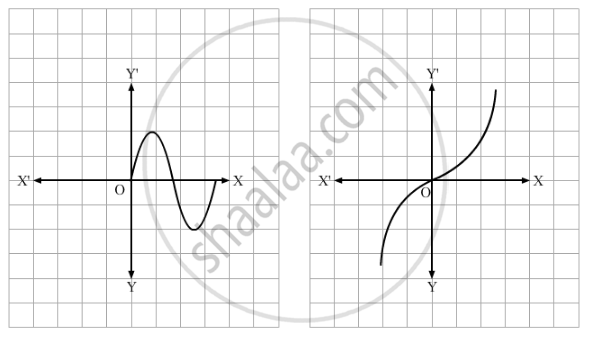
Let C denote the set of all complex numbers. A function f : C → C is defined by f(x) = x3. Write f−1(1).
Let \[f : \left( - \frac{\pi}{2}, \frac{\pi}{2} \right) \to R\] be a function defined by f(x) = cos [x]. Write range (f).
If f : R → R be defined by f(x) = (3 − x3)1/3, then find fof (x).
If f : R → R is defined by f(x) = 3x + 2, find f (f (x)).
If f : {5, 6} → {2, 3} and g : {2, 3} → {5, 6} are given by f = {(5, 2), (6, 3)} and g = {(2, 5), (3, 6)}, then find fog. [NCERT EXEMPLAR]
Let
\[f : R - \left\{ n \right\} \to R\]
Let
The inverse of the function
\[f : R \to \left\{ x \in R : x < 1 \right\}\] given by
\[f\left( x \right) = \frac{e^x - e^{- x}}{e^x + e^{- x}}\] is
Let \[f\left( x \right) = \frac{1}{1 - x} . \text{Then}, \left\{ f o \left( fof \right) \right\} \left( x \right)\]
Let \[f\left( x \right) = \frac{\alpha x}{x + 1}, x \neq - 1\] Then, for what value of α is \[f \left( f\left( x \right) \right) = x?\]
If \[g\left( x \right) = x^2 + x - 2\text{ and} \frac{1}{2} gof\left( x \right) = 2 x^2 - 5x + 2\] is equal to
Write about strcmp() function.
Let f: R → R be defined by f(x) = 3x – 4. Then f–1(x) is given by ______.
For sets A, B and C, let f: A → B, g: B → C be functions such that g o f is surjective. Then g is surjective.
Are the following set of ordered pairs functions? If so, examine whether the mapping is injective or surjective.
{(a, b): a is a person, b is an ancestor of a}
Let the function f: R → R be defined by f(x) = cosx, ∀ x ∈ R. Show that f is neither one-one nor onto
Let g(x) = x2 – 4x – 5, then ____________.
If N be the set of all-natural numbers, consider f: N → N such that f(x) = 2x, ∀ x ∈ N, then f is ____________.
The domain of the function `"f"("x") = 1/(sqrt ({"sin x"} + {"sin" ( pi + "x")}))` where {.} denotes fractional part, is
Let f(x) = ax (a > 0) be written as f(x) = f1(x) + f2(x), where f1(x) is an even function and f2(x) is an odd function. Then f1(x + y) + f1(x – y) equals ______.
Let f(n) = `[1/3 + (3n)/100]n`, where [n] denotes the greatest integer less than or equal to n. Then `sum_(n = 1)^56f(n)` is equal to ______.
Let a function `f: N rightarrow N` be defined by
f(n) = `{:[(2n",", n = 2"," 4"," 6"," 8","......),(n - 1",", n = 3"," 7"," 11"," 15","......),((n + 1)/2",", n = 1"," 5"," 9"," 13","......):}`
then f is ______.
A function is a rule that assigns each element of one set to exactly how many elements of another set?
A function is called one-one if different elements of the domain have:
For \(f(x)=x^2+x\), if \(y=1\), which two domain elements have the same image?
In the function from \(X\) to \(Y\), if \(6\in Y\) is not the image of any element of \(X\), the function is:
Which condition represents an into function?
