Advertisements
Advertisements
Question
Let [x] denote the greatest integer less than or equal to x. If \[f\left( x \right) = \sin^{- 1} x, g\left( x \right) = \left[ x^2 \right]\text{ and } h\left( x \right) = 2x, \frac{1}{2} \leq x \leq \frac{1}{\sqrt{2}}\]
Options
\[\text{fogoh}\left( x \right) = \frac{\pi}{2}\]
fogoh (x) = π
\[\text{ho f og = hogo f}\]
\[\text{ho f og ≠ hogo f}\]
Advertisements
Solution
(c) \[\text{ho fog = hogo f}\]
\[\text{We have}, \]
\[g\left( x \right) = \left[ x^2 \right] \]
\[ = 0 \left(As\frac{1}{2} \leq x \leq \frac{1}{\sqrt{2}}\therefore \frac{1}{4} \leq x^2 \leq \frac{1}{2} \right)\]
\[\text{fog}\left( x \right) = f\left( g\left( x \right) \right) = \sin^{- 1} \left( 0 \right)\]
\[ = 0\]
\[\text{hofog}\left( x \right) = h\left( f\left( g\left( x \right) \right) \right) = 2 \times 0 = 0\]
\[\text{And}\]
\[f\left( x \right) = \sin^{- 1} x\]
\[Now, \]
\[for, x \in \left[ \frac{1}{2}, \frac{1}{\sqrt{2}} \right]\]
\[f\left( x \right) \in \left[ \frac{\pi}{6}, \frac{\pi}{4} \right]\]
\[f\left( x \right) \in \left[ 0 . 52, 0 . 78 \right]\]
\[gof\left( x \right) = 0 \left( As, f\left( x \right) \in \left[ 0 . 52, 0 . 78 \right] \right)\]
\[ = 0\]
\[\text{hogof}\left( x \right) = h\left( g\left( f\left( x \right) \right) \right) = 2 \times 0 = 0\]
\[\therefore \text{hofog = hogof} = 0\]
APPEARS IN
RELATED QUESTIONS
Check the injectivity and surjectivity of the following function:
f : N → N given by f(x) = x3
Given examples of two functions f: N → N and g: N → N such that gof is onto but f is not onto.
(Hint: Consider f(x) = x + 1 and `g(x) = {(x-1, ifx >1),(1, if x = 1):}`
Give an example of a function which is neither one-one nor onto ?
Classify the following function as injection, surjection or bijection : f : Z → Z given by f(x) = x2
Classify the following function as injection, surjection or bijection : f : Z → Z given by f(x) = x3
If f : A → B is an injection, such that range of f = {a}, determine the number of elements in A.
Show that the logarithmic function f : R0+ → R given by f (x) loga x ,a> 0 is a bijection.
If A = {1, 2, 3}, show that a onto function f : A → A must be one-one.
Find fog and gof if : f (x) = |x|, g (x) = sin x .
Find fog and gof if : f(x)= x + 1, g (x) = 2x + 3 .
If f(x) = |x|, prove that fof = f.
if `f (x) = sqrt(1-x)` and g(x) = `log_e` x are two real functions, then describe functions fog and gof.
State with reason whether the following functions have inverse :
f : {1, 2, 3, 4} → {10} with f = {(1, 10), (2, 10), (3, 10), (4, 10)}
Let A = {1, 2, 3, 4}; B = {3, 5, 7, 9}; C = {7, 23, 47, 79} and f : A → B, g : B → C be defined as f(x) = 2x + 1 and g(x) = x2 − 2. Express (gof)−1 and f−1 og−1 as the sets of ordered pairs and verify that (gof)−1 = f−1 og−1.
Which of the following graphs represents a one-one function?
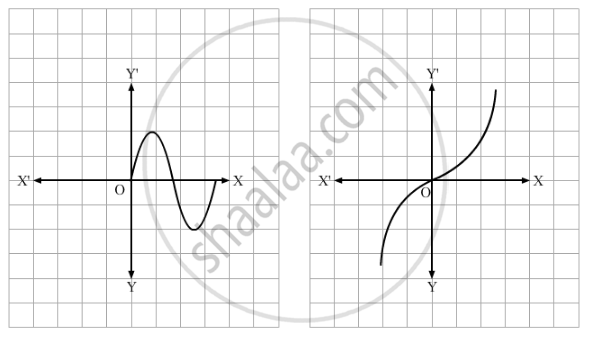
If f : R → R is defined by f(x) = x2, write f−1 (25)
If f : C → C is defined by f(x) = (x − 2)3, write f−1 (−1).
Let \[f : \left[ - \frac{\pi}{2}, \frac{\pi}{2} \right] \to\] A be defined by f(x) = sin x. If f is a bijection, write set A.
Which one the following relations on A = {1, 2, 3} is a function?
f = {(1, 3), (2, 3), (3, 2)}, g = {(1, 2), (1, 3), (3, 1)} [NCERT EXEMPLAR]
\[f : A \to \text{B given by } 3^{ f\left( x \right)} + 2^{- x} = 4\] is a bijection, then
Let the function
\[f : R - \left\{ - b \right\} \to R - \left\{ 1 \right\}\]
\[f\left( x \right) = \frac{x + a}{x + b}, a \neq b .\text{Then},\]
A function f from the set of natural numbers to integers defined by
`{([n-1]/2," when n is odd" is ),(-n/2,when n is even ) :}`
If a function\[f : [2, \infty )\text{ to B defined by f}\left( x \right) = x^2 - 4x + 5\] is a bijection, then B =
\[f : Z \to Z\] be given by
` f (x) = {(x/2, ", if x is even" ) ,(0 , ", if x is odd "):}`
Then, f is
Show that the function f: R → R defined by f(x) = `x/(x^2 + 1)`, ∀ ∈ + R , is neither one-one nor onto
Let f: R → R be defined by f(x) = x2 + 1. Then, pre-images of 17 and – 3, respectively, are ______.
Consider the set A containing n elements. Then, the total number of injective functions from A onto itself is ______
Let A be a finite set. Then, each injective function from A into itself is not surjective.
Are the following set of ordered pairs functions? If so, examine whether the mapping is injective or surjective.
{(a, b): a is a person, b is an ancestor of a}
Using the definition, prove that the function f: A→ B is invertible if and only if f is both one-one and onto
Which of the following functions from Z into Z are bijections?
An organization conducted a bike race under 2 different categories-boys and girls. Totally there were 250 participants. Among all of them finally, three from Category 1 and two from Category 2 were selected for the final race. Ravi forms two sets B and G with these participants for his college project. Let B = {b1,b2,b3} G={g1,g2} where B represents the set of boys selected and G the set of girls who were selected for the final race.
Ravi decides to explore these sets for various types of relations and functions.
- Let R: B → G be defined by R = { (b1,g1), (b2,g2),(b3,g1)}, then R is ____________.
'If 'f' is a linear function satisfying f[x + f(x)] = x + f(x), then f(5) can be equal to:
Consider a function f: `[0, pi/2] ->` R, given by f(x) = sinx and `g[0, pi/2] ->` R given by g(x) = cosx then f and g are
If f: R→R is a function defined by f(x) = `[x - 1]cos((2x - 1)/2)π`, where [ ] denotes the greatest integer function, then f is ______.
The solution set of the inequation log1/3(x2 + x + 1) + 1 > 0 is ______.
`x^(log_5x) > 5` implies ______.
The function defined by \[\mathrm{f}(x)=\frac{2x+3}{3x+4},x\neq-\frac{4}{3}\] is
If every seat in a classroom is occupied by one student, the situation resembles:
