Topics
Relations and Functions
Relations and Functions
Algebra
Inverse Trigonometric Functions
Calculus
Matrices
- Concept of Matrices
- Types of Matrices
- Equality of Matrices
- Operations on Matrices> Addition and Subtraction of Matrices
- Operations on Matrices>Scalar Multiplication
- Operations on Matrices> Matrix Multiplication
- Transpose of a Matrix
- Symmetric and Skew Symmetric Matrices
- Invertible Matrices
- Overview of Matrices
Determinants
Vectors and Three-dimensional Geometry
Continuity and Differentiability
- Continuous and Discontinuous Functions
- Algebra of Continuous Functions
- Concept of Differentiability
- Derivatives of Composite Functions
- Differentiation of Implicit Functions
- Derivative of Inverse Trigonometric Function
- Exponential and Logarithmic Functions
- Logarithmic Differentiation
- Derivatives of Functions in Parametric Forms
- Second Order Derivative
- Overview of Continuity and Differentiability
Linear Programming
Applications of Derivatives
Probability
Integrals
- Integration
- Integration as an Inverse Process of Differentiation
- Properties of Indefinite Integral
- Methods of Integration> Integration by Substitution
- Methods of Integration>Integration Using Trigonometric Identities
- Methods of Integration> Integration Using Partial Fraction
- Methods of Integration> Integration by Parts
- Integrals of Some Particular Functions
- Definite Integrals
- Fundamental Theorem of Integral Calculus
- Evaluation of Definite Integrals
- Properties of Definite Integrals
- Overview of Integrals
Sets
Applications of the Integrals
Differential Equations
- Basic Concepts of Differential Equations
- Order and Degree of a Differential Equation
- Solution of a Differential Equation
- Forms of Solving Differential Equations> Variable Separable
- Forms of Solving Differential Equations> Homogeneous Differential Equations
- Forms of Solving Differential Equations>Linear Differential Equations
- Overview of Differential Equations
Vectors
- Basic Concepts of Vector Algebra
- Direction Ratios, Direction Cosine & Direction Angles in Vector
- Types of Vectors in Algebra
- Algebra of Vectors > Addition & Subtraction of Two Vectors
- Algebra of Vectors > Scalar Multiplication
- Components of Vector in Algebra
- Vector Joining Two Points in Algebra
- Section Formula in Vector Algebra
- Product of Two Vectors > Scalar (Dot) Product
- Product of Two Vectors > Vector (Cross) Product
- Overview of Vectors
Three - Dimensional Geometry
Linear Programming
Probability
Introduction
A function is a rule that assigns each element of one set to exactly one element of another set. In this topic, the main goal is to understand how different functions behave based on the way elements of the domain are mapped to elements of the codomain.
Types
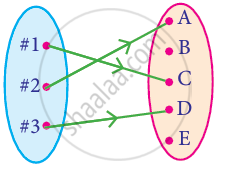
1. One-one (Injective) function
A function is called one-one if different elements of the domain have different images in the codomain.
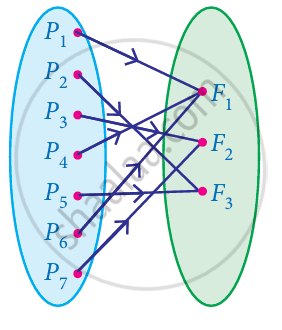
2. Many-one function
A function is called many-one if two or more different elements of the domain have the same image in the codomain.
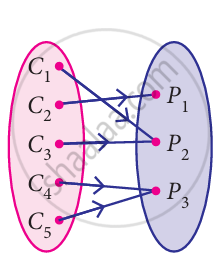
3. Onto function
A function is called onto if every element of the codomain has at least one pre-image in the domain.
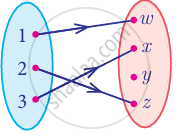
4. Into function
A function is called into if at least one element of the codomain is not the image of any element of the domain.
5.Bijection
A function is called bijective if it is both one-one and onto
Example 1
Show that the function f: N → N defined by f(x) = 2x is one-one but not onto.
Solution:
The function f is one-one.
Reason : Let x₁, x₂ ∈ N be such that f(x₁) = f(x₂) ⇒ 2x₁ = 2x₂ ⇒ x₁ = x₂
Thus, f(x₁) = f(x₂) ⇒ x₁ = x₂ ⇒ f is one-one.
The function f is not onto.
Reason: As 1 ∈ N (codomain of f) and there does not exist any x ∈ N (domain of f) such that f(x) = 1. So f is not onto.
Example 2
Show that the function f: Z → Z defined by f(x) = x² + x, for all x ∈ Z, is a many-one function.
Solution:
Let x, y ∈ Z such that f(x) = f(y). Then f(x) = f(y)
⇒ x² + x = y² + y
⇒ (x² − y²) + (x − y) = 0
⇒ (x − y)(x + y + 1) = 0
⇒ x = y or x = −y − 1
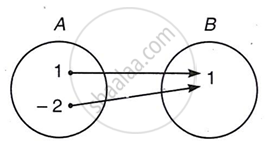
Since f(x) = f(y) does not yield the unique solution x = y but also provides the solution x = −y − 1, so it is not a one-one function. For example, if y = 1, then x = 1 from x = y and also x = −2 from y = −x − 1. This means that 1 and −2 have the same image in B under f.
Hence, f is a many-one function.
Example 3
State whether the function f: N → N given by f(x) = 5x is injective, surjective or both.
Solution:
For a function to be injective, it should be one-one and for surjective, it should be onto.
Given f(x) = 5x.
Let x₁, x₂ ∈ N. Then
f(x₁) = f(x₂) ⇒ 5x₁ = 5x₂ ⇒ x₁ = x₂, ∀ x₁, x₂ ∈ N
Hence, f(x) is an injective function.
Now, the range is a set comprising multiples of 5 ∀x in the domain. But codomain = N. Thus, the range ≠ codomain, or we can say that every element of the codomain does not have a pre-image in the domain.
∴ f(x) is not a surjection.
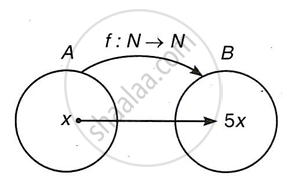
Note:
If the given function f were f: R → R, i.e., the domain and codomain both equal to R, then the function f(x) = 5x would have been a surjection.
Example 4
Let X = {−1, 2, 5, 8, 11}, Y = {4, 6, 8} and f be the function from X to Y depicted by the adjoining arrow diagram, then f is
- a many-one function.
Reason: different elements 2, 5 and 8 of X have the same image 4 - an into function.
Reason: there exists 6 ∈ Y which is not the image of any element of X.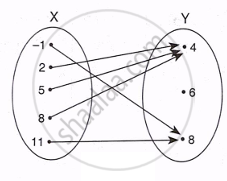
Thus, the function f from X to Y is a many-one into function.
Example 5
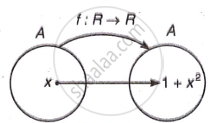
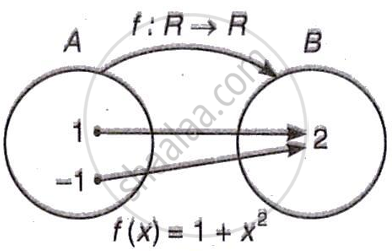
State whether the function f: R → R defined by f(x) = 1 + x² is one-one, onto or bijective.
Solution: Given, function f: R → R such that f(x) = 1 + x².
Let A and B be two sets of real numbers.
Let x₁, x₂ ∈ A such that f(x₁) = f(x₂).
⇒ 1 + x₁² = 1 + x₂² ⇒ x₁² − x₂² = 0 ⇒ (x₁ − x₂)(x₁ + x₂) = 0
⇒ x₁ = ± x₂. Thus f(x₁) = f(x₂) does not imply that x₁ = x₂.
For instance, f(1) = f(−1) = 2, i.e., two elements (1, −1) of A have the same image in B. So, f is a many-one function.
Now, y = 1 + x² ⇒ x = ±\[\sqrt{y-1}\]⇒ elements < y have no pre-image in A (for instance, an element −2 in the codomain has no pre-image in the domain A). So, f is not onto.
Hence, f is neither one-one nor onto. So, it is not bijective.
Real-Life Examples
-
Roll number to student: Each roll number identifies exactly one student, so this resembles a one-one idea when no roll number is repeated.
-
Students to favourite subject: Many students may choose the same favourite subject, so this resembles a many-one function.
-
Seats filled in a classroom: If every seat is occupied by one student, the situation resembles onto coverage; if some seats are empty, it resembles into.
-
Password or code matching system: A perfect one-to-one matching between users and unique IDs is similar to a bijection.
Maharashtra State Board: Class 12
Key Points: Types of Functions
| Type of Function | Condition | Key Idea |
|---|---|---|
| One-One (Injective) | f(x₁) = f(x₂) ⇒ x₁ = x₂ | Different inputs → different outputs |
| Onto (Surjective) | Range = Codomain | Every element of the codomain is mapped |
| Into Function | Range ⊂ Codomain | Some elements of the codomain are not mapped |
| Many-One Function | x₁ ≠ x₂ but f(x₁) = f(x₂) | Different inputs → same output |
| Bijective Function | One-one + Onto | Perfect mapping (1-1 and onto) |
