Topics
Relations and Functions
Relations and Functions
Algebra
Inverse Trigonometric Functions
Calculus
Matrices
- Concept of Matrices
- Types of Matrices
- Equality of Matrices
- Operations on Matrices> Addition and Subtraction of Matrices
- Operations on Matrices>Scalar Multiplication
- Operations on Matrices> Matrix Multiplication
- Transpose of a Matrix
- Symmetric and Skew Symmetric Matrices
- Invertible Matrices
- Overview of Matrices
Determinants
Vectors and Three-dimensional Geometry
Continuity and Differentiability
- Continuous and Discontinuous Functions
- Algebra of Continuous Functions
- Concept of Differentiability
- Derivatives of Composite Functions
- Differentiation of Implicit Functions
- Derivative of Inverse Trigonometric Function
- Exponential and Logarithmic Functions
- Logarithmic Differentiation
- Derivatives of Functions in Parametric Forms
- Second Order Derivative
- Overview of Continuity and Differentiability
Linear Programming
Applications of Derivatives
Probability
Integrals
- Integration
- Integration as an Inverse Process of Differentiation
- Properties of Indefinite Integral
- Methods of Integration> Integration by Substitution
- Methods of Integration>Integration Using Trigonometric Identities
- Methods of Integration> Integration Using Partial Fraction
- Methods of Integration> Integration by Parts
- Integrals of Some Particular Functions
- Definite Integrals
- Fundamental Theorem of Integral Calculus
- Evaluation of Definite Integrals
- Properties of Definite Integrals
- Overview of Integrals
Sets
Applications of the Integrals
Differential Equations
- Basic Concepts of Differential Equations
- Order and Degree of a Differential Equation
- Solution of a Differential Equation
- Forms of Solving Differential Equations> Variable Separable
- Forms of Solving Differential Equations> Homogeneous Differential Equations
- Forms of Solving Differential Equations>Linear Differential Equations
- Overview of Differential Equations
Vectors
- Basic Concepts of Vector Algebra
- Direction Ratios, Direction Cosine & Direction Angles in Vector
- Types of Vectors in Algebra
- Algebra of Vectors > Addition & Subtraction of Two Vectors
- Algebra of Vectors > Scalar Multiplication
- Components of Vector in Algebra
- Vector Joining Two Points in Algebra
- Section Formula in Vector Algebra
- Product of Two Vectors > Scalar (Dot) Product
- Product of Two Vectors > Vector (Cross) Product
- Overview of Vectors
Three - Dimensional Geometry
Linear Programming
Probability
Introduction
The angle between two lines in three-dimensional geometry is found by comparing their directions rather than their positions. When two lines are represented by direction ratios, direction cosines, vector form, or symmetric form, the required angle is obtained from the angle between their direction vectors.
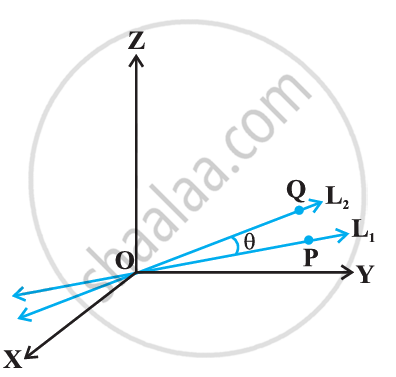
Formula: If Direction Ratios are Given
If the direction ratios of two lines are:
First line: \[(a_1, b_1, c_1)\]
Second line: \[(a_2, b_2, c_2)\]
then the cosine of the angle \[\theta\] between them is:
Formula: If Direction Cosines are Given
If the direction cosines of the two lines are
\[(l_1, m_1, n_1)\] and \[(l_2, m_2, n_2)\], then:
Formula: For Sine of the Angle
If the direction ratios are \[(a_1, b_1, c_1)\] and \[(a_2, b_2, c_2)\], then:
Special Cases
-
Perpendicular lines: \[(a_1 a_2 + b_1 b_2 + c_1 c_2 = 0)\].
-
Parallel lines: \[\frac{a_1}{a_2} = \frac{b_1}{b_2} = \frac{c_1}{c_2}\].
-
Vector form of lines: If two lines are given by:
\[\vec{r} = \vec{a}_1 + \lambda \vec{b}_1\]
\[\vec{r} = \vec{a}_2 + \mu \vec{b}_2\]
then the angle between the lines is the angle between \[\vec{b}_1\] and \[\vec{b}_2\]. - Symmetric or Cartesian form
\[\frac{x - x_1}{a} = \frac{y - y_1}{b} = \frac{z - z_1}{c}\]
Example 1
Find the angle between them.
Solution:
In vector form, the angle between the two lines is the angle between their direction vectors. Therefore, from the equations,
-
\[\vec{b}_1 = \hat{i} + 2\hat{j} + 2\hat{k}\]
-
\[\vec{b}_2 = 3\hat{i} + 2\hat{j} + 6\hat{k}\]
Write these as component form:
-
\[\vec{b}_1 = (1, 2, 2)\]
-
\[\vec{b}_2 = (3, 2, 6)\]
Now find the dot product:
Next, find the magnitudes:
Substitute into the formula:
Therefore,
Key Points: Angle Between Two Lines
-
The angle between two lines depends only on their directions.
-
If lines do not pass through the origin, imagine parallel lines through the origin.
-
The dot-product formula is the main method for solving these questions.
-
In symmetric form, denominators give direction ratios.
-
Zero dot product means perpendicular lines.
-
Proportional direction ratios mean parallel lines.
-
The required angle is generally the acute angle.
