Topics
Sets, Relations, and Functions
- Sets and Their Representations
- Classification of Sets
- Empty Set (Null or Void Set)
- Finite and Infinite Sets
- Equal Sets
- Subsets
- Power Set
- Universal Set
- Venn Diagrams
- Union of Sets
- Intersection of Sets
- Disjoint Sets
- Difference of Sets
- Complement of a Set
- Practical Problems on Union and Intersection of Two Sets
- Algebra of Real Functions
- Algebraic Operations on Functions
Complex Numbers and Quadratic Equations
- Introduction of Complex Number
- Concept of Complex Numbers
- Complex Numbers as Ordered Pairs of Reals
- Representation of Complex Numbers
- Argand Plane and Polar Representation
- Algebraic Operations of Complex Numbers
- Properties of Conjugate, Modulus and Argument (or Amplitude) of Complex Numbers
- Square Root of a Complex Number
- Triangle Inequality
- Integral Powers of Iota
- Rotational Theorem of Complex Number
- Cube Root of Unity
- Geometry of Complex Numbers
- Demoiver's Theorem
- Powers of Complex Numbers
- Sum and Product of Root
- Nature of Roots of a Quadratic Equation
- Formation of a Quadratic Equation with Given Roots
- Quadratic Formula (Shreedharacharya's Rule)
- Condition for Common Roots
- Maximum and Minimum Value of Quadratic Equation
- Quadratic Expression in Two Variables
- Solution of Quadratic Inequalities
Matrices and Determinants
- Concept of Matrices
- Operations on Matrices>Scalar Multiplication
- Operations on Matrices> Addition and Subtraction of Matrices
- Operations on Matrices>Scalar Multiplication
- Operations on Matrices> Matrix Multiplication
- Types of Matrices
- Concept of Determinant
- Properties of Determinants
- Evaluation of Determinants
- Application of Determinants to Coordinate Geometry
- Adjoint and Inverse of a Matrix
- Inverse of a Square Matrix by the Adjoint Method
- Test of Consistency
- Application of Determinants to Coordinate Geometry
- Transpose of a Matrix
- Symmetric and Skew Symmetric Matrices
- Multiplication of Two Determinants
- Minors and Co-factors
- Some Special Cases of Matrix
- Rank of a Matrix
Permutations and Combinations
- Permutations
- Fundamental Principles of Counting
- Combination
- Meaning of P (n,r) and C (n,r)
- Simple Applications of Permutations and Combinations
- Factorials
- Division and Distribution of Objects
- Dearrangement Theorem
- Sum of Numbers
- Important Result About Point
Mathematical Inductions
- Mathematical Induction
- Principle of Mathematical Induction
- Motivation
- Simple Applications of Mathematical Induction
Binomial Theorem and Its Simple Applications
- Introduction of Binomial Theorem
- Binomial Theorem for Positive Integral Indices
- General and Middle Terms
- Properties of Binomial Coefficient with Simple Application
- Expansion of Binomial
- Coefficient of Any Power of 'X'
- Greatest Term
- Independent Term
- Particular Term from End in Binomial Expansion
- Greatest Binomial Coefficients
- Number of Terms in the Expansion of (x + y + z)n
- Multinomial Theorem
- Infinite Series
- Binomial Theorem for Any Index (Without Proof)
Sequence and Series
- Sequence, Series, and Progression
- Relation Between Arithmetic Mean (A.M.), Geometric Mean (G.M.), Harmonic Mean (H.M.)
- Arithmetico-geometric Sequence
- Arithmetic Progression (A.P.)
- Geometric Progression (G. P.)
- Harmonic Progression (H. P.)
- Insertion of Arithmetic
- Geometric Mean
- Sum to' n' Terms of a Geometric Progression
- Some Special Sequences
Limit, Continuity, and Differentiability
- Concept of Limits
- Limits by Factorisation, Substitution and Rationalisation
- Algebra of Limits
- Limits of Polynomials and Rational Functions
- Limits of Logarithmic Functions
- Limits of Exponential Functions
- Limits of Trigonometric Functions
- Inverse Functions
- Graphs of Simple Functions
- Continuous and Discontinuous Functions
- Concept of Differentiability
- Differentiation of the Sum, Difference, Product, and Quotient of Two Functions
- Derivatives of Composite Functions
- Derivative of Inverse Trigonometric Function
- Derivative of Inverse Trigonometric Function
- Exponential and Logarithmic Functions
- Exponential and Logarithmic Functions
- Derivatives of Composite Functions
- Differentiation of Implicit Functions
- Derivatives of Functions in Parametric Forms
- Second Order Derivative
- Mean Value Theorem
- Simple Problems on Applications of Derivatives
- Rate of Change of Quantities
- Increasing and Decreasing Functions
- Maxima and Minima
- Tangents and Normals
- Limits Using L-hospital's Rule
- Evaluation of Limits
- Infinite Series
- Successive Differentiation
- nth Derivative of Standard Functions
- Algebra of Derivative (Leibnitz or Product Rule)
- Rolle's Theorem
- Lagrange's Mean Value Theorem (LMVT)
- Approximations
Integral Calculas
- Integration
- Integration as an Inverse Process of Differentiation
- Fundamental Integrals Involving Algebraic Functions
- Fundamental Integrals Involving Trigonometric Functions
- Fundamental Integrals Involving Exponential Functions
- Fundamental Integrals Involving Logarithms Functions
- Methods of Integration> Integration by Substitution
- Methods of Integration> Integration by Parts
- Methods of Integration> Integration Using Partial Fraction
- Methods of Integration>Integration Using Trigonometric Identities
- Integrals of Some Particular Functions
- Definite Integral as the Limit of a Sum
- Fundamental Theorem of Integral Calculus
- Properties of Definite Integrals
- Evaluation of Definite Integrals
- Area Bounded by Two Curves
- Area Under Simple Curves
- Integration of Some Special Irrational Algebraic Functions
- Summation of Series by Integration
Diffrential Equations
- Introduction to Ordinary Differential Equations
- Formation of Ordinary Differential Equations
- Order and Degree of a Differential Equation
- Formation of Differential Equations
- Solution of a Differential Equation
- Solutions of Linear Differential Equation
- Methods of Solving First Order, First Degree Differential Equations
- Forms of Solving Differential Equations> Variable Separable
- Forms of Solving Differential Equations> Homogeneous Differential Equations
- Forms of Solving Differential Equations>Linear Differential Equations
- Solution by Inspection Method
Co-ordinate Geometry
- Brief Review of Cartesian System of Rectanglar Co-ordinates
- Distance Formula
- Section Formula in Coordinate Geometry
- Locus
- Translation of Axes
- Concept of Slope (or, gradient)
- Parallel and Perpendicular Lines
- Intercepts on Axes
- Various Forms of the Equation of a Line
- Intersection of Two Lines
- Angle Between Two Lines
- Conditions for Concurrence of Three Lines
- Distance in Lines (Point & Parallel Lines)
- Equations of Line in Different Forms
- Equations of Internal and External by Sectors of Angles Between Two Lines Co-ordinate of the Centroid, Orthocentre, and Circumcentre of a Triangle
- Equations of Internal and External by Sectors of Angles Between Two Lines Co-ordinate of the Centroid, Orthocentre, and Circumcentre of a Triangle
- Equation of Family of Lines Passing Through the Point of Intersection of Two Lines
- Equations of a Circle in Standard Form
- Equations of a Circle in General Form
- Equation of a Circle When the Endpoints of a Diameter Are Given
- Point of Intersection of a Line and a Circle
- Equation of Tangent and Condition of Tangency
- Fundamentals of Conic Sections
- Parabola and its types
- Hyperbola and its Types
- Ellipse and its Types
- Condition for Y = mx + c to Be a Tangent and Point(s) of Tangency
- Results of Triangle
- Various Forms of Equation of a Line
- Shortest Distance Between Two Lines
- Bisector of the Angle Between the Two Lines
- Distance in Lines (Point & Parallel Lines)
- Foot of the Perpendicular
- Position of a Point with Respect to a Line
- Pedal Points
- Pair of Straight Lines
- Advanced Concept of Circle
- Standard Equation of a Circle
Three Dimensional Geometry
- Foundation of Coordinate Geometry
- Coordinates of a Point in Space
- Distance Between Two Points
- Section Formula in Coordinate Geometry
- Direction Ratios, Direction Cosine & Direction Angles in Vector
- Direction Cosines and Direction Ratios of a Line
- The Angle Between Two Intersecting Lines
- Skew Lines
- Shortest Distance Between Two Lines
- Equations of Line in Different Forms
- Intersection of the Line and Plane
- Coplanarity of Two Lines
- Angle Between Two Lines
- Projection of a Point on a Line
- Projection of a Line Segment Joining Two Points
- Equation of a Straight Line in Cartesian and Vector Form
- Concept of Slope (or, gradient)
- Distance in Lines (Point & Parallel Lines)
- Shortest Distance Between Two Lines
- Different Forms of Equation of a Plane
- Angle Between Two Planes
- Angle Between Line and a Plane
- Distance Between Two Parallel Planes
- Position of Point and Line wrt a Plane
- Projection of a Line on a Plane
Vector Algebra
- Basic Concepts of Vector Algebra
- Vector Analysis
- Vector Operations>Addition and Subtraction of Vectors
- Components of Vector in Algebra
- Multiplication of Vectors>Scalar Product(Dot Product)
- Scalar Triple Product
- Vector Triple Product
- Basic Concepts of Vector Algebra
- Section Formula in Coordinate Geometry
- Linear Dependent and Independent Vectors
- Position Vector of a Point in a Space
- Modulus of a Vector
- Collinearity of Three Points
- Coplanarity of Three Vectors and Four Points
- Vector Inequality
- Product of Two Vectors > Scalar (Dot) Product
- Projection of a Vector Along Any Other Vector
- Area of a Parallelogram
- Geometric Interpretation of the Area of a Triangle
Statistics and Probability
- Measures of Discretion
- Arithmetic Mean
- Mean of Grouped Data
- Basic Concept of Median
- Basic Concept of Mode
- Standard Deviation
- Variance
- Mean Deviation
- Geometric Mean
- Harmonic Mean (H.M.)
- Coefficient of Variation
- Addition Theorem of Probability
- Multiplication Theorem of Probability
- Bayes’ Theorem
- Probability using Binomial Distribution
- Concept of Probability
- Elementary Types of Events and Properties of Probability
- Odds in Favour and Against
- Boole's Inequality
- Demorgan's Law
- Independent Events
- Conditional Probability
- Probability Distribution of Discrete Random Variables
- Poisson Distribution
Trigonometry
- Trigonometric Identities (Square Relations)
- Trigonometric Equations
- Trigonometric Functions
- Properties of Inverse Trigonometric Functions > Self-adjusting Property
- Angles of Elevation and Depression
- Circular System
- Trigonometric Ratios
- Domain and Range of Trigonometric Functions
- Trigonometric Functions of Allied Angels
- Conditional Trigonometric Identities
- Greatest and Least Value of Trigonometric Expressions
- Solution of Trigonometric Equations (Solution in the Specified Range)
- Intervals for Inverse Trigonometric Functions
- Infinite Series of Inverse Trigonometric Functions
- Properties of Inverse Trigonometric Functions > Negative Argument Property
- Properties of Inverse Trigonometric Functions > Complementary Property
- Properties of Inverse Trigonometric Functions > Conversion Property
- Properties of Inverse Trigonometric Functions > Addition & Subtraction Formula for Inverse Tangent
- Properties of Inverse Trigonometric Functions > Double-angle Property
- Properties of Inverse Trigonometric Functions > Triple-angle Property
- Properties of Inverse Trigonometric Functions > Addition–Subtraction Formula for Inverse Sine & Cosine
Mathematical Reasoning
- Mathematical Reasoning
- Introduction of Validating Statements
- Mathematically Acceptable Statements
- Statements and Truth Values in Mathematical Logic
- Tautology, Contradiction, and Contingency
- Logical Connective
- Truth Tables
- Logical Equivalance
- Quantifier, Quantified and Duality Statements in Logic
- Converse, Inverse and Contrapositive of the Conditional Staternent
- Negative of a Compound Statement
- Algebra of Statements
Linear Inequality
- Linear Inequations
- Method of Solving a Linear Inequality
- System of Inequations
- Inequalities of Various Functions
Properties of Triangles
- Properties of Triangle
- Solutions of Triangle>Polar Co-Ordinates
- Geometrical Concepts Related to a Circle
- Advanced Regular Polygon
- Angles of Elevation and Depression
Notes
Let f be a continuous function defined on close interval [a, b]. Assume that all the values taken by the function are non negative, so the graph of the function is a curve above the x-axis.
The definite integral `int_a^b`f(x) dx is the area bounded by the curve y = f(x), the ordinates x = a, x = b and the x-axis. To evaluate this area, consider the region PRSQP between this curve, x-axis and the ordinates x = a and x = b. Fig.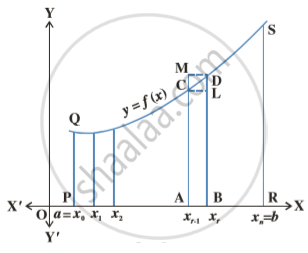
Divide the interval [a, b] into n equal subintervals denoted by `[x_0, x_1]`, `[x_1, x_2]` ,..., `[x_(r – 1), x_r], ..., [x_(n – 1), x_n],` where `x_0 = a, x_1 = a + h, x_2 = a + 2h, ... , x_r` = a + rh and `x_n` = b = a + nh or `n =(b-a)/h` We note that as n → ∞, h → 0. From the above fig. we have
area of the rectangle (ABLC) < area of the region (ABDCA) < area of the rectangle (ABDM) ... (1)
Same as `x_r – x_(r–1) → 0, i.e., h → 0 all the three areas shown in (1) become nearly equal to each other. Now we form the following sums.
`s_n = h[f(x_0) + ...+f(x_(n-1))] = h summation f(x_r)` ...(2)
and `S_n =h[f(x_1) + f(x_2) + ...+ f(x^n)] = h summation f(x_r) ` ..(3)
Here, `s_n` and `S_n` denote the sum of areas of all lower rectangles and upper rectangles raised over subintervals `[x_(r–1), x_r] for r = 1, 2, 3, …, n, respectively. In view of the inequality (1) for an arbitrary subinterval `[x_(r–1), x_r]`, we have `s_n < area of the region PRSQP < S_n` ... (4)
As n→∞ strips become narrower and narrower, it is assumed that the limiting values of (2) and (3) are the same in both cases and the common limiting value is the required area under the curve.
Symbolically, we write
`lim_(n ->∞ ) S_n = lim _(n-> ∞) s_n` = area of the region PRSQP = `int _a^b f(x)`
dx ...(5)
It follows that this area is also the limiting value of any area which is between that of the rectangles below the curve and that of the rectangles above the curve.
`int _a^b f(x)dx =lim_(h->0) h [f(a) + f(a+h) + ...+f(a+(n-1))h]`
or `int _a^b f(x) dx = (b-a) lim_(n ->∞) 1/ n [f(a) + f(a+h) + ...+ f(a+(n-1)h)]` ...(6)
where `h = (b-a)/n -> 0 as n -> ∞`
Remark: The value of the definite integral of a function over any particular interval depends on the function and the interval, but not on the variable of integration that we choose to represent the independent variable. If the independent variable is denoted by t or u instead of x, we simply write the integral as `int _a^b f(t)dt` or `int _a^b f(u)du instead of `int _a^b f(x)dx. Hence, the variable of integration is called a dummy variable.
Video link : https://youtu.be/CMG6ucGUQiU
