Topics
Real Numbers
- Concept of Divisibility
- Euclid's Division Lemma
- Euclid’s Division Algorithm
- Application of Euclid Lemma > Finding the HCF of Two Positive Integers
- Application of Euclid Lemma > Finding the HCF of Three Numbers
- Application of Euclid Lemma > On Expressing the HCF of Two Numbers a and b in the Form xa + yb
- Fundamental Theorem of Arithmetic
- Applications of the Fundamental Theorem of Arithmetic
- Rational Numbers
- Irrational Numbers
- Nature of the Decimal Expansions of Rational Numbers
Number Systems
Algebra
Polynomials
- Concept of Polyomial
- Graph of Polynomials
- Geometrical Meaning of the Zeroes of a Polynomial
- Relation Between Zeroes (Roots) and Coefficients of a Polynomial
- Relationship Between the Zeros and Coefficients of a Quadratic Polynomial
- Relationship between Zeros And Coefficients of a Cubic Polynomial
- Division Algorithm for Polynomials
Coordinate Geometry
Pair of Linear Equations in Two Variables
- Linear Equations in Two Variables
- Simultaneous Linear Equations in Two Variables
- Solution of a Given System of Two Simultaneous Equations
- Graphical Representation of Linear Equations
- Methods of Solving Linear Equations in Two Variables > Graphical Method
- Substitution Method
- Elimination Method
- Cross - Multiplication Method
- Conditions for Solvability (or Consistency)
- Application of Simultaneous Equations
- Problems Based on Articles and Their Costs
- Applications to Problems Based on Numbers
- Application to Problems Based on Fractions
- Applications to Problems on Ages
- Application to Problems Based on Time, Distance, and Speed
Quadratic Equations
- Concept of Quadratic Equations
- Formulation of a Quadratic Equation
- Method of Solving a Quadratic Equation>Factorisation Method
- Method of Solving a Quadratic Equation>Quadratic Formula (Shreedharacharya's Rule)
- Nature of Roots of a Quadratic Equation
- Word Problems on Quadratic Equations
- Problems on Numbers
- General Problem on Money Matters
- Problems on Ages
- Problems on Geometry
- Problems on Speed and Time
- Problems on Time and Work
- Problems on Areas or Mensuration
Geometry
Trignometry
Arithmetic Progressions
Coordinate Geometry
- Foundation of Coordinate Geometry
- Distance Formula
- Collinearity of Three Points
- Section Formula in Coordinate Geometry
- Application of Section Formula
- Coordinate Formula for Area of a Triangle
Mensuration
Triangles
- Concept of Similarity
- Similar Polygons
- Similarity of Triangles (Corresponding Sides & Angles)
- Basic Proportionality Theorem
- Angle Bisector Theorem
- Criteria for Similarity of Triangles
- Equiangular Triangles Theorems
- Ratios of Areas of Two Triangles
- Pythagoras Theorem
Statistics and Probability
Circles
- Tangent to a Circle
- Number of Tangents from a Point on a Circle
Introduction to Trigonometry
Some Applications of Trigonometry
- Angles of Elevation and Depression
- Problems based on Elevation and Depression
Areas Related to Circles
Surface Areas and Volumes
Statistics
Probability
Definition: Favourable Outcomes
The outcomes satisfying a particular condition are called favourable outcomes.
Definition: Event
A set of favourable outcomes of a given sample space is an ‘event’. Event is a subset of the sample space.
- Events are denoted by capital letters A, B, C, D etc.
- The number of elements in event A is written n(A).
- Since A ⊆ S, always 0 ≤ n(A) ≤ n(S).
- Example: two coins tossed, A = getting at least one tail → A = {TT, TH, HT}, n(A) = 3.
Concept Map
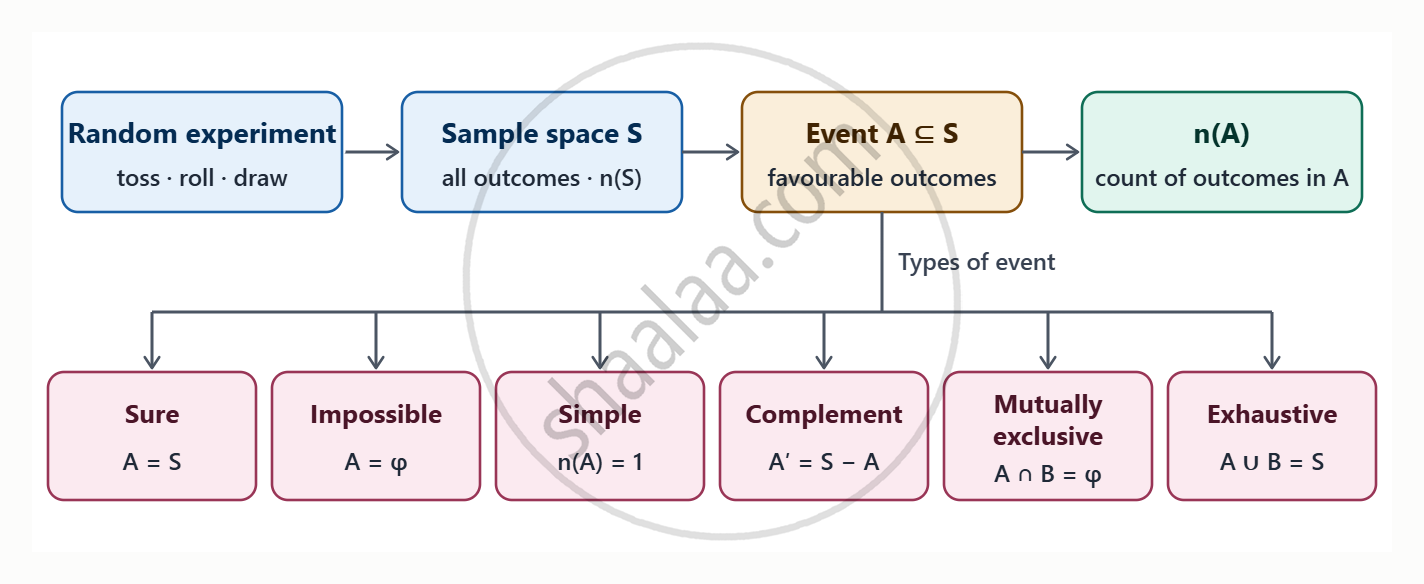
Types of Event
Examples use one die: \[ S = \{1, 2, 3, 4, 5, 6\}, \; n(S) = 6. \]
\[ \begin{array}{|l|l|} \hline \textbf{TYPE} & \textbf{MEANING AND EXAMPLE} \\ \hline \text{Certain / Sure event} & \begin{array}{l} \text{Contains every outcome, } A = S. \\ \text{“Number } \leq 6\text{”} \rightarrow \{1, 2, 3, 4, 5, 6\}, \; n = 6 \end{array} \\ \hline \text{Impossible event} & \begin{array}{l} \text{Contains no outcome, } A = \{ \; \} = \phi. \\ \text{“Number 7”} \rightarrow \phi, \; n = 0 \end{array} \\ \hline \text{Simple / Elementary event} & \begin{array}{l} \text{Contains exactly one outcome.} \\ \text{“Getting 4”} \rightarrow \{4\}, \; n = 1 \end{array} \\ \hline \text{Complement of an event} & \begin{array}{l} \text{All outcomes of } S \text{ not in } A \text{; written } A'. \\ n(A') = n(S) - n(A). \\ A = \text{even} = \{2, 4, 6\} \rightarrow A' = \{1, 3, 5\} \end{array} \\ \hline \text{Mutually exclusive events} & \begin{array}{l} \text{Cannot happen together; } A \cap B = \phi. \\ A = \{1, 2\}, \; B = \{5, 6\} \end{array} \\ \hline \text{Exhaustive events} & \begin{array}{l} \text{Together cover the whole sample space;} \\ A \cup B = S. \\ A = \{1, 2, 3, 4\}, \; B = \{3, 4, 5, 6\} \end{array} \\ \hline \end{array} \]
Condition Words Decoder
Two coins tossed. Most marks are lost by misreading these words.
\[ \begin{array}{|l|l|} \hline \textbf{CONDITION} & \textbf{MEANING} \rightarrow \textbf{SET} \\ \hline \text{At least one tail} & \text{1 or more tails} \rightarrow \{HT, TH, TT\}, \; n = 3 \\ \hline \text{At most one tail} & \text{0 or 1 tail} \rightarrow \{HH, HT, TH\}, \; n = 3 \\ \hline \text{Only one head} & \text{Exactly 1 head} \rightarrow \{HT, TH\}, \; n = 2 \\ \hline \text{No head} & \text{0 heads} \rightarrow \{TT\}, \; n = 1 \\ \hline \end{array} \]
Real-Life Example
The sample space is the full attendance register of a class. An event is a list you make from that register by a rule: “students who wear glasses”. The list can be empty, can be the whole register, or anything in between, but it can never contain a name that isn't in the register.
Example
Two coins are tossed simultaneously. Write the sample space ( \[ S \] ) and number of sample points \[ n(S). \] Also write the following events in the set form and write the number of sample points in each event.
Solution : If two coins are tossed simultaneously,
\[ S = \{HH, HT, TH, TT\}, \; n(S) = 4 \]
i. Condition for event \[ A \] : to get at least one tail.
\[ A = \{HT, TH, TT\} \quad n(A) = 3 \]
ii. Condition for event \[ B \] : to get only one head.
\[ B = \{HT, TH\} \quad n(B) = 2 \]
iii. Condition for event \[ C \] : to get at most one tail.
\[ C = \{HH, HT, TH\} \quad n(C) = 3 \]
iv. Condition for event \[ D \] : to get no head.
\[ D = \{TT\} \quad n(D) = 1 \]
Key Points: Elementary Types of Events and Properties of Probability
- The sample space \[ S \] contains all possible outcomes.
- An event is a subset of the sample space.
- A simple event has one outcome; a compound event has more than one outcome.
- A certain event has probability \[ 1; \] an impossible event has probability \[ 0. \]
- The complement of \[ A \] is \[ A', \] and \[ P(A') = 1 - P(A). \]
- Mutually exclusive events cannot occur together: \[ A \cap B = \varnothing. \]
- Exhaustive events together cover the entire sample space: \[ A \cup B = S. \]
- For equally likely outcomes, \[ P(A) = \frac{n(A)}{n(S)}. \]
- For any two events, \[ P(A \cup B) = P(A) + P(B) - P(A \cap B). \]
