Topics
Number Systems
Real Numbers
- Concept of Divisibility
- Euclid's Division Lemma
- Euclid’s Division Algorithm
- Application of Euclid Lemma > Finding the HCF of Two Positive Integers
- Application of Euclid Lemma > Finding the HCF of Three Numbers
- Application of Euclid Lemma > On Expressing the HCF of Two Numbers a and b in the Form xa + yb
- Fundamental Theorem of Arithmetic
- Applications of the Fundamental Theorem of Arithmetic
- Rational Numbers
- Irrational Numbers
- Nature of the Decimal Expansions of Rational Numbers
Polynomials
- Concept of Polyomial
- Graph of Polynomials
- Geometrical Meaning of the Zeroes of a Polynomial
- Relation Between Zeroes (Roots) and Coefficients of a Polynomial
- Relationship Between the Zeros and Coefficients of a Quadratic Polynomial
- Relationship between Zeros And Coefficients of a Cubic Polynomial
- Division Algorithm for Polynomials
Algebra
Pair of Linear Equations in Two Variables
- Linear Equations in Two Variables
- Simultaneous Linear Equations in Two Variables
- Solution of a Given System of Two Simultaneous Equations
- Graphical Representation of Linear Equations
- Methods of Solving Linear Equations in Two Variables > Graphical Method
- Substitution Method
- Elimination Method
- Cross - Multiplication Method
- Conditions for Solvability (or Consistency)
- Application of Simultaneous Equations
- Problems Based on Articles and Their Costs
- Applications to Problems Based on Numbers
- Application to Problems Based on Fractions
- Applications to Problems on Ages
- Application to Problems Based on Time, Distance, and Speed
Coordinate Geometry
Geometry
Quadratic Equations
- Concept of Quadratic Equations
- Formulation of a Quadratic Equation
- Method of Solving a Quadratic Equation>Factorisation Method
- Method of Solving a Quadratic Equation>Quadratic Formula (Shreedharacharya's Rule)
- Nature of Roots of a Quadratic Equation
- Word Problems on Quadratic Equations
- Problems on Numbers
- General Problem on Money Matters
- Problems on Ages
- Problems on Geometry
- Problems on Speed and Time
- Problems on Time and Work
- Problems on Areas or Mensuration
Trignometry
Arithmetic Progressions
Coordinate Geometry
- Foundation of Coordinate Geometry
- Distance Formula
- Collinearity of Three Points
- Section Formula in Coordinate Geometry
- Application of Section Formula
- Coordinate Formula for Area of a Triangle
Mensuration
Triangles
- Concept of Similarity
- Similar Polygons
- Similarity of Triangles (Corresponding Sides & Angles)
- Basic Proportionality Theorem
- Angle Bisector Theorem
- Criteria for Similarity of Triangles
- Equiangular Triangles Theorems
- Ratios of Areas of Two Triangles
- Pythagoras Theorem
Statistics and Probability
Circles
- Tangent to a Circle
- Number of Tangents from a Point on a Circle
Introduction to Trigonometry
Some Applications of Trigonometry
- Angles of Elevation and Depression
- Problems based on Elevation and Depression
Areas Related to Circles
Surface Areas and Volumes
Statistics
Probability
- Theorem
CISCE: Class 10
Basic Proportionality Theorem
Statement:
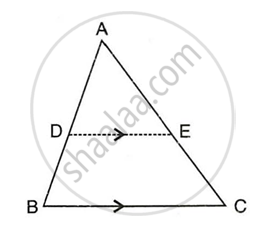
If a line is drawn parallel to one side of a triangle, it divides the other two sides in the same ratio.
To Prove:
\[\frac{\mathrm{AD}}{\mathrm{DB}}=\frac{\mathrm{AE}}{\mathrm{EC}}\]
Proof:
-
A line parallel to a side of a triangle forms equal corresponding angles.
-
Hence, the two triangles formed are similar (AAA similarity).
-
In similar triangles, corresponding sides are proportional.
Therefore, the line divides the two sides in the same ratio.
\[\frac{\mathrm{AD}}{\mathrm{DB}}=\frac{\mathrm{AE}}{\mathrm{EC}}\]
CISCE: Class 10
Converse of Basic Proportionality Theorem
Statement:
If a line divides any two sides of a triangle in the same ratio, then the line is parallel to the third side.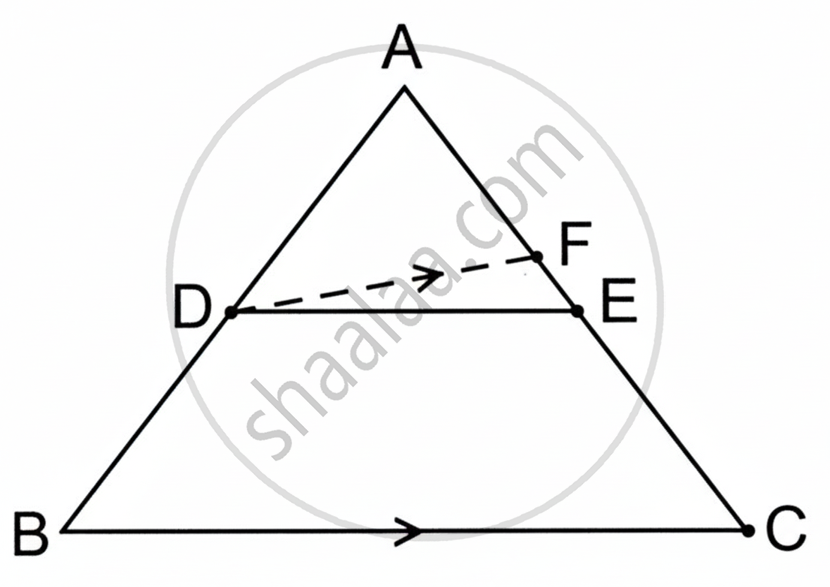
To Prove:
-
Assume a line through point D parallel to BC meets AC at F.
-
By BPT, \[\frac{\mathrm{AD}}{\mathrm{DB}}=\frac{\mathrm{AF}}{\mathrm{FC}}\]
- Given, \[\frac{\mathrm{AD}}{\mathrm{DB}}=\frac{\mathrm{AE}}{\mathrm{EC}}\]
-
Hence,\[\frac{AF}{FC}=\frac{AE}{EC}\]
-
⇒ Points E and F coincide.
Therefore,