Topics
Commercial Mathematics
Compound Interest
- Compound Interest as a Repeated Simple Interest Computation with a Growing Principal
- Use of Compound Interest in Computing Amount Over a Period of 2 Or 3-years
- Use of Formula
- Finding CI from the Relation CI = A – P
Goods and Services Tax (G.S.T.)
Algebra
Banking
Geometry
Shares and Dividends
Linear Inequations
Mensuration
Quadratic Equations
- Concept of Quadratic Equations
- Method of Solving a Quadratic Equation>Factorisation Method
- Method of Solving a Quadratic Equation>Factorisation Method
- Method of Solving a Quadratic Equation>Quadratic Formula (Shreedharacharya's Rule)
- Nature of Roots of a Quadratic Equation
- Equations Reducible to Quadratic Equations
Trigonometry
Ratio and Proportion
Statistics
Factorisation of Polynomials
- Function and Polynomial
- Division Algorithm for Polynomials
- Remainder Theorem
- Factor Theorem
- Applications of Factor Theorem
Probability
Matrices
Arithmetic and Geometric Progression
Co-ordinate Geometry
- Foundation of Coordinate Geometry
- Advanced Concept of Reflection in Mathematics
- Invariant Points
- Combination of Reflections
- Using Graph Paper for Reflection
Similarity
Symmetry
Loci
- Locus
- Points Equidistant from Two Given Points
- Points Equidistant from Two Intersecting Lines
- Summary of Important Results on Locus
- Important Points on Concurrency in a Triangle
Circles
Tangent and Secant Properties
Constructions
Area and Volume of Solids (Cylinder, Cone and Sphere)
- Mensuration of Cylinder
- Hollow Cylinder
- Mensuration of Cones
- Mensuration of a Sphere
- Hemisphere
- Conversion of Solids
- Solid Figures
- Problems on Mensuration
Trigonometrical Identities
Heights and Distances
- Angles of Elevation and Depression
- Problems based on Elevation and Depression
Statistics : basic concepts, Mean, Median, Mode. Histograms and Ogive
Probability
Maharashtra State Board: Class 10
CISCE: Class 10
Definition: Discriminant
For the quadratic equation ax² + bx + c = 0, a ≠ 0; the expression b² − 4ac is called the discriminant and is, in general, denoted by the letter 'D'.
Thus, discriminant D = b² − 4ac.
Maharashtra State Board: Class 10
CISCE: Class 10
Formula: Quadratic Formula (Shreedharacharya’s Rule)
\[x=\frac{-b\pm\sqrt{b^2-4ac}}{2a}\]
Graphical Interpretation
For \[ y = ax^{2} + bx + c, \] the real roots are the x-intercepts of the parabola.
| Discriminant | Graphical Meaning | Number of x-intercepts |
| D > 0 | Parabola cuts the x-axis at two points | 2 |
| D = 0 | Parabola touches the x-axis at one point | 1 |
| D < 0 | Parabola does not meet the x-axis | 0 |
Example 1
Solve: \[ m^{2} - 14m + 13 = 0. \]
Step 1: Compare with the standard form to find coefficients
Given equation: \[ m^{2} - 14m + 13 = 0. \]
Comparing with \[ am^{2} + bm + c = 0, \] we get:
\[ a = 1, \quad b = -14, \quad c = 13 \]
Step 2: Calculate the discriminant ( \[ b^{2} - 4ac \] )
\[ b^{2} - 4ac = (-14)^{2} - 4(1)(13) \]
\[ = 196 - 52 = 144 \]
Step 3: Apply the quadratic formula
The formula for roots is:
\[ m = \frac{-b \pm \sqrt{b^{2} - 4ac}}{2a} \]
Substituting the values:
\[ m = \frac{-(-14) \pm \sqrt{144}}{2(1)} = \frac{14 \pm 12}{2} \]
Example 2
Question: Solve the quadratic equation \[ x^{2} - 2x - 3 = 0 \] graphically.
Solution:
Step 1: Rearrange the equation
Rewrite the given equation into an equivalent form: \[ x^{2} = 2x + 3. \]
Step 2: Formulate two separate equations for graphing
Split the equation into two functions: \[ y = x^{2} \] and \[ y = 2x + 3. \]
Step 3: Plot and find intersection points
Draw the graphs for both functions using coordinate tables.
Let \[ y = x^2 = 2x + 3. \] Let us draw graph of \[ y = x^2 \] and \[ y = 2x + 3 \]
\[ y = x^2 \]
\[ \begin{array}{|c|c|c|c|c|c|c|c|} \hline x & 3 & 2 & 1 & 0 & -1 & -2 & -3 \\ \hline y & 9 & 4 & 1 & 0 & 1 & 4 & 9 \\ \hline \end{array} \]
\[ y = 2x + 3 \]
\[ \begin{array}{|c|c|c|c|c|} \hline x & -1 & 0 & 1 & -2 \\ \hline y & 1 & 3 & 5 & -1 \\ \hline \end{array} \]
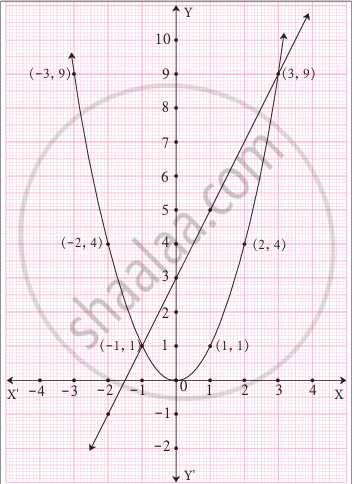
Observe that the two graphs intersect each other at the points \[ (-1, 1) \] and \[ (3, 9). \]
Step 4: Extract the roots
The x-coordinates of the intersection points represent the solutions to the equation.
Therefore, the solutions are \[ x = -1 \] or \[ x = 3. \]
Maharashtra State Board: Class 10
CISCE: Class 10
Key Points: Quadratic Formula (Shreedharacharya's Rule)
-
Write the given equation in the standard form
ax2 + bx + c = 0 -
Identify the values of a, b, and c.
-
Find the value of the discriminant
D = b2 − 4ac -
Substitute the values of a, b, and D in the formula
-
Simplify to obtain the roots.
