Topics
Commercial Mathematics
Compound Interest
- Compound Interest as a Repeated Simple Interest Computation with a Growing Principal
- Use of Compound Interest in Computing Amount Over a Period of 2 Or 3-years
- Use of Formula
- Finding CI from the Relation CI = A – P
Goods and Services Tax (G.S.T.)
Algebra
Banking
Geometry
Shares and Dividends
Linear Inequations
Mensuration
Quadratic Equations
Trigonometry
Ratio and Proportion
Statistics
Probability
Factorisation of Polynomials
- Function and Polynomial
- Division Algorithm for Polynomials
- Remainder Theorem
- Factor Theorem
- Applications of Factor Theorem
Matrices
Arithmetic and Geometric Progression
Co-ordinate Geometry
- Foundation of Coordinate Geometry
- Advanced Concept of Reflection in Mathematics
- Invariant Points
- Combination of Reflections
- Using Graph Paper for Reflection
Similarity
Symmetry
Loci
- Locus
- Points Equidistant from Two Given Points
- Points Equidistant from Two Intersecting Lines
- Summary of Important Results on Locus
- Important Points on Concurrency in a Triangle
Circles
Tangent and Secant Properties
Constructions
Area and Volume of Solids (Cylinder, Cone and Sphere)
- Mensuration of Cylinder
- Hollow Cylinder
- Mensuration of Cones
- Mensuration of a Sphere
- Hemisphere
- Conversion of Solids
- Solid Figures
- Problems on Mensuration
Trigonometrical Identities
Heights and Distances
- Angles of Elevation and Depression
- Problems based on Elevation and Depression
Statistics : basic concepts, Mean, Median, Mode. Histograms and Ogive
Probability
Introduction
Factorisation is often the quickest method for solving a quadratic equation when the factors are easy to identify. It helps students:
-
Understand the structure of quadratic expressions.
-
Find roots without using lengthy formulas.
-
Build a strong foundation for higher algebra.
-
Apply algebraic skills in physics, chemistry, and competitive examinations.
Key Idea: Factorisation converts one quadratic equation into two simple linear equations, making it easier to find the values of x.
Definition: Factorisation Method
The factorisation method expresses a quadratic polynomial as a product of two linear factors.
If \[ ax^{2} + bx + c = (px + q)(rx + s), \]
then the roots are obtained by solving:
\[ px + q = 0 \] and
\[ rx + s = 0. \]
Definition: Zero-Product Principle
If product of two numbers is zero then at least one of them is zero.
\[ p \times q = 0 \;\Rightarrow\; p = 0 \;\text{ or }\; q = 0 \]
Applied:
\[ x^{2} - 4x - 5 = (x - 5)(x + 1) = 0 \]
\[ \therefore\; x - 5 = 0 \;\text{ or }\; x + 1 = 0 \]
\[ \therefore\; x = 5 \;\text{ or }\; x = -1 \]
Methods of Factorisation
| Type of quadratic | Strategy | Example |
| Common factor present | Take out the common factor first | \[2x^2 + 4x = 0\] |
| Simple trinomial | Find two numbers whose product is ac and sum is b | \[x^2 - 4x - 5 = 0\] |
| Difference of squares | Use \[a^2 - b^2 = (a + b)(a - b)\] | \[x^2 - 9 = 0\] |
| Perfect square | Use \[(a \pm b)^2 = a^2 \pm 2ab + b^2\] | \[x^2 + 6x + 9 = 0\] |
| Equation with surds | Factorise carefully or use the quadratic formula | \[x^2 - 2\sqrt{3}x + 3 = 0\] |
Step-by-Step Method
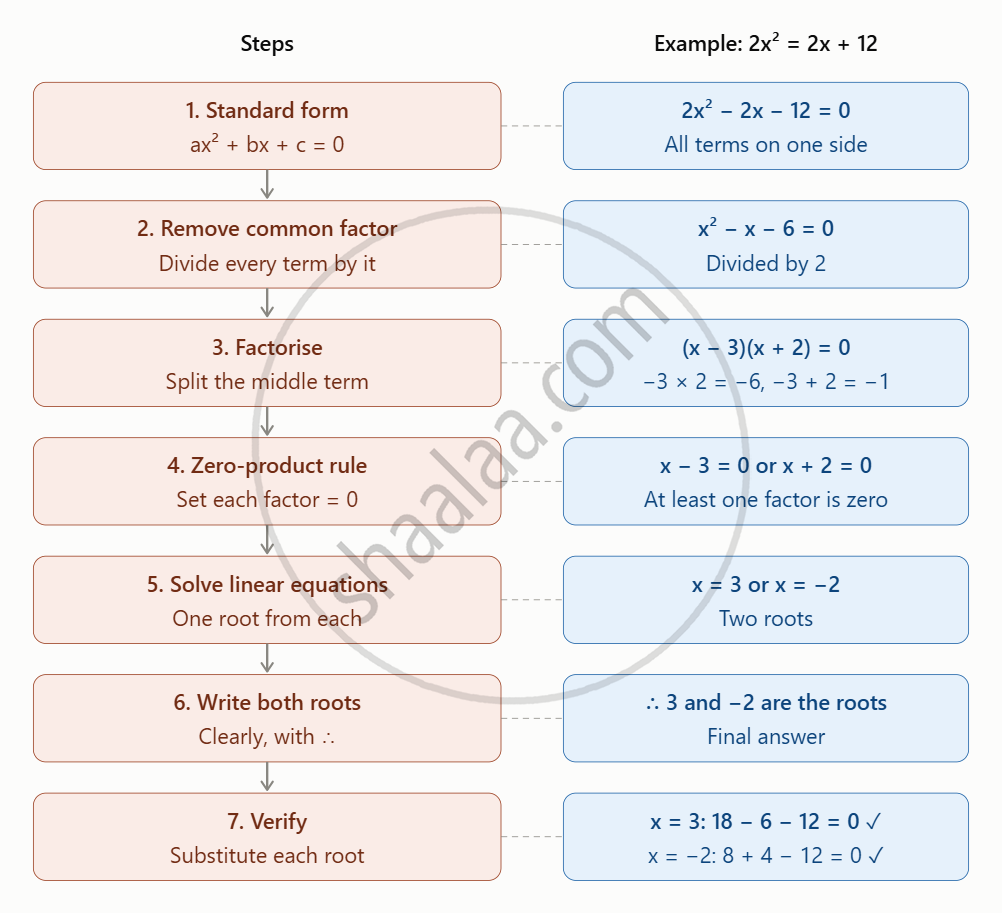
Example 1
Solve: \[ x^{2} - 4x - 5 = 0 \]
Solution: Find two numbers whose product is \[ -5 \] and sum is \[ -4. \]
The numbers are \[ -5 \] and \[ 1. \]
\[ x^{2} - 5x + x - 5 = 0 \]
\[ x(x - 5) + 1(x - 5) = 0 \]
\[ (x - 5)(x + 1) = 0 \]
Using the zero-product rule:
\[ x - 5 = 0 \quad \text{or} \quad x + 1 = 0 \]
\[ \boxed{x = 5 \text{ or } x = -1} \]
Verification:
For \[ x = 5: \]
\[ 25 - 20 - 5 = 0 \]
For \[ x = -1: \]
\[ 1 + 4 - 5 = 0 \]
Hence, both roots are correct.
Example 2
Solve: \[ 6\sqrt{3}x^{2} + 7x = \sqrt{3} \]
Step 1: Express the equation in standard form
\[ 6\sqrt{3}x^{2} + 7x = \sqrt{3} \]
\[ \therefore\; 6\sqrt{3}x^{2} + 7x - \sqrt{3} = 0 \ldots \]
Step 2: Split the middle term
\[ 6\sqrt{3} \times (-\sqrt{3}) = -18 \]
Factors of \[ -18 \] : \[ 9 \] and \[ -2 \]
\[ 9 = 3\sqrt{3} \times \sqrt{3} \]
\[ \therefore\; 6\sqrt{3}x^{2} + 9x - 2x - \sqrt{3} = 0 \]
Step 3: Factorise by grouping
\[ \therefore\; 3\sqrt{3}x(2x + \sqrt{3}) - 1(2x + \sqrt{3}) = 0 \]
\[ \therefore\; (2x + \sqrt{3})(3\sqrt{3}x - 1) = 0 \]
Step 4: Find the roots
\[ \therefore\; 2x + \sqrt{3} = 0 \quad \text{or} \quad 3\sqrt{3}x - 1 = 0 \]
\[ \therefore\; 2x = -\sqrt{3} \quad \text{or} \quad 3\sqrt{3}x = 1 \]
\[ \therefore\; x = -\frac{\sqrt{3}}{2} \quad \text{or} \quad x = \frac{1}{3\sqrt{3}} \]
Final Answer:
\[ \therefore\; -\frac{\sqrt{3}}{2} \] and \[ \frac{1}{3\sqrt{3}} \] are the roots of the given quadratic equation.
Maharashtra State Board: Class 10
Key Points: Factorisation Method
In the factorisation method, the quadratic expression is written as a product of two linear factors
-
Clear fractions and brackets, if any.
- Transpose all terms to one side to get the standard form
ax2 + bx + c = 0 - Factorise the quadratic expression into two linear factors.
-
Put each factor equal to zero (using the zero product rule).
-
Solve the resulting linear equations to obtain the roots.
