Topics
Commercial Mathematics
Compound Interest
- Compound Interest as a Repeated Simple Interest Computation with a Growing Principal
- Use of Compound Interest in Computing Amount Over a Period of 2 Or 3-years
- Use of Formula
- Finding CI from the Relation CI = A – P
Goods and Services Tax (G.S.T.)
Algebra
Banking
Geometry
Shares and Dividends
Linear Inequations
Mensuration
Quadratic Equations
Trigonometry
Ratio and Proportion
Statistics
Probability
Factorisation of Polynomials
- Function and Polynomial
- Division Algorithm for Polynomials
- Remainder Theorem
- Factor Theorem
- Applications of Factor Theorem
Matrices
Arithmetic and Geometric Progression
Co-ordinate Geometry
- Foundation of Coordinate Geometry
- Advanced Concept of Reflection in Mathematics
- Invariant Points
- Combination of Reflections
- Using Graph Paper for Reflection
Similarity
Symmetry
Loci
- Locus
- Points Equidistant from Two Given Points
- Points Equidistant from Two Intersecting Lines
- Summary of Important Results on Locus
- Important Points on Concurrency in a Triangle
Circles
Tangent and Secant Properties
Constructions
Area and Volume of Solids (Cylinder, Cone and Sphere)
- Mensuration of Cylinder
- Hollow Cylinder
- Mensuration of Cones
- Mensuration of a Sphere
- Hemisphere
- Conversion of Solids
- Solid Figures
- Problems on Mensuration
Trigonometrical Identities
Heights and Distances
- Angles of Elevation and Depression
- Problems based on Elevation and Depression
Statistics : basic concepts, Mean, Median, Mode. Histograms and Ogive
Probability
- Definition: Cone
- Types of Cones
- Properties of a Cone
- Activity
CISCE: Class 10
Definition: Cone
The solid obtained on revolving a right-angled triangle about one of its sides (other than the hypotenuse) is called a cone or a right circular cone.
CISCE: Class 10
Formula: Cone
- Volume = \[\frac{1}{3}\pi r^2h\]
-
Curved (lateral) surface area = πrl or \[\pi r\sqrt{h^{2}+r^{2}}\]
(\[l=\sqrt{h^2+r^2}\]) -
Total surface area =
Structure and Types of Cones with Examples
Parts of a cone:
- Apex:
The pointed tip is at the top of the cone. - Curved Face:
The curved face is a smooth, rounded surface that extends from the base to the apex. - Circular Flat Face:
The flat, circular base is present at the bottom of closed cones. - Circular Edge:
This term refers to the line that separates the curved face from the circular base.
 Types of Cone:
Closed Cone :
A closed cone consists of one curved face, one flat circular face, and one circular edge.
Example: Ice cream cone (closed) Open Cone :
An open cone features a curved face and a circular edge, but it lacks a flat face.
Example: clown’s cap
Maharashtra State Board: Class 6
Activity
Making a Cone from a Circle
Steps:
- Draw a Circle:
Use a compass to draw a circle on paper with centre C.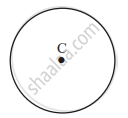
- Mark Two Radii:
Draw two lines from Centre C to the edge of the circle, naming them CR and CS (these are the radii).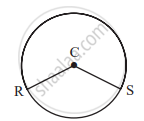
- Cut Along the Radii:
Cut the circle along both radii CR and CS to get two pieces.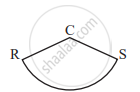
- Form a Cone Shape:
Take one piece and bring together the sides (CR and CS).
Join them to form a cone shape.
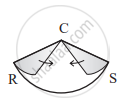 Conclusion:
You get a cone from each piece of the circle by joining the two straight edges (radii).
Video Tutorials
Shaalaa.com | Volume of a Right Circular Cone
to track your progress
