Topics
Commercial Mathematics
Compound Interest
- Compound Interest as a Repeated Simple Interest Computation with a Growing Principal
- Use of Compound Interest in Computing Amount Over a Period of 2 Or 3-years
- Use of Formula
- Finding CI from the Relation CI = A – P
Goods and Services Tax (G.S.T.)
Algebra
Banking
Geometry
Shares and Dividends
Linear Inequations
Mensuration
Quadratic Equations
Trigonometry
Ratio and Proportion
Statistics
Probability
Factorisation of Polynomials
- Function and Polynomial
- Division Algorithm for Polynomials
- Remainder Theorem
- Factor Theorem
- Applications of Factor Theorem
Matrices
Arithmetic and Geometric Progression
Co-ordinate Geometry
- Foundation of Coordinate Geometry
- Advanced Concept of Reflection in Mathematics
- Invariant Points
- Combination of Reflections
- Using Graph Paper for Reflection
Similarity
Symmetry
Loci
- Locus
- Points Equidistant from Two Given Points
- Points Equidistant from Two Intersecting Lines
- Summary of Important Results on Locus
- Important Points on Concurrency in a Triangle
Circles
Tangent and Secant Properties
Constructions
Area and Volume of Solids (Cylinder, Cone and Sphere)
- Mensuration of Cylinder
- Hollow Cylinder
- Mensuration of Cones
- Mensuration of a Sphere
- Hemisphere
- Conversion of Solids
- Solid Figures
- Problems on Mensuration
Trigonometrical Identities
Heights and Distances
- Angles of Elevation and Depression
- Problems based on Elevation and Depression
Statistics : basic concepts, Mean, Median, Mode. Histograms and Ogive
Probability
Maharashtra State Board: Class 10
CISCE: Class 10
CISCE: Class 10
Key Points: Histograms
- A Histogram is a graphical representation of a grouped frequency distribution using rectangles.
-
It is used for continuous grouped data.
-
Class intervals are shown on the X-axis.
-
Frequencies are shown on the Y-axis.
-
Rectangles are drawn without gaps between them.
-
The height of each rectangle is proportional to its frequency.
Shaalaa.com | Concept of Histrogram
to track your progress
Series: Graphical Representation of Data as Histograms
0%
Related QuestionsVIEW ALL [108]
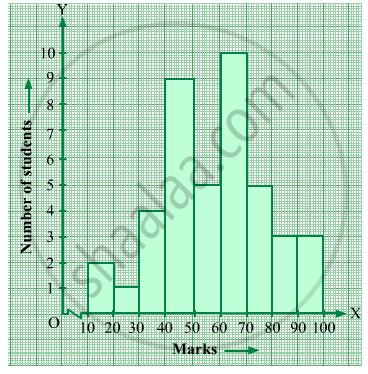
Represent the following data by Histogram:
|
Price of Sugar per kg (in Rs.) |
Number of Weeks |
| 18-20 | 4 |
| 20-22 | 8 |
| 22-24 | 22 |
| 24-26 | 12 |
| 26-28 | 8 |
| 28-30 | 6 |

Draw a histogram for the following data.
| Mid Value (x) | 15 | 25 | 35 | 45 | 55 | 65 | 75 |
| Frequency (f) | 12 | 24 | 30 | 18 | 26 | 10 | 8 |
