Topics
Commercial Mathematics
Compound Interest
- Compound Interest as a Repeated Simple Interest Computation with a Growing Principal
- Use of Compound Interest in Computing Amount Over a Period of 2 Or 3-years
- Use of Formula
- Finding CI from the Relation CI = A – P
Goods and Services Tax (G.S.T.)
Algebra
Banking
Geometry
Shares and Dividends
Linear Inequations
Mensuration
Quadratic Equations
Trigonometry
Ratio and Proportion
Statistics
Probability
Factorisation of Polynomials
- Function and Polynomial
- Division Algorithm for Polynomials
- Remainder Theorem
- Factor Theorem
- Applications of Factor Theorem
Matrices
Arithmetic and Geometric Progression
Co-ordinate Geometry
- Foundation of Coordinate Geometry
- Advanced Concept of Reflection in Mathematics
- Invariant Points
- Combination of Reflections
- Using Graph Paper for Reflection
Similarity
Symmetry
Loci
- Locus
- Points Equidistant from Two Given Points
- Points Equidistant from Two Intersecting Lines
- Summary of Important Results on Locus
- Important Points on Concurrency in a Triangle
Circles
Tangent and Secant Properties
Constructions
Area and Volume of Solids (Cylinder, Cone and Sphere)
- Mensuration of Cylinder
- Hollow Cylinder
- Mensuration of Cones
- Mensuration of a Sphere
- Hemisphere
- Conversion of Solids
- Solid Figures
- Problems on Mensuration
Trigonometrical Identities
Heights and Distances
- Angles of Elevation and Depression
- Problems based on Elevation and Depression
Statistics : basic concepts, Mean, Median, Mode. Histograms and Ogive
Probability
- Introduction to Banks
- Definition: Bank and Banking
- Functions of a Bank
- Financial Transactions
- Bank Accounts
Introduction
A bank is a government-recognised organisation that deals with financial transactions like saving, lending, and transferring.
Importance of Saving Money:
Even small amounts saved regularly can add up over time and become a big amount. If we keep our savings in a bank, the money remains secure and earns interest over time.
Financial Transactions and Users of Bank Services:
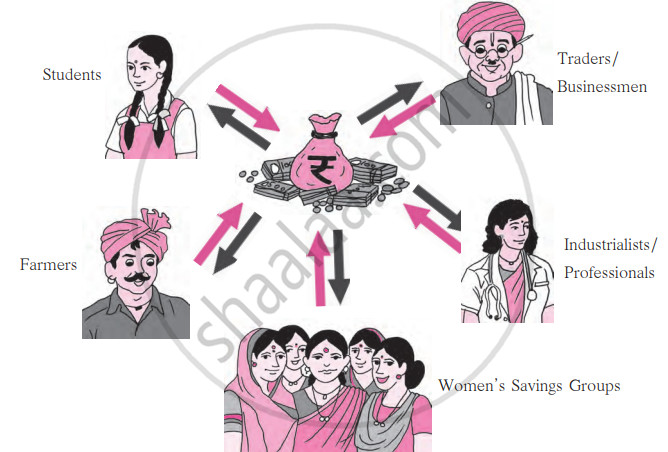
Observation:
1. Who is using bank services?
The users of bank services include students, farmers, traders/businessmen, industrialists/professionals, and women's savings groups.
2. What does the symbol on the bag mean?
The ₹ (rupee symbol) shows that it is about money.
3. What do the arrows show?
- Pink arrows: People are putting money into the bank (saving/depositing).
- Black arrows: People are taking money from the bank (loans/withdrawals).
Bank Accounts
Opening a Bank Account
To open an account in a bank, you need:
- Proof of residence (any one of these): Ration card, electricity bill, telephone bill, domicile certificate, identity card, etc.
- Proof of identity (any one of these): Aadhaar card, Voter ID, PAN card, passport, or a reference from an existing bank customer.
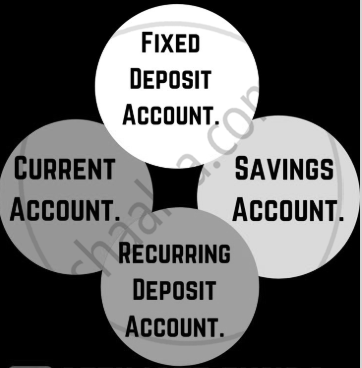
Types of Bank Accounts:
- Savings Account: Helps you save money regularly. You can deposit and withdraw money as needed. Banks give 4% to 6% interest on your savings.
- Current Account: Used mainly by traders and businesspeople. The account allows for unlimited deposits and withdrawals within a single day. No interest is given.
- Recurring Deposite (RD): You deposit a fixed amount every month. Interest is higher than a savings account. Regular saving is beneficial for long-term planning.
- Fixed Deposit (FD): You deposit a lump sum for a fixed time. Earns more interest than savings accounts. Interest rates vary between banks. Senior citizens get extra interest.
Video Tutorials
Shaalaa.com | Banking Part 2
Related QuestionsVIEW ALL [36]
Fill in the blanks in the table.
| Principal | Rate of interest (p.c.p.a.) | Time | Interest | Amount |
| 8000 | 5% | ...... | 800 | ...... |
