Methods of Solving Linear Equations in Two Variables > Graphical Method
Topics
Real Numbers
- Concept of Divisibility
- Euclid's Division Lemma
- Euclid’s Division Algorithm
- Application of Euclid Lemma > Finding the HCF of Two Positive Integers
- Application of Euclid Lemma > Finding the HCF of Three Numbers
- Application of Euclid Lemma > On Expressing the HCF of Two Numbers a and b in the Form xa + yb
- Fundamental Theorem of Arithmetic
- Applications of the Fundamental Theorem of Arithmetic
- Rational Numbers
- Irrational Numbers
- Nature of the Decimal Expansions of Rational Numbers
Number Systems
Polynomials
- Concept of Polyomial
- Graph of Polynomials
- Geometrical Meaning of the Zeroes of a Polynomial
- Relation Between Zeroes (Roots) and Coefficients of a Polynomial
- Relationship Between the Zeros and Coefficients of a Quadratic Polynomial
- Relationship between Zeros And Coefficients of a Cubic Polynomial
- Division Algorithm for Polynomials
Algebra
Pair of Linear Equations in Two Variables
- Linear Equations in Two Variables
- Simultaneous Linear Equations in Two Variables
- Solution of a Given System of Two Simultaneous Equations
- Graphical Representation of Linear Equations
- Methods of Solving Linear Equations in Two Variables > Graphical Method
- Substitution Method
- Elimination Method
- Cross - Multiplication Method
- Conditions for Solvability (or Consistency)
- Application of Simultaneous Equations
- Problems Based on Articles and Their Costs
- Applications to Problems Based on Numbers
- Application to Problems Based on Fractions
- Applications to Problems on Ages
- Application to Problems Based on Time, Distance, and Speed
Coordinate Geometry
Quadratic Equations
- Concept of Quadratic Equations
- Formulation of a Quadratic Equation
- Method of Solving a Quadratic Equation>Factorisation Method
- Method of Solving a Quadratic Equation>Quadratic Formula (Shreedharacharya's Rule)
- Nature of Roots of a Quadratic Equation
- Word Problems on Quadratic Equations
- Problems on Numbers
- General Problem on Money Matters
- Problems on Ages
- Problems on Geometry
- Problems on Speed and Time
- Problems on Time and Work
- Problems on Areas or Mensuration
Geometry
Trignometry
Arithmetic Progressions
Mensuration
Coordinate Geometry
- Foundation of Coordinate Geometry
- Distance Formula
- Collinearity of Three Points
- Section Formula in Coordinate Geometry
- Application of Section Formula
- Coordinate Formula for Area of a Triangle
Triangles
- Concept of Similarity
- Similar Polygons
- Similarity of Triangles (Corresponding Sides & Angles)
- Basic Proportionality Theorem
- Angle Bisector Theorem
- Criteria for Similarity of Triangles
- Equiangular Triangles Theorems
- Ratios of Areas of Two Triangles
- Pythagoras Theorem
Statistics and Probability
Circles
- Secant and Tangent
- Tangent to a Circle
- Number of Tangents from a Point on a Circle
Introduction to Trigonometry
Some Applications of Trigonometry
- Angles of Elevation and Depression
- Problems based on Elevation and Depression
Areas Related to Circles
- Perimeter and Area of a Circle
- Sector of a Circle and its Area
- Segment of a Circle and its Area
- Areas of Combinations of Plane Figures
Surface Areas and Volumes
- Formulas for Areas and Volumes of Solids
- Surface Area of a Combination of Solids
- Volume of a Combination of Solids
- Frustum of a Cone
- Volume and Surface Area of a Frustum of a Right Circular Cone
Statistics
- Mean of Grouped Data
- Arithmetic Mean of a Continuous Frequency Distribution
- Median of Grouped and Ungrouped Data
- Computation of Mode of a Series of Individual Observations
- Computation of Mode by Grouping
- Mode of Grouped Data(Continuous Frequency Distribution)
- Relationship Among Mean, Median and Mode
- Ogives (Cumulative Frequency Curve)
- Application of Ogive
Probability
- Measurement of Probability
- Elementary Types of Events and Properties of Probability
- Theoretical Approach to Probability
- Theoretical Probability of an Event
- Geometric Probability
Advertisements
Definition: Graphical Solution
The solution of a pair of simultaneous linear equations obtained by drawing the graph of both equations on the same coordinate plane and identifying their common point.
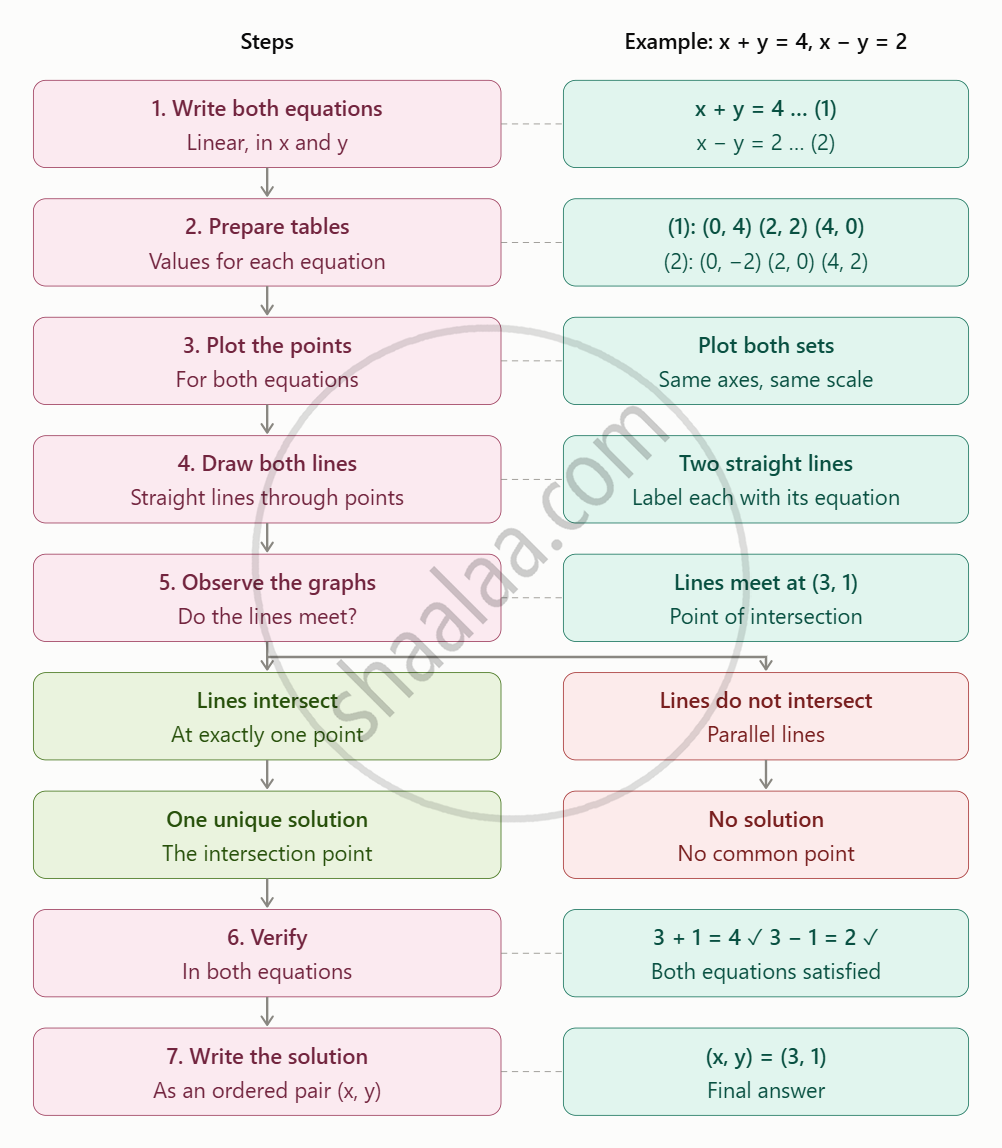
If the two lines intersect at a point P(x,y) then x and y satisfy both equations. Therefore, P(x,y) is the solution of the system.
Steps for Solving Equations Graphically
Example
Draw graphs of \[ x + y = 4 \]and \[ 2x - y = 2 \]
Step 1: Write down the equations
Equation 1: \[ x + y = 4 \]
Equation 2: \[ 2x - y = 2 \]
Step 2: Prepare tables for both equations (4 points each)
Table 1: For equation \[ x + y = 4 \]
\[ \begin{array}{|c|c|c|c|c|} \hline x & -1 & 4 & 1 & 6 \\ \hline y & 5 & 0 & 3 & -2 \\ \hline (x, y) & (-1, 5) & (4, 0) & (1, 3) & (6, -2) \\ \hline \end{array} \]
Table 2: For equation \[ 2x - y = 2 \]
\[ \begin{array}{|c|c|c|c|c|} \hline x & 0 & 1 & 3 & -1 \\ \hline y & -2 & 0 & 4 & -4 \\ \hline (x, y) & (0, -2) & (1, 0) & (3, 4) & (-1, -4) \\ \hline \end{array} \]
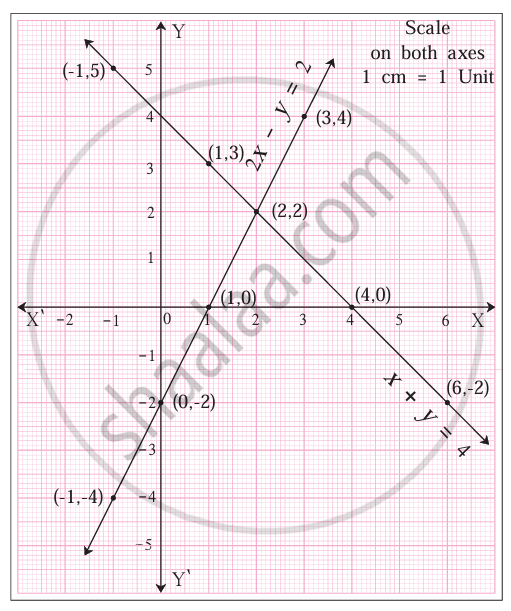
Step 3: Choose a scale and plot the points
Scale: On both axes, \[ 1 \text{ cm} = 1 \text{ unit}. \]
Plot both sets of coordinates accurately on the graph paper.
Step 4: Draw both lines and label them
Draw straight lines passing through the points and label each line with its respective equation ( \[ x + y = 4 \] and \[ 2x - y = 2 \] ).
Step 5: Observe the intersection point
The two lines intersect each other at the point \[ (2, 2). \]
Step 6: Write the final solution
The point of intersection represents the solution to the simultaneous linear equations: \[ x = 2, y = 2 \] (or \[ (x, y) = (2, 2) \] ).
Key Points: Graphical Method
-
A linear equation in two variables represents a straight line.
-
A pair of linear equations can be solved by drawing both lines on the same graph.
-
The intersection point gives the unique solution.
