Topics
Relations and Functions
Relations and Functions
Inverse Trigonometric Functions
Algebra
Matrices
- Concept of Matrices
- Types of Matrices
- Equality of Matrices
- Operations on Matrices> Addition and Subtraction of Matrices
- Operations on Matrices>Scalar Multiplication
- Operations on Matrices> Matrix Multiplication
- Transpose of a Matrix
- Symmetric and Skew Symmetric Matrices
- Invertible Matrices
- Overview of Matrices
Calculus
Determinants
Vectors and Three-dimensional Geometry
Continuity and Differentiability
- Continuous and Discontinuous Functions
- Algebra of Continuous Functions
- Concept of Differentiability
- Derivatives of Composite Functions
- Derivative of Implicit Functions
- Derivative of Inverse Function
- Exponential and Logarithmic Functions
- Logarithmic Differentiation
- Derivatives of Functions in Parametric Forms
- Second Order Derivative
- Overview of Continuity and Differentiability
Linear Programming
Applications of Derivatives
Probability
Integrals
- Introduction of Integrals
- Integration as an Inverse Process of Differentiation
- Properties of Indefinite Integral
- Methods of Integration> Integration by Substitution
- Methods of Integration>Integration Using Trigonometric Identities
- Methods of Integration> Integration Using Partial Fraction
- Methods of Integration> Integration by Parts
- Integrals of Some Particular Functions
- Definite Integrals
- Fundamental Theorem of Integral Calculus
- Evaluation of Definite Integrals by Substitution
- Properties of Definite Integrals
- Overview of Integrals
Sets
Applications of the Integrals
Differential Equations
- Basic Concepts of Differential Equations
- Order and Degree of a Differential Equation
- General and Particular Solutions of a Differential Equation
- Methods of Solving Differential Equations> Variable Separable Differential Equations
- Methods of Solving Differential Equations> Homogeneous Differential Equations
- Methods of Solving Differential Equations>Linear Differential Equations
- Overview of Differential Equations
Vectors
- Basic Concepts of Vector Algebra
- Direction Ratios, Direction Cosine & Direction Angles
- Types of Vectors in Algebra
- Algebra of Vector Addition
- Multiplication in Vector Algebra
- Components of Vector in Algebra
- Vector Joining Two Points in Algebra
- Section Formula in Vector Algebra
- Product of Two Vectors
- Overview of Vectors
Three - Dimensional Geometry
Linear Programming
Probability
Introduction
Vectors can be combined in more than one way, and each type of product gives different information. The two most important products are the scalar (dot) product and the vector (cross) product, which are used to find angles, projections, area, and direction-related results.
Maharashtra State Board: Class 12
Definition: Scalar Product (Dot Product)
If \[\vec{a}\] and \[\vec{b}\] are two vectors and \[\theta\] is the angle between them, then their scalar product is given by:
Properties of Dot Product
- Commutative: \[\vec{a} \cdot \vec{b} = \vec{b} \cdot \vec{a}\]
-
Distributive: \[\vec{a} \cdot (\vec{b} + \vec{c}) = \vec{a} \cdot \vec{b} + \vec{a} \cdot \vec{c}\]
-
\[\vec{a} \cdot \vec{a} = |\vec{a}|^2\]
-
If \[\vec{a} \cdot \vec{b} = 0\], the vectors are perpendicular if both are non-zero.
-
\[\vec{a} \cdot \vec{b} = a_1b_1 + a_2b_2 + a_3b_3\]
-
\[\hat{i} \cdot \hat{i} = \hat{j} \cdot \hat{j} = \hat{k} \cdot \hat{k} = 1\]
\[\hat{i} \cdot \hat{j} = \hat{j} \cdot \hat{k} = \hat{k} \cdot \hat{i} = 0\]
Definition: Projection of One Vector on Another
Projection is the part of one vector in the direction of another vector.
Scalar projection of \[\vec{a}\] on \[\vec{b}\]
Vector projection of \[\vec{a}\] on \[\vec{b}\]
Definition: Vector Product (Cross Product)
If \[\vec{a}\] and \[\vec{b}\] are two vectors with angle \[\theta\] between them, then their vector product is:
where \[\hat{n}\] is a unit vector perpendicular to both \[\vec{a}\] and \[\vec{b}\], in the direction given by the right-hand rule.
Cross Product Angle: \[\sin \theta = \frac{|\vec{a} \times \vec{b}|}{|\vec{a}| |\vec{b}|}\]
Properties of Cross Product
-
Not commutative: \[\vec{a} \times \vec{b} = -(\vec{b} \times \vec{a})\].
-
Distributive over addition.
-
\[\vec{a} \times \vec{a} = \vec{0}\].
-
The result is perpendicular to both vectors.
-
If vectors are parallel, then \[\sin \theta = 0\], so \[\vec{a} \times \vec{b} = \vec{0}\].
-
If vectors are perpendicular, then \[|\vec{a} \times \vec{b}| = |\vec{a}||\vec{b}|\].
- Unit Vector Cross Product Relations:
\[\hat{i} \times \hat{j} = \hat{k}\]\[\hat{j} \times \hat{k} = \hat{i}\]\[\hat{k} \times \hat{i} = \hat{j}\]
and
\[\hat{j} \times \hat{i} = -\hat{k}\]\[\hat{k} \times \hat{j} = -\hat{i}\]\[\hat{i} \times \hat{k} = -\hat{j}\] -
Determinant form:
\[\vec{a} \times \vec{b} = \begin{vmatrix} \hat{i} & \hat{j} & \hat{k} \\ a_1 & a_2 & a_3 \\ b_1 & b_2 & b_3 \end{vmatrix}\]
Example 1
For any two vectors \[\vec{a}\] and \[\vec{b}\], we always have \[|\vec{a} + \vec{b}| \leq |\vec{a}| + |\vec{b}|\] (triangle inequality).
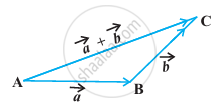
Fig 10.21
Solution: The inequality holds trivially in case either \[\vec{a} = \vec{0}\] or \[\vec{b} = \vec{0}\] (How?). So, let \[|\vec{a}| \neq 0 \neq |\vec{b}|\]. Then,
\[|\vec{a} + \vec{b}|^2 = (\vec{a} + \vec{b})^2 = (\vec{a} + \vec{b}) \cdot (\vec{a} + \vec{b})\]
\[= \vec{a} \cdot \vec{a} + \vec{a} \cdot \vec{b} + \vec{b} \cdot \vec{a} + \vec{b} \cdot \vec{b}\]
\[= |\vec{a}|^2 + 2\vec{a} \cdot \vec{b} + |\vec{b}|^2\] (scalar product is commutative)
\[\leq |\vec{a}|^2 + 2|\vec{a} \cdot \vec{b}| + |\vec{b}|^2\] (since \[x \leq |x| \forall x \in \mathbf{R}\])
\[\leq |\vec{a}|^2 + 2|\vec{a}| |\vec{b}| + |\vec{b}|^2\] (from Example 19)
\[= (|\vec{a}| + |\vec{b}|)^2\]
Hence \[|\vec{a} + \vec{b}| \leq |\vec{a}| + |\vec{b}|\]
Example 2
Find \[|\vec{a} \times \vec{b}|\], if \[\vec{a} = 2\hat{i} + \hat{j} + 3\hat{k}\] and \[\vec{b} = 3\hat{i} + 5\hat{j} - 2\hat{k}\]
Solution: We have
Hence \[|\vec{a} \times \vec{b}| = \sqrt{(-17)^2 + (13)^2 + (7)^2} = \sqrt{507}\]
Example 3
Find the area of a parallelogram whose adjacent sides are given by the vectors \[\vec{a} = 3\hat{i} + \hat{j} + 4\hat{k}\] and \[\vec{b} = \hat{i} - \hat{j} + \hat{k}\].
Solution: The area of a parallelogram with \[\vec{a}\] and \[\vec{b}\] as its adjacent sides is given by \[|\vec{a} \times \vec{b}|\].
Now
Therefore \[|\vec{a} \times \vec{b}| = \sqrt{25 + 1 + 16} = \sqrt{42}\]
and hence, the required area is \[\sqrt{42}\].
Maharashtra State Board: Class 12
Key Points: Product of Vector in Algebra
-
Dot product result is a scalar.
-
Cross product result is a vector.
-
Dot product uses cosine; cross product uses sine.
-
Dot product helps in angle and projection questions.
-
Cross product helps in area and direction questions.
-
\[\vec{a} \cdot \vec{b} = 0\] indicates perpendicular non-zero vectors.
-
\[\vec{a} \times \vec{b} = \vec{0}\] indicates parallel vectors.
- Applications of Cross Product:
Area of Triangle:
\[\frac{1}{2}|\vec{a} \times \vec{b}|\]Area of Parallelogram:
\[|\vec{a} \times \vec{b}|\]
