Topics
Mathematical Logic
Matrices
Differentiation
Applications of Derivatives
Integration
Definite Integration
Applications of Definite Integration
- Standard Forms of Parabola and Their Shapes
- Ellipse and its Types
- Area Under Simple Curves
- Overview of Application of Definite Integration
Differential Equation and Applications
- Basic Concepts of Differential Equations
- Order and Degree of a Differential Equation
- Formation of Differential Equation by Eliminating Arbitary Constant
- Forms of Solving Differential Equations> Variable Separable
- Forms of Solving Differential Equations> Homogeneous Differential Equations
- Forms of Solving Differential Equations>Linear Differential Equations
- Applications of Differential Equation
- Overview of Differential Equations
Commission, Brokerage and Discount
- Commission and Brokerage Agent
- Concept of Discount
- Overview of Commission, Brokerage and Discount
Insurance and Annuity
- Insurance
- Types of Insurance
- Annuity
- Overview of Insurance and Annuity
Linear Regression
- Regression
- Types of Linear Regression
- Fitting Simple Linear Regression
- The Method of Least Squares
- Lines of Regression of X on Y and Y on X Or Equation of Line of Regression
- Properties of Regression Coefficients
- Overview: Linear Regression
Time Series
- Introduction to Time Series
- Uses of Time Series Analysis
- Components of a Time Series
- Mathematical Models
- Measurement of Secular Trend
- Overview of Time Series
Index Numbers
- Weighted Aggregate Method
- Cost of Living Index Number
- Method of Constructing Cost of Living Index Numbers - Aggregative Expenditure Method
- Overview of Index Numbers
- Method of Constructing Cost of Living Index Numbers - Family Budget Method
- Uses of Cost of Living Index Number
Linear Programming
Assignment Problem and Sequencing
- Assignment Problem
- Hungarian Method of Solving Assignment Problem
- Special Cases of Assignment Problem
- Sequencing Problem
- Types of Sequencing Problem
- Finding an Optimal Sequence
- Overview of Assignment Problem and Sequencing
Probability Distributions
Concepts of Linear Programming
| Term | Definition |
| Linear Programming Problem (LPP) | subject to specific linear constraints and non-negative conditions. |
| Objective Function | A linear function, generally written as Z = ax + by (where a and b are constants), which needs to be maximized or minimized. |
| Decision Variables | The variables (like x and y) representing the quantities to be determined. |
| Constraints | The linear inequalities or restrictions placed on the variables due to limited resources (e.g., maximum budget or storage capacity). |
| Non-negative Restrictions | The condition that variables cannot be negative, mathematically stated as \[x \ge 0, y \ge 0\]. |
| Optimisation Problem | Any broader problem that seeks to maximize or minimize a mathematical function subject to specific constraints. An LPP is a special, strictly linear type of optimization problem. |
Example 1
To maximize profit (Z), a problem can be formulated mathematically as follows:
-
Maximise: Z = 250x + 75y
-
Subject to the constraints:
-
\[5x + y \le 100\]
-
\[x + y \le 60\]
-
-
With non-negative restrictions: \[x \ge 0, y \ge 0\]
Key Points: Linear Programming Problem and Its Mathematical Formulation
-
Linear Programming is a method of optimisation under linear constraints.
-
The quantity to be optimised is called the objective function.
-
The unknown quantities are called decision variables.
-
Restrictions are called constraints.
-
Non-negative restrictions must always be included.
Test Yourself
Video Tutorials
Shaalaa.com | Objective Function
Related QuestionsVIEW ALL [73]
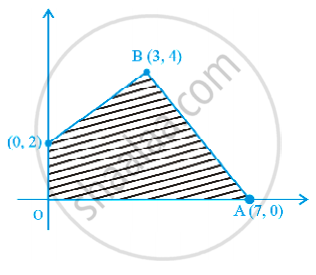
In order to supplement daily diet, a person wishes to take some X and some wishes Y tablets. The contents of iron, calcium and vitamins in X and Y (in milligrams per tablet) are given as below:
| Tablets | Iron | Calcium | Vitamin |
| X | 6 | 3 | 2 |
| Y | 2 | 3 | 4 |
The person needs atleast 18 milligrams of iron, 21 milligrams of calcium and 16 milligrams of vitamin. The price of each tablet of X and Y is Rs 2 and Rs 1 respectively. How many tablets of each should the person take in order to satisfy the above requirement at the minimum cost?
