Topics
Relations and Functions
Relations and Functions
Inverse Trigonometric Functions
Algebra
Matrices
- Concept of Matrices
- Types of Matrices
- Equality of Matrices
- Operations on Matrices> Addition and Subtraction of Matrices
- Operations on Matrices>Scalar Multiplication
- Operations on Matrices> Matrix Multiplication
- Transpose of a Matrix
- Symmetric and Skew Symmetric Matrices
- Invertible Matrices
- Overview of Matrices
Calculus
Determinants
Vectors and Three-dimensional Geometry
Continuity and Differentiability
- Continuous and Discontinuous Functions
- Algebra of Continuous Functions
- Concept of Differentiability
- Derivatives of Composite Functions
- Derivative of Implicit Functions
- Derivative of Inverse Function
- Exponential and Logarithmic Functions
- Logarithmic Differentiation
- Derivatives of Functions in Parametric Forms
- Second Order Derivative
- Overview of Continuity and Differentiability
Linear Programming
Applications of Derivatives
Probability
Integrals
- Introduction of Integrals
- Integration as an Inverse Process of Differentiation
- Properties of Indefinite Integral
- Methods of Integration> Integration by Substitution
- Methods of Integration>Integration Using Trigonometric Identities
- Methods of Integration> Integration Using Partial Fraction
- Methods of Integration> Integration by Parts
- Integrals of Some Particular Functions
- Definite Integrals
- Fundamental Theorem of Integral Calculus
- Evaluation of Definite Integrals by Substitution
- Properties of Definite Integrals
- Overview of Integrals
Sets
Applications of the Integrals
Differential Equations
- Basic Concepts of Differential Equations
- Order and Degree of a Differential Equation
- General and Particular Solutions of a Differential Equation
- Methods of Solving Differential Equations> Variable Separable Differential Equations
- Methods of Solving Differential Equations> Homogeneous Differential Equations
- Methods of Solving Differential Equations>Linear Differential Equations
- Overview of Differential Equations
Vectors
- Basic Concepts of Vector Algebra
- Direction Ratios, Direction Cosine & Direction Angles
- Types of Vectors in Algebra
- Algebra of Vector Addition
- Multiplication in Vector Algebra
- Components of Vector in Algebra
- Vector Joining Two Points in Algebra
- Section Formula in Vector Algebra
- Product of Two Vectors
- Overview of Vectors
Three - Dimensional Geometry
Linear Programming
Probability
Introduction
Vector addition explains how two or more vectors are combined to produce a single resultant vector. It is a fundamental concept in Vector Algebra and is also useful in physics applications such as displacement and velocity. Vector addition is introduced geometrically through the triangle law and parallelogram law.
Properties
| Property | Statement | Meaning |
|---|---|---|
| Commutative Property | \[(\vec{a}+\vec{b}=\vec{b}+\vec{a})\] | Changing the order of vectors does not change the sum. |
| Associative Property | \[((\vec{a}+\vec{b})+\vec{c}=\vec{a}+(\vec{b}+\vec{c}))\] | Vectors can be grouped in any order while adding. |
| Additive Identity | \[(\vec{a}+\vec{0}=\vec{0}+\vec{a}=\vec{a})\] | The zero vector does not affect a vector when added. |
| Additive Inverse | \[(\vec{a}+(-\vec{a})=\vec{0})\] | Every vector has an opposite vector which gives the zero vector when added. |
Triangle Law of Vector Addition
If two vectors are represented by two sides of a triangle taken in order, then their sum is represented by the third side of the triangle taken in the same order.
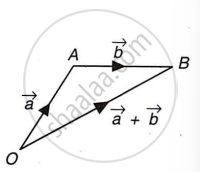
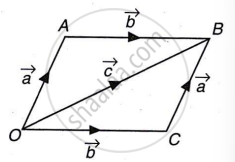
Parallelogram Law of Vector Addition
If two vectors are represented by two adjacent sides of a parallelogram, then their resultant is represented by the diagonal passing through their common initial point.
Difference of Two Vectors
The difference of two vectors is obtained by adding the negative of one vector.
Real Life Examples
-
Walking path: A student walks 3 m east and then 4 m north; the direct displacement is the resultant vector.
-
Boat in a river: The motion of a boat crossing a river and the river current together form a resultant velocity, illustrating vector addition.
Key Points: Algebra of Vector Addition
-
A vector has both magnitude and direction.
-
Resultant means the combined effect of two or more vectors.
-
Triangle law uses head-to-tail arrangement.
-
Parallelogram law uses adjacent sides from the same initial point.
-
Vector addition is commutative and associative.
-
Zero vector is the identity element for vector addition.
-
Difference of vectors is obtained by adding the negative of a vector.
