Advertisements
Advertisements
Question
Let A = R - {3} and B = R - {1}. Consider the function f : A → B defined by f(x) = `(x-2)/(x-3).`Show that f is one-one and onto and hence find f-1.
[CBSE 2012, 2014]
Advertisements
Solution
We have,
A = R {3} and B = R - {1}
The function f : A → B defined by f(x) = `(x-2)/(x-3)`
Let x,y ∈ A such that f (x) = f (y). Then,
`(x-2)/(x-3) = (y-2)/(y-3)`
⇒ xy −3x − 2y + 6 = xy − 2x − 3y + 6
⇒ −x = −y
⇒ x = y
∴ f is one − one .
Let y ∈ B. Then, y ≠ 1.
The function f is onto if there exists x ∈ A such that f (x) = y . Now,
f (x) = y
⇒ `(x-2)/(x-3) = y`
⇒ x - 2 = xy - 3y
⇒ x - xy = 2 - 3y
⇒ x (1 - y ) = 2 - 3y
⇒ ` x = (2 - 3y)/ (1 - y ) in A [ y ≠ 1]`
Thus, for any y ∈ B, there exists `(2-3y)/(1-y)` ∈ A such that
`f ((2 - 3y) / (1-y)) = (((2-3y)/(1-y))-2)/(((2-3y)/(1 - y))-3 `= `(2-3y - 2 +2y)/(2-3y -3 +3y) = (-y)/(-1) = y`
∴ f is onto.
So, f is one−one and onto fucntion.
Now,
` As , x = (2 - 3y)/(1- y)`
`so , f^-1 (x) = (2- 3x)/(1 - x) = (3x - 2)/(x-1)`
APPEARS IN
RELATED QUESTIONS
Check the injectivity and surjectivity of the following function:
f : Z → Z given by f(x) = x3
Let A = {1, 2, 3}, B = {4, 5, 6, 7} and let f = {(1, 4), (2, 5), (3, 6)} be a function from A to B. Show that f is one-one.
In the following case, state whether the function is one-one, onto or bijective. Justify your answer.
f : R → R defined by f(x) = 1 + x2
If the function `f(x) = sqrt(2x - 3)` is invertible then find its inverse. Hence prove that `(fof^(-1))(x) = x`
Give an example of a function which is neither one-one nor onto ?
Classify the following function as injection, surjection or bijection :
f : R → R, defined by f(x) = x3 + 1
If f : A → B and g : B → C are onto functions, show that gof is a onto function.
Find fog and gof if : f (x) = |x|, g (x) = sin x .
If f(x) = 2x + 5 and g(x) = x2 + 1 be two real functions, then describe each of the following functions:
(1) fog
(2) gof
(3) fof
(4) f2
Also, show that fof ≠ f2
Let f, g, h be real functions given by f(x) = sin x, g (x) = 2x and h (x) = cos x. Prove that fog = go (fh).
Let f be a real function given by f (x)=`sqrt (x-2)`
Find each of the following:
(i) fof
(ii) fofof
(iii) (fofof) (38)
(iv) f2
Also, show that fof ≠ `f^2` .
A function f : R → R is defined as f(x) = x3 + 4. Is it a bijection or not? In case it is a bijection, find f−1 (3).
Let f be a function from R to R, such that f(x) = cos (x + 2). Is f invertible? Justify your answer.
If f : A → A, g : A → A are two bijections, then prove that fog is an injection ?
Which of the following graphs represents a one-one function?
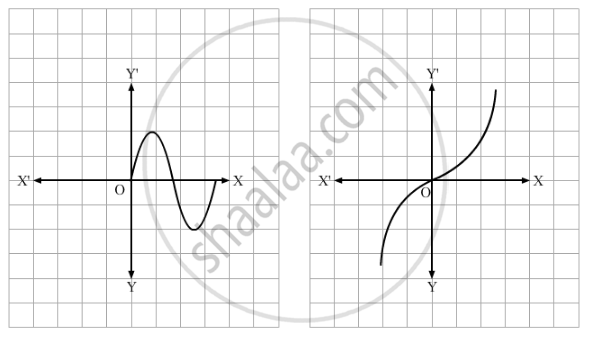
If A = {1, 2, 3} and B = {a, b}, write the total number of functions from A to B.
If f : R → R is defined by f(x) = x2, write f−1 (25)
If f : R → R is given by f(x) = x3, write f−1 (1).
If f : C → C is defined by f(x) = (x − 2)3, write f−1 (−1).
Let f be an invertible real function. Write ( f-1 of ) (1) + ( f-1 of ) (2) +..... +( f-1 of ) (100 )
Let A = {1, 2, 3, 4} and B = {a, b} be two sets. Write the total number of onto functions from A to B.
Write the domain of the real function
`f (x) = sqrtx - [x] .`
Write the domain of the real function
`f (x) = sqrt([x] - x) .`
What is the range of the function
`f (x) = ([x - 1])/(x -1) ?`
If the mapping f : {1, 3, 4} → {1, 2, 5} and g : {1, 2, 5} → {1, 3}, given by f = {(1, 2), (3, 5), (4, 1)} and g = {(2, 3), (5, 1), (1, 3)}, then write fog. [NCERT EXEMPLAR]
A function f from the set of natural numbers to integers defined by
`{([n-1]/2," when n is odd" is ),(-n/2,when n is even ) :}`
Let
\[A = \left\{ x : - 1 \leq x \leq 1 \right\} \text{and} f : A \to \text{A such that f}\left( x \right) = x|x|\]
The function f : [-1/2, 1/2, 1/2] → [-π /2,π/2], defined by f (x) = `sin^-1` (3x - `4x^3`), is
Let
\[A = \left\{ x \in R : x \geq 1 \right\}\] The inverse of the function,
\[f : A \to A\] given by
\[f\left( x \right) = 2^{x \left( x - 1 \right)} , is\]
If \[F : [1, \infty ) \to [2, \infty )\] is given by
\[f\left( x \right) = x + \frac{1}{x}, then f^{- 1} \left( x \right)\]
Let the function f: R → R be defined by f(x) = 4x – 1, ∀ x ∈ R. Then, show that f is one-one.
If the set A contains 5 elements and the set B contains 6 elements, then the number of one-one and onto mappings from A to B is ______.
The domain of the function `cos^-1((2sin^-1(1/(4x^2-1)))/π)` is ______.
The solution set of the inequation log1/3(x2 + x + 1) + 1 > 0 is ______.
If A = {x ∈ R: |x – 2| > 1}, B = `{x ∈ R : sqrt(x^2 - 3) > 1}`, C = {x ∈ R : |x – 4| ≥ 2} and Z is the set of all integers, then the number of subsets of the set (A ∩ B ∩ C) C ∩ Z is ______.
The trigonometric equation tan–1x = 3tan–1 a has solution for ______.
In the function from \(X\) to \(Y\), if \(6\in Y\) is not the image of any element of \(X\), the function is:
If every seat in a classroom is occupied by one student, the situation resembles:
