Advertisements
Advertisements
Question
Find fog and gof if : f (x) = x2 g(x) = cos x .
Advertisements
Solution
f (x) = x2, g(x) = cos x
f : R→ [0, ∞) ; g : R→[−1, 1]
Computing fog :
Clearly, the range of g is not a subset of the domain of f.
⇒ Domain (fog) = {x: x∈domain of g and g (x) ∈domain of f}
⇒ Domain (fog) = x : x ∈ R and cos x ∈ R}
⇒ Domain of (fog) = R
fog : R→ R
(fog) (x) = f (g (x))
= f ( cos x )
= cos2x
Computing gof :
Clearly, the range of f is a subset of the domain of g.
⇒ fog : R→R
(gof) (x) = g (f (x))
= g (x2)
= cos ( x2)
APPEARS IN
RELATED QUESTIONS
Check the injectivity and surjectivity of the following function:
f : Z → Z given by f(x) = x3
Show that the function f : R → R given by f(x) = x3 is injective.
Let A = {–1, 0, 1, 2}, B = {–4, –2, 0, 2} and f, g : A → B be functions defined by f(x) = x2 – x, x ∈ A and g(x) = `2|x - 1/2| – 1`, x ∈ A. Are f and g equal?
Justify your answer. (Hint: One may note that two functions f : A → B and g : A → B such that f(a) = g(a) ∀ a ∈ A are called equal functions.)
Give an example of a function which is not one-one but onto ?
Classify the following function as injection, surjection or bijection :
f : R → R, defined by f(x) = |x|
Classify the following function as injection, surjection or bijection :
f : R → R, defined by f(x) = 3 − 4x
Classify the following function as injection, surjection or bijection :
f : R → R, defined by f(x) = 1 + x2
Set of ordered pair of a function? If so, examine whether the mapping is injective or surjective :{(x, y) : x is a person, y is the mother of x}
Set of ordered pair of a function ? If so, examine whether the mapping is injective or surjective :{(a, b) : a is a person, b is an ancestor of a}
Show that the logarithmic function f : R0+ → R given by f (x) loga x ,a> 0 is a bijection.
If A = {1, 2, 3}, show that a one-one function f : A → A must be onto.
Find the number of all onto functions from the set A = {1, 2, 3, ..., n} to itself.
Let R+ be the set of all non-negative real numbers. If f : R+ → R+ and g : R+ → R+ are defined as `f(x)=x^2` and `g(x)=+sqrtx` , find fog and gof. Are they equal functions ?
If f(x) = |x|, prove that fof = f.
If f(x) = sin x and g(x) = 2x be two real functions, then describe gof and fog. Are these equal functions?
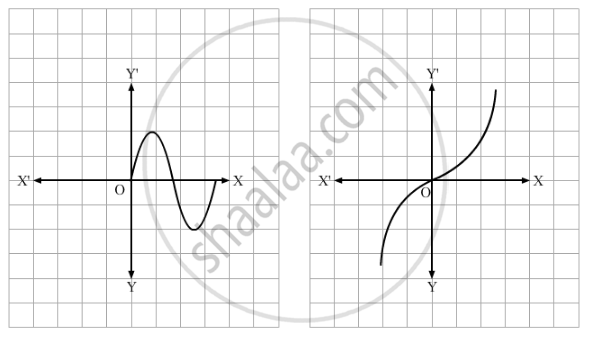
Which of the following graphs represents a one-one function?
Let A = {1, 2, 3, 4} and B = {a, b} be two sets. Write the total number of onto functions from A to B.
Write whether f : R → R, given by `f(x) = x + sqrtx^2` is one-one, many-one, onto or into.
The function
f : A → B defined by
f (x) = - x2 + 6x - 8 is a bijection if
Let
\[A = \left\{ x \in R : - 1 \leq x \leq 1 \right\} = B\] Then, the mapping\[f : A \to \text{B given by} f\left( x \right) = x\left| x \right|\] is
Which of the following functions from
\[A = \left\{ x \in R : - 1 \leq x \leq 1 \right\}\]
If \[F : [1, \infty ) \to [2, \infty )\] is given by
\[f\left( x \right) = x + \frac{1}{x}, then f^{- 1} \left( x \right)\]
If \[g\left( x \right) = x^2 + x - 2\text{ and} \frac{1}{2} gof\left( x \right) = 2 x^2 - 5x + 2\] is equal to
Mark the correct alternative in the following question:
Let f : R \[-\] \[\left\{ \frac{3}{5} \right\}\] \[\to\] R be defined by f(x) = \[\frac{3x + 2}{5x - 3}\] Then,
If f(x) = `(x+3)/(4x−5) , "g"(x) = (3+5x)/(4x−1)` then verify that `("fog") (x)` = x.
Which function is used to check whether a character is alphanumeric or not?
Let f, g: R → R be two functions defined as f(x) = |x| + x and g(x) = x – x ∀ x ∈ R. Then, find f o g and g o f
Are the following set of ordered pairs functions? If so, examine whether the mapping is injective or surjective.
{(a, b): a is a person, b is an ancestor of a}
Let f: R → R be defined by f(x) = `1/x` ∀ x ∈ R. Then f is ______.
Let f: R → R be the functions defined by f(x) = x3 + 5. Then f–1(x) is ______.
The function f : R → R defined by f(x) = 3 – 4x is ____________.
The function f: R → R defined as f(x) = x3 is:
If f; R → R f(x) = 10x + 3 then f–1(x) is:
Let f(x) = ax (a > 0) be written as f(x) = f1(x) + f2(x), where f1(x) is an even function and f2(x) is an odd function. Then f1(x + y) + f1(x – y) equals ______.
Let a function `f: N rightarrow N` be defined by
f(n) = `{:[(2n",", n = 2"," 4"," 6"," 8","......),(n - 1",", n = 3"," 7"," 11"," 15","......),((n + 1)/2",", n = 1"," 5"," 9"," 13","......):}`
then f is ______.
Let S = {1, 2, 3, 4, 5, 6, 7}. Then the number of possible functions f: S `rightarrow` S such that f(m.n) = f(m).f(n) for every m, n ∈ S and m.n ∈ S is equal to ______.
For x ∈ R, x ≠ 0, let f0(x) = `1/(1 - x)` and fn+1 (x) = f0(fn(x)), n = 0, 1, 2, .... Then the value of `f_100(3) + f_1(2/3) + f_2(3/2)` is equal to ______.
Which one of the following graphs is a function of x?
 |
 |
| Graph A | Graph B |
A function is onto when every element of the codomain has:
