Advertisements
Advertisements
Question
Classify the following function as injection, surjection or bijection :
f : Z → Z, defined by f(x) = x2 + x
Advertisements
Solution
f : Z → Z, defined by f(x) = x2 + x
Injection test:
Let x and y be any two elements in the domain (Z), such that f(x) = f(y).
f(x) = f(y)
x2+ x = y2 + y
Here, we cannot say that x = y.
For example, x = 2 and y = - 3
Then,
x2+x=22+2= 6
y2+y=(−3)2−3= 6
So, we have two numbers 2 and -3 in the domain Z whose image is same as 6.
So, f is not an injection .
Surjection test:
Let y be any element in the co-domain (Z), such that f(x) = y for some element x in Z (domain).
f(x) = y
x2 + x = y
Here, we cannot say x ∈ Z.
For example, y = - 4.
x2 + x = − 4
x2+ x + 4 = 0
x =` (-1 ±sqrt-5)/2 = (-1 ±isqrt5)/2` which is not in Z.
So, f is not a surjection and f is not a bijection.
APPEARS IN
RELATED QUESTIONS
Check the injectivity and surjectivity of the following function:
f : N → N given by f(x) = x3
Let f : R → R be defined as f(x) = 3x. Choose the correct answer.
Let S = {a, b, c} and T = {1, 2, 3}. Find F−1 of the following functions F from S to T, if it exists.
F = {(a, 3), (b, 2), (c, 1)}
Let A = {–1, 0, 1, 2}, B = {–4, –2, 0, 2} and f, g : A → B be functions defined by f(x) = x2 – x, x ∈ A and g(x) = `2|x - 1/2| – 1`, x ∈ A. Are f and g equal?
Justify your answer. (Hint: One may note that two functions f : A → B and g : A → B such that f(a) = g(a) ∀ a ∈ A are called equal functions.)
Give an example of a function which is not one-one but onto ?
Classify the following function as injection, surjection or bijection : f : Z → Z given by f(x) = x2
Set of ordered pair of a function? If so, examine whether the mapping is injective or surjective :{(x, y) : x is a person, y is the mother of x}
Let A = {1, 2, 3}. Write all one-one from A to itself.
Let f = {(1, −1), (4, −2), (9, −3), (16, 4)} and g = {(−1, −2), (−2, −4), (−3, −6), (4, 8)}. Show that gof is defined while fog is not defined. Also, find gof.
Find fog and gof if : f(x) = c, c ∈ R, g(x) = sin `x^2`
If f(x) = |x|, prove that fof = f.
Let f : R `{- 4/3} `- 43 →">→ R be a function defined as f(x) = `(4x)/(3x +4)` . Show that f : R - `{-4/3}`→ Rang (f) is one-one and onto. Hence, find f -1.
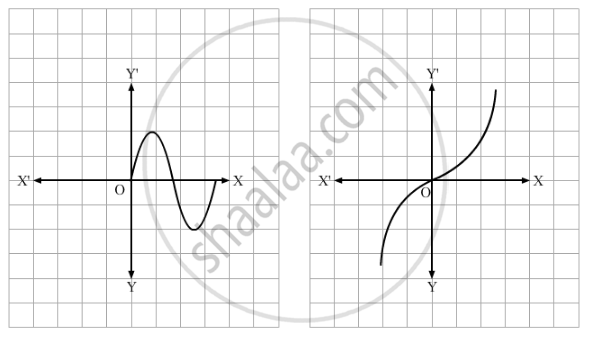
Which of the following graphs represents a one-one function?
If A = {a, b, c} and B = {−2, −1, 0, 1, 2}, write the total number of one-one functions from A to B.
If f : R → R is given by f(x) = x3, write f−1 (1).
Let A = {x ∈ R : −4 ≤ x ≤ 4 and x ≠ 0} and f : A → R be defined by \[f\left( x \right) = \frac{\left| x \right|}{x}\]Write the range of f.
Write whether f : R → R, given by `f(x) = x + sqrtx^2` is one-one, many-one, onto or into.
Which one the following relations on A = {1, 2, 3} is a function?
f = {(1, 3), (2, 3), (3, 2)}, g = {(1, 2), (1, 3), (3, 1)} [NCERT EXEMPLAR]
If a function g = {(1, 1), (2, 3), (3, 5), (4, 7)} is described by g(x) = \[\alpha x + \beta\] then find the values of \[\alpha\] and \[ \beta\] . [NCERT EXEMPLAR]
Let
f : R → R be given by
\[f\left( x \right) = \left[ x^2 \right] + \left[ x + 1 \right] - 3\]
where [x] denotes the greatest integer less than or equal to x. Then, f(x) is
(d) one-one and onto
Which of the following functions from
to itself are bijections?
If \[F : [1, \infty ) \to [2, \infty )\] is given by
\[f\left( x \right) = x + \frac{1}{x}, then f^{- 1} \left( x \right)\]
If \[g\left( x \right) = x^2 + x - 2\text{ and} \frac{1}{2} gof\left( x \right) = 2 x^2 - 5x + 2\] is equal to
Let A = ℝ − {3}, B = ℝ − {1}. Let f : A → B be defined by \[f\left( x \right) = \frac{x - 2}{x - 3}, \forall x \in A\] Show that f is bijective. Also, find
(i) x, if f−1(x) = 4
(ii) f−1(7)
Set A has 3 elements and the set B has 4 elements. Then the number of injective mappings that can be defined from A to B is ______.
Let A = [–1, 1]. Then, discuss whether the following functions defined on A are one-one, onto or bijective:
f(x) = `x/2`
Let A = [–1, 1]. Then, discuss whether the following functions defined on A are one-one, onto or bijective:
k(x) = x2
Let f: R – `{3/5}` → R be defined by f(x) = `(3x + 2)/(5x - 3)`. Then ______.
If f(x) = (4 – (x – 7)3}, then f–1(x) = ______.
Let f : R → R be defind by f(x) = `1/"x" AA "x" in "R".` Then f is ____________.
A general election of Lok Sabha is a gigantic exercise. About 911 million people were eligible to vote and voter turnout was about 67%, the highest ever

Let I be the set of all citizens of India who were eligible to exercise their voting right in the general election held in 2019. A relation ‘R’ is defined on I as follows:
R = {(V1, V2) ∶ V1, V2 ∈ I and both use their voting right in the general election - 2019}
- Three friends F1, F2, and F3 exercised their voting right in general election-2019, then which of the following is true?
An organization conducted a bike race under 2 different categories-boys and girls. Totally there were 250 participants. Among all of them finally, three from Category 1 and two from Category 2 were selected for the final race. Ravi forms two sets B and G with these participants for his college project. Let B = {b1,b2,b3} G={g1,g2} where B represents the set of boys selected and G the set of girls who were selected for the final race.
Ravi decides to explore these sets for various types of relations and functions.
- Ravi wants to know among those relations, how many functions can be formed from B to G?
An organization conducted a bike race under 2 different categories-boys and girls. Totally there were 250 participants. Among all of them finally, three from Category 1 and two from Category 2 were selected for the final race. Ravi forms two sets B and G with these participants for his college project. Let B = {b1,b2,b3} G={g1,g2} where B represents the set of boys selected and G the set of girls who were selected for the final race.
Ravi decides to explore these sets for various types of relations and functions.
- Ravi wants to find the number of injective functions from B to G. How many numbers of injective functions are possible?
The graph of the function y = f(x) is symmetrical about the line x = 2, then ______.
The function f(x) = [x], where [x] denotes the greatest integer less than or equal to x; is continuous at ______.
Write the domain and range (principle value branch) of the following functions:
f(x) = tan–1 x.
Which one of the following graphs is a function of x?
 |
 |
| Graph A | Graph B |
A function is called into if:
Which condition represents a many-one function?
