Advertisements
Advertisements
Question
If A = {1, 2, 3, 4} and B = {a, b, c, d}, define any four bijections from A to B. Also give their inverse functions.
Advertisements
Solution
f1={ (1, a), (2, b), (3, c), (4, d)} ⇒ f1−1 ={(a, 1), (b, 2), (c, 3), (d, 4)}
f2={(1, b), (2, a), (3, c), (4, d)} ⇒f2−1 {(b, 1), (a, 2), (c, 3), (d, 4)}
f3= { (1, a), (2, b), (4, c), (3, d)} ⇒ f3−1 {(a, 1), (b, 2), (c, 4), (d, 3)}
f4 = {(1, b), (2, a), (4, c), (3, d)} ⇒ f4−1 = {(b, 1), (a, 2), (c, 4), (d, 3)}
Clearly, all these are bijections because they are one-one and onto.
APPEARS IN
RELATED QUESTIONS
In the following case, state whether the function is one-one, onto or bijective. Justify your answer.
f : R → R defined by f(x) = 1 + x2
Find the number of all onto functions from the set {1, 2, 3, ..., n} to itself.
Let S = {a, b, c} and T = {1, 2, 3}. Find F−1 of the following functions F from S to T, if it exists.
F = {(a, 3), (b, 2), (c, 1)}
Give an example of a function which is one-one but not onto ?
Give examples of two surjective functions f1 and f2 from Z to Z such that f1 + f2 is not surjective.
If f : A → B and g : B → C are onto functions, show that gof is a onto function.
Find fog and gof if : f(x) = sin−1 x, g(x) = x2
Let f, g, h be real functions given by f(x) = sin x, g (x) = 2x and h (x) = cos x. Prove that fog = go (fh).
State with reason whether the following functions have inverse :
g : {5, 6, 7, 8} → {1, 2, 3, 4} with g = {(5, 4), (6, 3), (7, 4), (8, 2)}
State with reason whether the following functions have inverse:
h : {2, 3, 4, 5} → {7, 9, 11, 13} with h = {(2, 7), (3, 9), (4, 11), (5, 13)}
Find f −1 if it exists : f : A → B, where A = {0, −1, −3, 2}; B = {−9, −3, 0, 6} and f(x) = 3 x.
Which of the following graphs represents a one-one function?
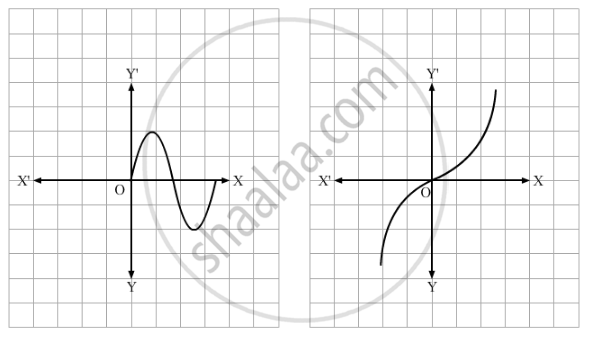
Let f be a function from C (set of all complex numbers) to itself given by f(x) = x3. Write f−1 (−1).
If f : R → R is defined by f(x) = 10 x − 7, then write f−1 (x).
Let \[f : \left[ - \frac{\pi}{2}, \frac{\pi}{2} \right] \to\] A be defined by f(x) = sin x. If f is a bijection, write set A.
Write the domain of the real function
`f (x) = 1/(sqrt([x] - x)`.
Write whether f : R → R, given by `f(x) = x + sqrtx^2` is one-one, many-one, onto or into.
If f : R → R is defined by f(x) = 3x + 2, find f (f (x)).
Let the function
\[f : R - \left\{ - b \right\} \to R - \left\{ 1 \right\}\]
\[f\left( x \right) = \frac{x + a}{x + b}, a \neq b .\text{Then},\]
Let f be an injective map with domain {x, y, z} and range {1, 2, 3}, such that exactly one of the following statements is correct and the remaining are false.
\[f\left( x \right) = 1, f\left( y \right) \neq 1, f\left( z \right) \neq 2 .\]
The value of
\[f^{- 1} \left( 1 \right)\] is
\[f : R \to R\] is defined by
\[f\left( x \right) = \frac{e^{x^2} - e^{- x^2}}{e^{x^2 + e^{- x^2}}} is\]
If \[F : [1, \infty ) \to [2, \infty )\] is given by
\[f\left( x \right) = x + \frac{1}{x}, then f^{- 1} \left( x \right)\]
The distinct linear functions that map [−1, 1] onto [0, 2] are
If \[f : R \to R\] is given by \[f\left( x \right) = x^3 + 3, \text{then} f^{- 1} \left( x \right)\] is equal to
Mark the correct alternative in the following question:
If the set A contains 5 elements and the set B contains 6 elements, then the number of one-one and onto mappings from A to B is
Write about strlen() function.
Let R be the set of real numbers and f: R → R be the function defined by f(x) = 4x + 5. Show that f is invertible and find f–1.
Set A has 3 elements and the set B has 4 elements. Then the number of injective mappings that can be defined from A to B is ______.
Let A = [–1, 1]. Then, discuss whether the following functions defined on A are one-one, onto or bijective:
k(x) = x2
The number of bijective functions from set A to itself when A contains 106 elements is ____________.
Let f : R → R be defind by f(x) = `1/"x" AA "x" in "R".` Then f is ____________.
An organization conducted a bike race under 2 different categories-boys and girls. Totally there were 250 participants. Among all of them finally, three from Category 1 and two from Category 2 were selected for the final race. Ravi forms two sets B and G with these participants for his college project. Let B = {b1,b2,b3} G={g1,g2} where B represents the set of boys selected and G the set of girls who were selected for the final race.
Ravi decides to explore these sets for various types of relations and functions.
- Ravi wants to know among those relations, how many functions can be formed from B to G?
A function is onto when every element of the codomain has:
A function is called into if:
A function is called bijective if it is both:
In the function from \(X\) to \(Y\), if \(6\in Y\) is not the image of any element of \(X\), the function is:
Many students choosing the same favourite subject resembles which type of function?
Which condition represents a one-one (injective) function?
