Advertisements
Advertisements
Question
Let
\[f : R \to R\] be a function defined by
Options
f is a bijection
f is an injection only
f is surjection on only
f is neither an injection nor a surjection
Advertisements
Solution
f is neither an injection nor a surjection
\[f : R \to R\]
\[f\left( x \right) = \frac{e^{|x|} - e^{- x}}{e^x + e^{- x}}\]
\[\text{For } x = - 2 \text{ and} - 3 \in R \]
\[f( - 2) = \frac{e^\left| - 2 \right| - e^2}{e^{- 2} + e^2}\]
\[ = \frac{e^2 - e^2}{e^{- 2} + e^2}\]
\[ = 0\]
\[\text{& } f( - 3) = \frac{e^\left| - 3 \right| - e^3}{e^{- 3} + e^3}\]
\[ = \frac{e^3 - e^3}{e^{- 3} + e^3}\]
\[ = 0\] \[\text{Hence, for different values of x we are getting same values of f }(x)\]
\[\text{That means , the given function is many one} . \]
Therefore, this function is not injective.
\[ \text{For } x < 0\]
\[f (x ) = 0\]
\[\text{ For } x > 0\]
\[f(x) = \frac{e^x - e^{- x}}{e^x + e^{- x}}\]
\[ = \frac{e^x + e^{- x}}{e^x + e^{- x}} - \frac{2 e^{- x}}{e^x + e^{- x}}\]
\[ = 1 - \frac{2 e^{- x}}{e^x + e^{- x}}\]
\[\text{The value of } \frac{2 e^{- x}}{e^x + e^{- x}} \text{is always positive} . \]
\[\text{Therefore, the value of} f(x) \text{is always less than} 1\]
\[\text{Numbers more than 1 are not included in the range but they are included in codomain} . \]
\[\text{As the codomain is } R . \]
\[ \therefore \text{Codomain} \neq \text{Range}\]
\[\text{Hence, the given function is not onto} . \]
Therefore, this function is not surjective .
APPEARS IN
RELATED QUESTIONS
Check the injectivity and surjectivity of the following function:
f : N → N given by f(x) = x3
In the following case, state whether the function is one-one, onto or bijective. Justify your answer.
f : R → R defined by f(x) = 3 – 4x
Show that the function f : R → R given by f(x) = x3 is injective.
Find the number of all onto functions from the set {1, 2, 3, ..., n} to itself.
If the function `f(x) = sqrt(2x - 3)` is invertible then find its inverse. Hence prove that `(fof^(-1))(x) = x`
Which of the following functions from A to B are one-one and onto?
f2 = {(2, a), (3, b), (4, c)} ; A = {2, 3, 4}, B = {a, b, c}
Which of the following functions from A to B are one-one and onto ?
f3 = {(a, x), (b, x), (c, z), (d, z)} ; A = {a, b, c, d,}, B = {x, y, z}.
Prove that the function f : N → N, defined by f(x) = x2 + x + 1, is one-one but not onto
Let A = {1, 2, 3}. Write all one-one from A to itself.
Give examples of two one-one functions f1 and f2 from R to R, such that f1 + f2 : R → R. defined by (f1 + f2) (x) = f1 (x) + f2 (x) is not one-one.
Given A = {2, 3, 4}, B = {2, 5, 6, 7}. Construct an example of each of the following:
(i) an injective map from A to B
(ii) a mapping from A to B which is not injective
(iii) a mapping from A to B.
Find fog (2) and gof (1) when : f : R → R ; f(x) = x2 + 8 and g : R → R; g(x) = 3x3 + 1.
if `f (x) = sqrt(1-x)` and g(x) = `log_e` x are two real functions, then describe functions fog and gof.
State with reason whether the following functions have inverse :
f : {1, 2, 3, 4} → {10} with f = {(1, 10), (2, 10), (3, 10), (4, 10)}
State with reason whether the following functions have inverse :
g : {5, 6, 7, 8} → {1, 2, 3, 4} with g = {(5, 4), (6, 3), (7, 4), (8, 2)}
Consider f : R → R+ → [4, ∞) given by f(x) = x2 + 4. Show that f is invertible with inverse f−1 of f given by f−1 `(x)= sqrt (x-4)` where R+ is the set of all non-negative real numbers.
Which of the following graphs represents a one-one function?
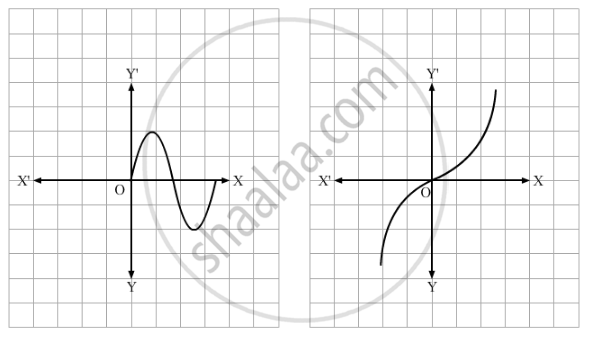
What is the range of the function
`f (x) = ([x - 1])/(x -1) ?`
If f : R → R be defined by f(x) = (3 − x3)1/3, then find fof (x).
Write the domain of the real function f defined by f(x) = `sqrt (25 -x^2)` [NCERT EXEMPLAR]
Let\[A = \left\{ x \in R : - 1 \leq x \leq 1 \right\} = \text{B and C} = \left\{ x \in R : x \geq 0 \right\} and\]\[S = \left\{ \left( x, y \right) \in A \times B : x^2 + y^2 = 1 \right\} \text{and } S_0 = \left\{ \left( x, y \right) \in A \times C : x^2 + y^2 = 1 \right\}\]
Then,
Which of the following functions form Z to itself are bijections?
The function f : [-1/2, 1/2, 1/2] → [-π /2,π/2], defined by f (x) = `sin^-1` (3x - `4x^3`), is
Which of the following functions from
\[A = \left\{ x \in R : - 1 \leq x \leq 1 \right\}\]
Let
\[A = \left\{ x \in R : x \leq 1 \right\} and f : A \to A\] be defined as
\[f\left( x \right) = x \left( 2 - x \right)\] Then,
\[f^{- 1} \left( x \right)\] is
Let \[f\left( x \right) = \frac{1}{1 - x} . \text{Then}, \left\{ f o \left( fof \right) \right\} \left( x \right)\]
Let
\[f : R \to R\] be given by \[f\left( x \right) = x^2 - 3\] Then, \[f^{- 1}\] is given by
Mark the correct alternative in the following question:
If the set A contains 5 elements and the set B contains 6 elements, then the number of one-one and onto mappings from A to B is
Write about strcmp() function.
If f: R → R is defined by f(x) = x2 – 3x + 2, write f(f (x))
Let C be the set of complex numbers. Prove that the mapping f: C → R given by f(z) = |z|, ∀ z ∈ C, is neither one-one nor onto.
Let A = {1, 2, 3, ...n} and B = {a, b}. Then the number of surjections from A into B is ______.
Let f : R → R be defind by f(x) = `1/"x" AA "x" in "R".` Then f is ____________.
Let f : R → R be a function defined by f(x) `= ("e"^abs"x" - "e"^-"x")/("e"^"x" + "e"^-"x")` then f(x) is
Let A = {1, 2, 3}, B = {4, 5, 6, 7} and let f = {(1, 4), (2, 5), (3, 6)} be a function from A to B. Based on the given information, f is best defined as:
An organization conducted a bike race under 2 different categories-boys and girls. Totally there were 250 participants. Among all of them finally, three from Category 1 and two from Category 2 were selected for the final race. Ravi forms two sets B and G with these participants for his college project. Let B = {b1,b2,b3} G={g1,g2} where B represents the set of boys selected and G the set of girls who were selected for the final race.
Ravi decides to explore these sets for various types of relations and functions.
- Let R: B → G be defined by R = { (b1,g1), (b2,g2),(b3,g1)}, then R is ____________.
Number of integral values of x satisfying the inequality `(3/4)^(6x + 10 - x^2) < 27/64` is ______.
A perfect one-to-one matching between users and unique IDs is similar to:
