Advertisements
Advertisements
Question
Show that the function f : R → {x ∈ R : –1 < x < 1} defined by f(x) = `x/(1 + |x|)`, x ∈ R is one-one and onto function.
Advertisements
Solution
It is given that f : R → {x ∈ R : –1 < x < 1} is defined as f(x) = `x/(1+ |x|)`, x ∈ R.
Suppose f(x) = f(y), where x, y ∈ R.
⇒ `x/(1 +| x|) = y/(1 - |y|)`
⇒ 2xy = x – y
⇒ `x/(1 + x) = y/(1 - y) `
⇒ x + xy = y + xy
⇒ x = y
Since x is positive and y is negative:
x > y
⇒ x − y > 0
But, 2xy is negative.
Then, 2xy ≠ x – y
Thus, the case of x being positive and y being negative can be ruled out.
Under a similar argument, x being negative and y being positive can also be ruled out
∴ x and y have to be either positive or negative.
When x and y are both positive, we have:
⇒ f(x) = f(y)
⇒ `x/(1 + |x|) = y/(1 - |y|) `
⇒ `x/(1 + x) = y/(1 + y)`
⇒ x + xy = y + xy
⇒ x = y
When x and y are both negative, we have:
f(x) = f(y)
⇒ `x/(1 - x) = y/(1 - y) `
⇒ x – xy = y – yx
⇒ x = y
∴ f is one-one.
Now, let y ∈ R such that –1 < y < 1.
If x is negative, then there exists x = `y/(1 + y) ∈ R` such that
`f(x) = f(y/(1 + y)) `
= `((y/(1 + y)))/(1+ |y/(1 + y)|)`
= `(y/(1 + y))/(1 + (-y)/(1 + y))`
= `y/(1 + y - y)`
= y
If x is positive, then there exists x = `y/(1 - y) ∈ R` such that
`f(x) = f(y/(1 - y)) = (y/(1 - y))/(1 + |(y/(1 - y))|)`
= `(y/(1 - y))/(1 + y/(1 - y))`
= `y/(1 - y + y)`
= y
∴ f is onto.
Hence, f is one-one and onto.
RELATED QUESTIONS
Show that the function f in `A=R-{2/3} ` defined as `f(x)=(4x+3)/(6x-4)` is one-one and onto hence find f-1
Check the injectivity and surjectivity of the following function:
f : Z → Z given by f(x) = x2
Let A = {1, 2, 3}, B = {4, 5, 6, 7} and let f = {(1, 4), (2, 5), (3, 6)} be a function from A to B. Show that f is one-one.
Let A = {–1, 0, 1, 2}, B = {–4, –2, 0, 2} and f, g : A → B be functions defined by f(x) = x2 – x, x ∈ A and g(x) = `2|x - 1/2| – 1`, x ∈ A. Are f and g equal?
Justify your answer. (Hint: One may note that two functions f : A → B and g : A → B such that f(a) = g(a) ∀ a ∈ A are called equal functions.)
Classify the following function as injection, surjection or bijection :
f : Z → Z, defined by f(x) = x − 5
Classify the following function as injection, surjection or bijection :
f : R → R, defined by f(x) = 1 + x2
Show that the logarithmic function f : R0+ → R given by f (x) loga x ,a> 0 is a bijection.
Find gof and fog when f : R → R and g : R → R is defined by f(x) = x and g(x) = |x| .
Find fog and gof if : f (x) = x2 g(x) = cos x .
Find fog and gof if : f (x) = x+1, g (x) = sin x .
Let f(x) = x2 + x + 1 and g(x) = sin x. Show that fog ≠ gof.
Let f be any real function and let g be a function given by g(x) = 2x. Prove that gof = f + f.
Find f −1 if it exists : f : A → B, where A = {0, −1, −3, 2}; B = {−9, −3, 0, 6} and f(x) = 3 x.
If A = {1, 2, 3, 4} and B = {a, b, c, d}, define any four bijections from A to B. Also give their inverse functions.
If f : A → A, g : A → A are two bijections, then prove that fog is a surjection ?
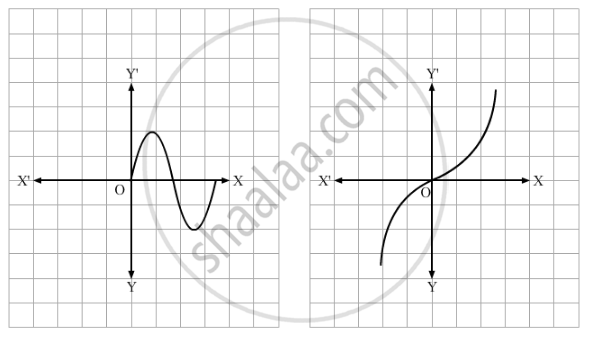
Which of the following graphs represents a one-one function?
Write the total number of one-one functions from set A = {1, 2, 3, 4} to set B = {a, b, c}.
Let \[f : \left[ - \frac{\pi}{2}, \frac{\pi}{2} \right] \to\] A be defined by f(x) = sin x. If f is a bijection, write set A.
Let f : R − {−1} → R − {1} be given by\[f\left( x \right) = \frac{x}{x + 1} . \text{Write } f^{- 1} \left( x \right)\]
If f : R → R be defined by f(x) = (3 − x3)1/3, then find fof (x).
The function f : R → R defined by
`f (x) = 2^x + 2^(|x|)` is
Let
\[A = \left\{ x \in R : x \geq 1 \right\}\] The inverse of the function,
\[f : A \to A\] given by
\[f\left( x \right) = 2^{x \left( x - 1 \right)} , is\]
If \[f : R \to R\] is given by \[f\left( x \right) = x^3 + 3, \text{then} f^{- 1} \left( x \right)\] is equal to
For sets A, B and C, let f: A → B, g: B → C be functions such that g o f is injective. Then both f and g are injective functions.
Are the following set of ordered pairs functions? If so, examine whether the mapping is injective or surjective.
{(x, y): x is a person, y is the mother of x}
Let C be the set of complex numbers. Prove that the mapping f: C → R given by f(z) = |z|, ∀ z ∈ C, is neither one-one nor onto.
Let X = {1, 2, 3}and Y = {4, 5}. Find whether the following subset of X ×Y are function from X to Y or not
h = {(1,4), (2, 5), (3, 5)}
If the set A contains 5 elements and the set B contains 6 elements, then the number of one-one and onto mappings from A to B is ______.
Let f: R → R be the functions defined by f(x) = x3 + 5. Then f–1(x) is ______.
The smallest integer function f(x) = [x] is ____________.
Let f : [0, ∞) → [0, 2] be defined by `"f" ("x") = (2"x")/(1 + "x"),` then f is ____________.
The domain of the function `cos^-1((2sin^-1(1/(4x^2-1)))/π)` is ______.
If f: R→R is a function defined by f(x) = `[x - 1]cos((2x - 1)/2)π`, where [ ] denotes the greatest integer function, then f is ______.
Let a function `f: N rightarrow N` be defined by
f(n) = `{:[(2n",", n = 2"," 4"," 6"," 8","......),(n - 1",", n = 3"," 7"," 11"," 15","......),((n + 1)/2",", n = 1"," 5"," 9"," 13","......):}`
then f is ______.
Let S = {1, 2, 3, 4, 5, 6, 7}. Then the number of possible functions f: S `rightarrow` S such that f(m.n) = f(m).f(n) for every m, n ∈ S and m.n ∈ S is equal to ______.
Which condition represents a one-one (injective) function?
Which condition represents an onto (surjective) function?
Which condition represents an into function?
