Advertisements
Advertisements
Question
Let f : R → R be the function defined by f(x) = 4x − 3 for all x ∈ R Then write f . [NCERT EXEMPLAR]
Advertisements
Solution
We have,
f : R → R is the function defined by f(x) = 4x −3 for all x ∈ R
\[y = 4x - 3\]
\[ \Rightarrow 4x = y + 3\]
\[ \Rightarrow x = \frac{y + 3}{4}\]
\[So, f^{- 1} \left( y \right) = \frac{y + 3}{4}\]
\[or, f^{- 1} \left( x \right) = \frac{x + 3}{4}\]
APPEARS IN
RELATED QUESTIONS
Prove that the greatest integer function f : R → R, given by f(x) = [x], is neither one-one nor onto, where [x] denotes the greatest integer less than or equal to x.
Show that the modulus function f : R → R, given by f(x) = |x|, is neither one-one nor onto, where |x| is x, if x is positive or 0 and |x| is –x, if x is negative.
Classify the following function as injection, surjection or bijection :
f : Q − {3} → Q, defined by `f (x) = (2x +3)/(x-3)`
Find gof and fog when f : R → R and g : R → R is defined by f(x) = x2 + 8 and g(x) = 3x3 + 1 .
if `f (x) = sqrt(1-x)` and g(x) = `log_e` x are two real functions, then describe functions fog and gof.
If f, g : R → R be two functions defined as f(x) = |x| + x and g(x) = |x|- x, ∀x∈R" .Then find fog and gof. Hence find fog(–3), fog(5) and gof (–2).
Find f −1 if it exists : f : A → B, where A = {1, 3, 5, 7, 9}; B = {0, 1, 9, 25, 49, 81} and f(x) = x2
If f : A → A, g : A → A are two bijections, then prove that fog is an injection ?
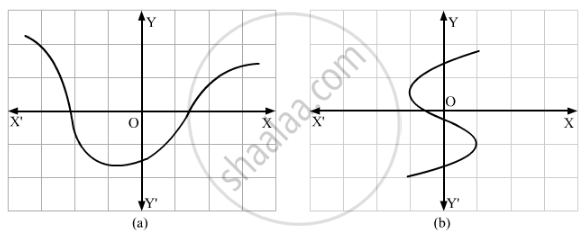
Which one of the following graphs represents a function?
Let \[f : \left( - \frac{\pi}{2}, \frac{\pi}{2} \right) \to R\] be a function defined by f(x) = cos [x]. Write range (f).
If f : R → R, g : R → are given by f(x) = (x + 1)2 and g(x) = x2 + 1, then write the value of fog (−3).
Write whether f : R → R, given by `f(x) = x + sqrtx^2` is one-one, many-one, onto or into.
If f : R → R be defined by f(x) = (3 − x3)1/3, then find fof (x).
Which one the following relations on A = {1, 2, 3} is a function?
f = {(1, 3), (2, 3), (3, 2)}, g = {(1, 2), (1, 3), (3, 1)} [NCERT EXEMPLAR]
The function
\[f : R \to R\] defined by\[f\left( x \right) = \left( x - 1 \right) \left( x - 2 \right) \left( x - 3 \right)\]
(a) one-one but not onto
(b) onto but not one-one
(c) both one and onto
(d) neither one-one nor onto
The function f : [-1/2, 1/2, 1/2] → [-π /2,π/2], defined by f (x) = `sin^-1` (3x - `4x^3`), is
Let
\[f : R - \left\{ n \right\} \to R\]
The function
A function f: R→ R defined by f(x) = `(3x) /5 + 2`, x ∈ R. Show that f is one-one and onto. Hence find f−1.
Let f, g: R → R be two functions defined as f(x) = |x| + x and g(x) = x – x ∀ x ∈ R. Then, find f o g and g o f
The domain of the function f: R → R defined by f(x) = `sqrt(x^2 - 3x + 2)` is ______
Let A be a finite set. Then, each injective function from A into itself is not surjective.
For sets A, B and C, let f: A → B, g: B → C be functions such that g o f is surjective. Then g is surjective.
If f: R → R is defined by f(x) = x2 – 3x + 2, write f(f (x))
Let X = {1, 2, 3}and Y = {4, 5}. Find whether the following subset of X ×Y are function from X to Y or not
f = {(1, 4), (1, 5), (2, 4), (3, 5)}
Let X = {1, 2, 3}and Y = {4, 5}. Find whether the following subset of X ×Y are function from X to Y or not
h = {(1,4), (2, 5), (3, 5)}
Let A = [–1, 1]. Then, discuss whether the following functions defined on A are one-one, onto or bijective:
g(x) = |x|
Let f: R – `{3/5}` → R be defined by f(x) = `(3x + 2)/(5x - 3)`. Then ______.
Let f: `[2, oo)` → R be the function defined by f(x) = x2 – 4x + 5, then the range of f is ______.
Let f: R → R be given by f(x) = tan x. Then f–1(1) is ______.
Let X = {-1, 0, 1}, Y = {0, 2} and a function f : X → Y defiend by y = 2x4, is ____________.
The domain of the function `"f"("x") = 1/(sqrt ({"sin x"} + {"sin" ( pi + "x")}))` where {.} denotes fractional part, is
If f; R → R f(x) = 10x + 3 then f–1(x) is:
If log102 = 0.3010.log103 = 0.4771 then the number of ciphers after decimal before a significant figure comes in `(5/3)^-100` is ______.
The solution set of the inequation log1/3(x2 + x + 1) + 1 > 0 is ______.
`x^(log_5x) > 5` implies ______.

The given function f : R → R is not ‘onto’ function. Give reason.
A function is a rule that assigns each element of one set to exactly how many elements of another set?
A function is called one-one if different elements of the domain have:
