Advertisements
Advertisements
Question
Set of ordered pair of a function ? If so, examine whether the mapping is injective or surjective :{(a, b) : a is a person, b is an ancestor of a}
Advertisements
Solution
g = {(a, b) : a is a person, b is an ancestor of a}
Since, the ordered map (a, b) does not map 'a' - a person to a living person.
So, g is not a function.
APPEARS IN
RELATED QUESTIONS
Let A and B be sets. Show that f : A × B → B × A such that f(a, b) = (b, a) is bijective function.
Find the number of all onto functions from the set {1, 2, 3, ..., n} to itself.
Classify the following function as injection, surjection or bijection : f : Z → Z given by f(x) = x2
Classify the following function as injection, surjection or bijection :
f : R → R, defined by f(x) = sinx
Classify the following function as injection, surjection or bijection :
f : R → R, defined by f(x) = 5x3 + 4
Show that the function f : R − {3} → R − {2} given by f(x) = `(x-2)/(x-3)` is a bijection.
Find gof and fog when f : R → R and g : R → R is defined by f(x) = x and g(x) = |x| .
If f, g : R → R be two functions defined as f(x) = |x| + x and g(x) = |x|- x, ∀x∈R" .Then find fog and gof. Hence find fog(–3), fog(5) and gof (–2).
Which one of the following graphs represents a function?
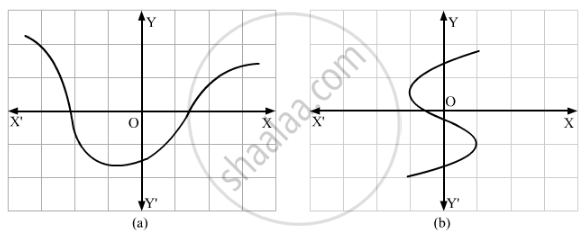
If A = {a, b, c} and B = {−2, −1, 0, 1, 2}, write the total number of one-one functions from A to B.
Let C denote the set of all complex numbers. A function f : C → C is defined by f(x) = x3. Write f−1(1).
If f : R → R defined by f(x) = 3x − 4 is invertible, then write f−1 (x).
Let `f : R - {- 3/5}` → R be a function defined as `f (x) = (2x)/(5x +3).`
f-1 : Range of f → `R -{-3/5}`.
Let f : R → R be defined as `f (x) = (2x - 3)/4.` write fo f-1 (1) .
Let A = {1, 2, 3, 4} and B = {a, b} be two sets. Write the total number of onto functions from A to B.
If f(x) = x + 7 and g(x) = x − 7, x ∈ R, write fog (7).
If f : R → R be defined by f(x) = (3 − x3)1/3, then find fof (x).
If f(x) = 4 −( x - 7)3 then write f-1 (x).
Which of the following functions from
to itself are bijections?
The function
\[f : R \to R\] defined by\[f\left( x \right) = \left( x - 1 \right) \left( x - 2 \right) \left( x - 3 \right)\]
(a) one-one but not onto
(b) onto but not one-one
(c) both one and onto
(d) neither one-one nor onto
Let
\[f : R - \left\{ n \right\} \to R\]
The function
Let \[f\left( x \right) = x^2 and g\left( x \right) = 2^x\] Then, the solution set of the equation
If \[f : R \to \left( - 1, 1 \right)\] is defined by
\[f\left( x \right) = \frac{- x|x|}{1 + x^2}, \text{ then } f^{- 1} \left( x \right)\] equals
Let [x] denote the greatest integer less than or equal to x. If \[f\left( x \right) = \sin^{- 1} x, g\left( x \right) = \left[ x^2 \right]\text{ and } h\left( x \right) = 2x, \frac{1}{2} \leq x \leq \frac{1}{\sqrt{2}}\]
If \[g\left( x \right) = x^2 + x - 2\text{ and} \frac{1}{2} gof\left( x \right) = 2 x^2 - 5x + 2\] is equal to
Write about strlen() function.
Let f: R → R be the function defined by f(x) = 2x – 3 ∀ x ∈ R. write f–1
If f: R → R is defined by f(x) = x2 – 3x + 2, write f(f (x))
Let X = {1, 2, 3}and Y = {4, 5}. Find whether the following subset of X ×Y are function from X to Y or not
h = {(1,4), (2, 5), (3, 5)}
Using the definition, prove that the function f: A→ B is invertible if and only if f is both one-one and onto
Let f: R → R be defined by f(x) = `1/x` ∀ x ∈ R. Then f is ______.
The function f : R → R defined by f(x) = 3 – 4x is ____________.
The number of bijective functions from set A to itself when A contains 106 elements is ____________.
Which of the following functions from Z into Z is bijective?
The function f : R → R given by f(x) = x3 – 1 is ____________.
Write the domain and range (principle value branch) of the following functions:
f(x) = tan–1 x.
Which condition represents a one-one (injective) function?
