Advertisements
Advertisements
Question
Are the following set of ordered pairs functions? If so, examine whether the mapping is injective or surjective.
{(a, b): a is a person, b is an ancestor of a}
Advertisements
Solution
Given, {(a, b): a is a person, b is an ancestor of a}
It’s clearly seen that any person ‘a’ has more than one ancestors.
Thus, it does not represent a function.
APPEARS IN
RELATED QUESTIONS
Let A and B be sets. Show that f : A × B → B × A such that f(a, b) = (b, a) is bijective function.
Find the number of all onto functions from the set {1, 2, 3, ..., n} to itself.
Let S = {a, b, c} and T = {1, 2, 3}. Find F−1 of the following functions F from S to T, if it exists.
F = {(a, 3), (b, 2), (c, 1)}
Give an example of a function which is one-one but not onto ?
Give an example of a function which is neither one-one nor onto ?
Which of the following functions from A to B are one-one and onto?
f2 = {(2, a), (3, b), (4, c)} ; A = {2, 3, 4}, B = {a, b, c}
Classify the following function as injection, surjection or bijection : f : N → N given by f(x) = x2
Classify the following function as injection, surjection or bijection :
f : Q → Q, defined by f(x) = x3 + 1
Set of ordered pair of a function ? If so, examine whether the mapping is injective or surjective :{(a, b) : a is a person, b is an ancestor of a}
If f : R → R be the function defined by f(x) = 4x3 + 7, show that f is a bijection.
If A = {1, 2, 3}, show that a one-one function f : A → A must be onto.
Let f = {(3, 1), (9, 3), (12, 4)} and g = {(1, 3), (3, 3) (4, 9) (5, 9)}. Show that gof and fog are both defined. Also, find fog and gof.
Let f : R → R and g : R → R be defined by f(x) = x + 1 and g (x) = x − 1. Show that fog = gof = IR.
If f : A → B and g : B → C are onto functions, show that gof is a onto function.
If f(x) = 2x + 5 and g(x) = x2 + 1 be two real functions, then describe each of the following functions:
(1) fog
(2) gof
(3) fof
(4) f2
Also, show that fof ≠ f2
Show that the function f : Q → Q, defined by f(x) = 3x + 5, is invertible. Also, find f−1
Consider f : R+ → [−5, ∞) given by f(x) = 9x2 + 6x − 5. Show that f is invertible with `f^-1 (x) = (sqrt (x +6)-1)/3 .`
Let A and B be two sets, each with a finite number of elements. Assume that there is an injective map from A to B and that there is an injective map from B to A. Prove that there is a bijection from A to B.
Which one of the following graphs represents a function?
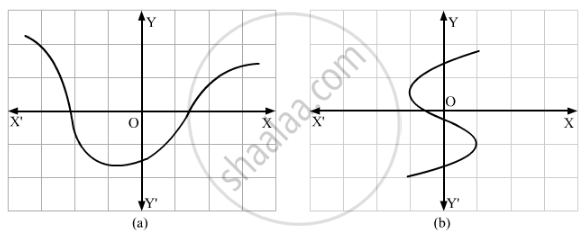
If f : C → C is defined by f(x) = x4, write f−1 (1).
Write whether f : R → R, given by `f(x) = x + sqrtx^2` is one-one, many-one, onto or into.
If f : R → R be defined by f(x) = (3 − x3)1/3, then find fof (x).
If f(x) = 4 −( x - 7)3 then write f-1 (x).
\[f : A \to \text{B given by } 3^{ f\left( x \right)} + 2^{- x} = 4\] is a bijection, then
The function \[f : [0, \infty ) \to \text {R given by } f\left( x \right) = \frac{x}{x + 1} is\]
\[f : R \to R\] is defined by
\[f\left( x \right) = \frac{e^{x^2} - e^{- x^2}}{e^{x^2 + e^{- x^2}}} is\]
Which of the following functions from
\[A = \left\{ x \in R : - 1 \leq x \leq 1 \right\}\]
Let [x] denote the greatest integer less than or equal to x. If \[f\left( x \right) = \sin^{- 1} x, g\left( x \right) = \left[ x^2 \right]\text{ and } h\left( x \right) = 2x, \frac{1}{2} \leq x \leq \frac{1}{\sqrt{2}}\]
Let \[f\left(x\right) = x^3\] be a function with domain {0, 1, 2, 3}. Then domain of \[f^{-1}\] is ______.
Set A has 3 elements and the set B has 4 elements. Then the number of injective mappings that can be defined from A to B is ______.
Let f : R `->` R be a function defined by f(x) = x3 + 4, then f is ______.
Sherlin and Danju are playing Ludo at home during Covid-19. While rolling the dice, Sherlin’s sister Raji observed and noted the possible outcomes of the throw every time belongs to set {1,2,3,4,5,6}. Let A be the set of players while B be the set of all possible outcomes.
A = {S, D}, B = {1,2,3,4,5,6}
- Raji wants to know the number of functions from A to B. How many number of functions are possible?
Raji visited the Exhibition along with her family. The Exhibition had a huge swing, which attracted many children. Raji found that the swing traced the path of a Parabola as given by y = x2.
Answer the following questions using the above information.
- Let : N → R be defined by f(x) = x2. Range of the function among the following is ____________.
If f: R → R given by f(x) =(3 − x3)1/3, find f0f(x)
A function f: x → y is said to be one – one (or injective) if:
`x^(log_5x) > 5` implies ______.
A function is called bijective if it is both:
If every seat in a classroom is occupied by one student, the situation resembles:
