Advertisements
Advertisements
Question
If \[F : [1, \infty ) \to [2, \infty )\] is given by
\[f\left( x \right) = x + \frac{1}{x}, then f^{- 1} \left( x \right)\]
Options
\[\frac{x + \sqrt{x^2 - 4}}{2}\]
\[\frac{x}{1 + x^2}\]
\[\frac{x - \sqrt{x^2 - 4}}{2}\]
\[1 + \sqrt{x^2 - 4}\]
Advertisements
Solution
\[\text{Let } f^{- 1} \left( x \right) = y\]
\[ \Rightarrow f\left( y \right) = x\]
\[ \Rightarrow y + \frac{1}{y} = x\]
\[ \Rightarrow y^2 + 1 = xy\]
\[ \Rightarrow y^2 - xy + 1 = 0\]
\[ \Rightarrow y^2 - 2 \times y \times \frac{x}{2} + \left( \frac{x}{2} \right)^2 - \left( \frac{x}{2} \right)^2 + 1 = 0\]
\[ \Rightarrow y^2 - 2 \times y \times \frac{x}{2} + \left( \frac{x}{2} \right)^2 = \frac{x^2 - 1}{4}\]
\[ \Rightarrow \left( y - \frac{x}{2} \right)^2 = \frac{x^2 - 1}{4}\]
\[ \Rightarrow y - \frac{x}{2} = \frac{\sqrt{x^2 - 4}}{2}\]
\[ \Rightarrow y = \frac{x}{2} + \frac{\sqrt{x^2 - 4}}{2}\]
\[ \Rightarrow y = \frac{x + \sqrt{x^2 - 4}}{2}\]
\[ \Rightarrow f^{- 1} \left( x \right) = \frac{x + \sqrt{x^2 - 4}}{2}\]
So, the answer is (a) .
APPEARS IN
RELATED QUESTIONS
Show that the function f : R → R given by f(x) = x3 is injective.
Classify the following function as injection, surjection or bijection :
f : R → R, defined by f(x) = sinx
Classify the following function as injection, surjection or bijection :
f : R → R, defined by f(x) = x3 + 1
Let A = {1, 2, 3}. Write all one-one from A to itself.
If f : R → R be the function defined by f(x) = 4x3 + 7, show that f is a bijection.
Show that the exponential function f : R → R, given by f(x) = ex, is one-one but not onto. What happens if the co-domain is replaced by`R0^+` (set of all positive real numbers)?
Let f = {(3, 1), (9, 3), (12, 4)} and g = {(1, 3), (3, 3) (4, 9) (5, 9)}. Show that gof and fog are both defined. Also, find fog and gof.
If f(x) = |x|, prove that fof = f.
` if f : (-π/2 , π/2)` → R and g : [−1, 1]→ R be defined as f(x) = tan x and g(x) = `sqrt(1 - x^2)` respectively, describe fog and gof.
Let f : R `{- 4/3} `- 43 →">→ R be a function defined as f(x) = `(4x)/(3x +4)` . Show that f : R - `{-4/3}`→ Rang (f) is one-one and onto. Hence, find f -1.
If f : R → (−1, 1) defined by `f (x) = (10^x- 10^-x)/(10^x + 10 ^-x)` is invertible, find f−1.
If A = {1, 2, 3, 4} and B = {a, b, c, d}, define any four bijections from A to B. Also give their inverse functions.
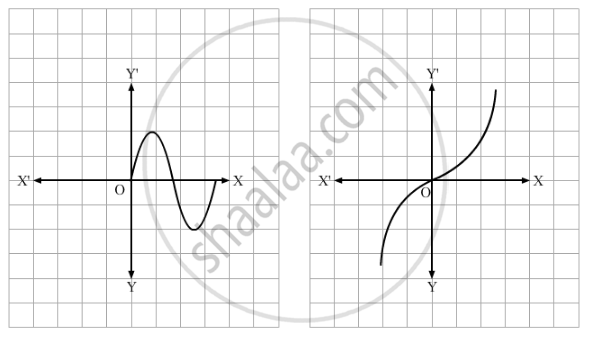
Which of the following graphs represents a one-one function?
Let A = {1, 2, 3}, B = {4, 5, 6, 7} and let f = {(1, 4), (2, 5), (3, 6)} be a function from A to B. State whether f is one-one or not.
Let f : R → R be the function defined by f(x) = 4x − 3 for all x ∈ R Then write f . [NCERT EXEMPLAR]
Which one the following relations on A = {1, 2, 3} is a function?
f = {(1, 3), (2, 3), (3, 2)}, g = {(1, 2), (1, 3), (3, 1)} [NCERT EXEMPLAR]
If the mapping f : {1, 3, 4} → {1, 2, 5} and g : {1, 2, 5} → {1, 3}, given by f = {(1, 2), (3, 5), (4, 1)} and g = {(2, 3), (5, 1), (1, 3)}, then write fog. [NCERT EXEMPLAR]
Let
\[A = \left\{ x \in R : - 1 \leq x \leq 1 \right\} = B\] Then, the mapping\[f : A \to \text{B given by} f\left( x \right) = x\left| x \right|\] is
Let
\[f : R \to R\] be a function defined by
Let \[f\left( x \right) = \frac{1}{1 - x} . \text{Then}, \left\{ f o \left( fof \right) \right\} \left( x \right)\]
Mark the correct alternative in the following question:
Let f : R→ R be defined as, f(x) = \[\begin{cases}2x, if x > 3 \\ x^2 , if 1 < x \leq 3 \\ 3x, if x \leq 1\end{cases}\]
Then, find f( \[-\]1) + f(2) + f(4)
If f(x) = `(x+3)/(4x−5) , "g"(x) = (3+5x)/(4x−1)` then verify that `("fog") (x)` = x.
Write about strcmp() function.
Let R be the set of real numbers and f: R → R be the function defined by f(x) = 4x + 5. Show that f is invertible and find f–1.
For sets A, B and C, let f: A → B, g: B → C be functions such that g o f is injective. Then both f and g are injective functions.
Let f: R – `{3/5}` → R be defined by f(x) = `(3x + 2)/(5x - 3)`. Then ______.
Let g(x) = x2 – 4x – 5, then ____________.
An organization conducted a bike race under 2 different categories-boys and girls. Totally there were 250 participants. Among all of them finally, three from Category 1 and two from Category 2 were selected for the final race. Ravi forms two sets B and G with these participants for his college project. Let B = {b1,b2,b3} G={g1,g2} where B represents the set of boys selected and G the set of girls who were selected for the final race.
Ravi decides to explore these sets for various types of relations and functions.
- Let R: B → G be defined by R = { (b1,g1), (b2,g2),(b3,g1)}, then R is ____________.
Function f: R → R, defined by f(x) = `x/(x^2 + 1)` ∀ x ∈ R is not
The domain of the function `cos^-1((2sin^-1(1/(4x^2-1)))/π)` is ______.
Let [x] denote the greatest integer ≤ x, where x ∈ R. If the domain of the real valued function f(x) = `sqrt((|[x]| - 2)/(|[x]| - 3)` is (–∞, a) ∪ [b, c) ∪ [4, ∞), a < b < c, then the value of a + b + c is ______.
Let f(1, 3) `rightarrow` R be a function defined by f(x) = `(x[x])/(1 + x^2)`, where [x] denotes the greatest integer ≤ x, Then the range of f is ______.
A function f : [– 4, 4] `rightarrow` [0, 4] is given by f(x) = `sqrt(16 - x^2)`. Show that f is an onto function but not a one-one function. Further, find all possible values of 'a' for which f(a) = `sqrt(7)`.
The function \(f:\mathbb{N}\to\mathbb{N}\) defined by \(f(x)=5x\) is:
Let \(X=\{-1,2,5,8,11\}\), \(Y=\{4,6,8\}\), and suppose different elements \(2,5,8\) of \(X\) have the same image \(4\). What type of function is it with respect to the one-one property?
For \(f:\mathbb{R}\to\mathbb{R}\) defined by \(f(x)=1+x^2\), which statement is correct?
A perfect one-to-one matching between users and unique IDs is similar to:
Which condition represents a many-one function?
