Advertisements
Advertisements
प्रश्न
If \[F : [1, \infty ) \to [2, \infty )\] is given by
\[f\left( x \right) = x + \frac{1}{x}, then f^{- 1} \left( x \right)\]
विकल्प
\[\frac{x + \sqrt{x^2 - 4}}{2}\]
\[\frac{x}{1 + x^2}\]
\[\frac{x - \sqrt{x^2 - 4}}{2}\]
\[1 + \sqrt{x^2 - 4}\]
Advertisements
उत्तर
\[\text{Let } f^{- 1} \left( x \right) = y\]
\[ \Rightarrow f\left( y \right) = x\]
\[ \Rightarrow y + \frac{1}{y} = x\]
\[ \Rightarrow y^2 + 1 = xy\]
\[ \Rightarrow y^2 - xy + 1 = 0\]
\[ \Rightarrow y^2 - 2 \times y \times \frac{x}{2} + \left( \frac{x}{2} \right)^2 - \left( \frac{x}{2} \right)^2 + 1 = 0\]
\[ \Rightarrow y^2 - 2 \times y \times \frac{x}{2} + \left( \frac{x}{2} \right)^2 = \frac{x^2 - 1}{4}\]
\[ \Rightarrow \left( y - \frac{x}{2} \right)^2 = \frac{x^2 - 1}{4}\]
\[ \Rightarrow y - \frac{x}{2} = \frac{\sqrt{x^2 - 4}}{2}\]
\[ \Rightarrow y = \frac{x}{2} + \frac{\sqrt{x^2 - 4}}{2}\]
\[ \Rightarrow y = \frac{x + \sqrt{x^2 - 4}}{2}\]
\[ \Rightarrow f^{- 1} \left( x \right) = \frac{x + \sqrt{x^2 - 4}}{2}\]
So, the answer is (a) .
APPEARS IN
संबंधित प्रश्न
Check the injectivity and surjectivity of the following function:
f : Z → Z given by f(x) = x3
Prove that the greatest integer function f : R → R, given by f(x) = [x], is neither one-one nor onto, where [x] denotes the greatest integer less than or equal to x.
Let A = {−1, 0, 1} and f = {(x, x2) : x ∈ A}. Show that f : A → A is neither one-one nor onto.
Classify the following function as injection, surjection or bijection : f : N → N given by f(x) = x2
Classify the following function as injection, surjection or bijection : f : N → N given by f(x) = x3
Show that the exponential function f : R → R, given by f(x) = ex, is one-one but not onto. What happens if the co-domain is replaced by`R0^+` (set of all positive real numbers)?
Show that if f1 and f2 are one-one maps from R to R, then the product f1 × f2 : R → R defined by (f1 × f2) (x) = f1 (x) f2 (x) need not be one - one.
Verify associativity for the following three mappings : f : N → Z0 (the set of non-zero integers), g : Z0 → Q and h : Q → R given by f(x) = 2x, g(x) = 1/x and h(x) = ex.
Find fog and gof if : f(x) = `x^2` + 2 , g (x) = 1 − `1/ (1-x)`.
Let f, g, h be real functions given by f(x) = sin x, g (x) = 2x and h (x) = cos x. Prove that fog = go (fh).
If f : R → R be defined by f(x) = x3 −3, then prove that f−1 exists and find a formula for f−1. Hence, find f−1(24) and f−1 (5).
Let A = {x &epsis; R | −1 ≤ x ≤ 1} and let f : A → A, g : A → A be two functions defined by f(x) = x2 and g(x) = sin (π x/2). Show that g−1 exists but f−1 does not exist. Also, find g−1.
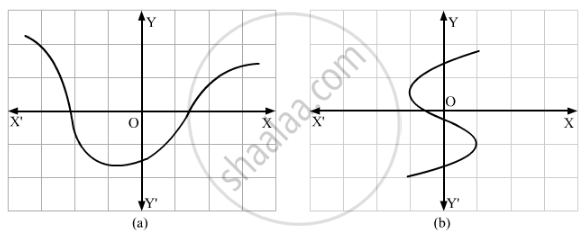
Which one of the following graphs represents a function?
Let\[A = \left\{ x \in R : - 1 \leq x \leq 1 \right\} = \text{B and C} = \left\{ x \in R : x \geq 0 \right\} and\]\[S = \left\{ \left( x, y \right) \in A \times B : x^2 + y^2 = 1 \right\} \text{and } S_0 = \left\{ \left( x, y \right) \in A \times C : x^2 + y^2 = 1 \right\}\]
Then,
The range of the function
\[f\left( x \right) =^{7 - x} P_{x - 3}\]
Which of the following functions from
to itself are bijections?
Let
\[A = \left\{ x : - 1 \leq x \leq 1 \right\} \text{and} f : A \to \text{A such that f}\left( x \right) = x|x|\]
If the function\[f : R \to \text{A given by} f\left( x \right) = \frac{x^2}{x^2 + 1}\] is a surjection, then A =
Let \[f\left( x \right) = \frac{1}{1 - x} . \text{Then}, \left\{ f o \left( fof \right) \right\} \left( x \right)\]
Mark the correct alternative in the following question:
If the set A contains 7 elements and the set B contains 10 elements, then the number one-one functions from A to B is
Let A = R − (2) and B = R − (1). If f: A ⟶ B is a function defined by`"f(x)"=("x"-1)/("x"-2),` how that f is one-one and onto. Hence, find f−1.
Let f: R → R be defined by f(x) = x2 + 1. Then, pre-images of 17 and – 3, respectively, are ______.
For sets A, B and C, let f: A → B, g: B → C be functions such that g o f is injective. Then both f and g are injective functions.
Let D be the domain of the real valued function f defined by f(x) = `sqrt(25 - x^2)`. Then, write D
Are the following set of ordered pairs functions? If so, examine whether the mapping is injective or surjective.
{(x, y): x is a person, y is the mother of x}
Let f: R → R be defined by f(x) = `1/x` ∀ x ∈ R. Then f is ______.
Let f: R – `{3/5}` → R be defined by f(x) = `(3x + 2)/(5x - 3)`. Then ______.
Let f: R → R be given by f(x) = tan x. Then f–1(1) is ______.
If f(x) = (4 – (x – 7)3}, then f–1(x) = ______.
Let f : R → R be defind by f(x) = `1/"x" AA "x" in "R".` Then f is ____________.
The function f: R → R defined as f(x) = x3 is:
A general election of Lok Sabha is a gigantic exercise. About 911 million people were eligible to vote and voter turnout was about 67%, the highest ever

Let I be the set of all citizens of India who were eligible to exercise their voting right in the general election held in 2019. A relation ‘R’ is defined on I as follows:
R = {(V1, V2) ∶ V1, V2 ∈ I and both use their voting right in the general election - 2019}
- Mr. ’X’ and his wife ‘W’ both exercised their voting right in the general election-2019, Which of the following is true?
Raji visited the Exhibition along with her family. The Exhibition had a huge swing, which attracted many children. Raji found that the swing traced the path of a Parabola as given by y = x2.
Answer the following questions using the above information.
- Let f: {1,2,3,....} → {1,4,9,....} be defined by f(x) = x2 is ____________.
'If 'f' is a linear function satisfying f[x + f(x)] = x + f(x), then f(5) can be equal to:
The trigonometric equation tan–1x = 3tan–1 a has solution for ______.

The given function f : R → R is not ‘onto’ function. Give reason.
A function is onto when every element of the codomain has:
For \(f:\mathbb{R}\to\mathbb{R}\) defined by \(f(x)=1+x^2\), which statement is correct?
If every seat in a classroom is occupied by one student, the situation resembles:
