Advertisements
Advertisements
प्रश्न
A function f : [– 4, 4] `rightarrow` [0, 4] is given by f(x) = `sqrt(16 - x^2)`. Show that f is an onto function but not a one-one function. Further, find all possible values of 'a' for which f(a) = `sqrt(7)`.
Advertisements
उत्तर
We have, f : [– 4, 4] `rightarrow` [0, 4] defined as f(x) = `sqrt(16 - x^2)`
(i) One-One
f(x1) = f(x2)
`\implies sqrt(16 - x_1^2) = sqrt(16 - x_2^2)`
`\implies 16 - x_1^2 = 16 - x_2^2`
`\implies x_1^2 = x_2^2`
`\implies x_1^2 - x_2^2` = 0
`\implies` (x1 + x2) (x1 – x2) = 0
Here, x1 + x2 = 0 is also possible.
As if x1 = 4 and x2 = – 4.
Then, x1 + x2 = 0 is also possible.
∴ x1 = – x2
But for one-one,
x1 = – x2
so, f(x) is not one-one.
(ii) Onto
Let, y = `sqrt(16 - x^2)`
`\implies` y2 = 16 – x2
`\implies` x2 = 16 – y2
`\implies` x = `sqrt(16 - y^2) ∈ [0, 4]`
So, f(x) is onto.
For f(a) = `sqrt(7)`, we have
f(a) = `sqrt(16 - a^2)`
`\implies sqrt(7) = sqrt(16 - a^2)`
On equating both sides
`\implies` 7 = 16 – a2
`\implies` a2 =16 – 7
`\implies` a2 = 9
`\implies` a = ± 3
Hence, possible values of a are 3 and – 3.
संबंधित प्रश्न
Let A and B be sets. Show that f : A × B → B × A such that f(a, b) = (b, a) is bijective function.
Give an example of a function which is neither one-one nor onto ?
Classify the following function as injection, surjection or bijection :
f : R → R, defined by f(x) = |x|
Let A = [-1, 1]. Then, discuss whether the following functions from A to itself is one-one, onto or bijective : h(x) = x2
If A = {1, 2, 3}, show that a one-one function f : A → A must be onto.
Give examples of two one-one functions f1 and f2 from R to R, such that f1 + f2 : R → R. defined by (f1 + f2) (x) = f1 (x) + f2 (x) is not one-one.
Show that if f1 and f2 are one-one maps from R to R, then the product f1 × f2 : R → R defined by (f1 × f2) (x) = f1 (x) f2 (x) need not be one - one.
If f, g : R → R be two functions defined as f(x) = |x| + x and g(x) = |x|- x, ∀x∈R" .Then find fog and gof. Hence find fog(–3), fog(5) and gof (–2).
State with reason whether the following functions have inverse:
h : {2, 3, 4, 5} → {7, 9, 11, 13} with h = {(2, 7), (3, 9), (4, 11), (5, 13)}
Let A = {1, 2, 3, 4}; B = {3, 5, 7, 9}; C = {7, 23, 47, 79} and f : A → B, g : B → C be defined as f(x) = 2x + 1 and g(x) = x2 − 2. Express (gof)−1 and f−1 og−1 as the sets of ordered pairs and verify that (gof)−1 = f−1 og−1.
Which one of the following graphs represents a function?
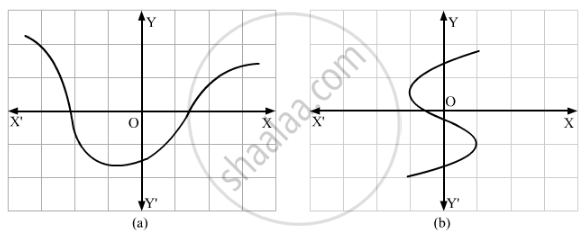
Let A = {1, 2, 3}, B = {4, 5, 6, 7} and let f = {(1, 4), (2, 5), (3, 6)} be a function from A to B. State whether f is one-one or not.
A function f from the set of natural numbers to integers defined by
`{([n-1]/2," when n is odd" is ),(-n/2,when n is even ) :}`
Which of the following functions from
to itself are bijections?
The function
\[f : R \to R\] defined by\[f\left( x \right) = \left( x - 1 \right) \left( x - 2 \right) \left( x - 3 \right)\]
(a) one-one but not onto
(b) onto but not one-one
(c) both one and onto
(d) neither one-one nor onto
\[f : Z \to Z\] be given by
` f (x) = {(x/2, ", if x is even" ) ,(0 , ", if x is odd "):}`
Then, f is
Let \[f\left( x \right) = x^2 and g\left( x \right) = 2^x\] Then, the solution set of the equation
If \[f\left( x \right) = \sin^2 x\] and the composite function \[g\left( f\left( x \right) \right) = \left| \sin x \right|\] then g(x) is equal to
Show that the function f: R → R defined by f(x) = `x/(x^2 + 1)`, ∀ ∈ + R , is neither one-one nor onto
For sets A, B and C, let f: A → B, g: B → C be functions such that g o f is injective. Then both f and g are injective functions.
Let X = {1, 2, 3}and Y = {4, 5}. Find whether the following subset of X ×Y are function from X to Y or not
g = {(1, 4), (2, 4), (3, 4)}
Let A = {0, 1} and N be the set of natural numbers. Then the mapping f: N → A defined by f(2n – 1) = 0, f(2n) = 1, ∀ n ∈ N, is onto.
The function f : R → R given by f(x) = x3 – 1 is ____________.
Let n(A) = 4 and n(B) = 6, Then the number of one – one functions from 'A' to 'B' is:
Let the function f: R → R be defined by f(x) = 4x – 1, ∀ x ∈ R then 'f' is
The domain of the function `cos^-1((2sin^-1(1/(4x^2-1)))/π)` is ______.
Let f: R→R be a polynomial function satisfying f(x + y) = f(x) + f(y) + 3xy(x + y) –1 ∀ x, y ∈ R and f'(0) = 1, then `lim_(x→∞)(f(2x))/(f(x)` is equal to ______.
Let f(x) = ax (a > 0) be written as f(x) = f1(x) + f2(x), where f1(x) is an even function and f2(x) is an odd function. Then f1(x + y) + f1(x – y) equals ______.
ASSERTION (A): The relation f : {1, 2, 3, 4} `rightarrow` {x, y, z, p} defined by f = {(1, x), (2, y), (3, z)} is a bijective function.
REASON (R): The function f : {1, 2, 3} `rightarrow` {x, y, z, p} such that f = {(1, x), (2, y), (3, z)} is one-one.
If every seat in a classroom is occupied by one student, the situation resembles:
