Advertisements
Advertisements
Question
if `f (x) = sqrt(1-x)` and g(x) = `log_e` x are two real functions, then describe functions fog and gof.
Advertisements
Solution
`f (x) = sqrt(1-x)`
For domain, 1-x≥0
⇒ x≤1
⇒ domain of f = (−∞, 1]
⇒ f : (−∞, 1] → (0,∞)
g(x) = loge x
Clearly, g : (0, ∞) → R
Computation of fog :
Clearly, the range of g is not a subset of the domain of f.
So,we need to compute the domain of fog.
⇒ Domain (fog) = {x : x ∈ Domain (g) and g(x) ∈ Domain of f}
⇒ Domain (fog) = {x: x ∈ (0, ∞) and loge x ∈ (−∞, 1]}
⇒ Domain (fog) = { x: x ∈ (0, ∞) and x ∈ (0, e] }
⇒ Domain (fog)= {x : x ∈ (0, e]}
⇒ Domain (fog )= (0, e]
⇒ fog : (0, e) → R
So, (fog) (x) = f (g (x))
= f (loge x)
= `sqrt( 1-log_e x)`
Computation of gof:Clearly, the range of f is a subset of the domain of g.
⇒ gof : (−∞,1] → R
⇒ (gof) (x) = g (f (x))
= `g (sqrt(1-x))`
= `log_e sqrt (1 - x)`
= `log_e (1 - x)^(1/2)`
= `1/2 log_e (1-x)`
APPEARS IN
RELATED QUESTIONS
Give examples of two functions f: N → Z and g: Z → Z such that g o f is injective but gis not injective.
(Hint: Consider f(x) = x and g(x) =|x|)
Let A = {–1, 0, 1, 2}, B = {–4, –2, 0, 2} and f, g : A → B be functions defined by f(x) = x2 – x, x ∈ A and g(x) = `2|x - 1/2| – 1`, x ∈ A. Are f and g equal?
Justify your answer. (Hint: One may note that two functions f : A → B and g : A → B such that f(a) = g(a) ∀ a ∈ A are called equal functions.)
Let A = {−1, 0, 1} and f = {(x, x2) : x ∈ A}. Show that f : A → A is neither one-one nor onto.
Classify the following function as injection, surjection or bijection :
f : R → R, defined by f(x) = sin2x + cos2x
If A = {1, 2, 3}, show that a onto function f : A → A must be one-one.
Find the number of all onto functions from the set A = {1, 2, 3, ..., n} to itself.
Let f : R → R and g : R → R be defined by f(x) = x + 1 and g (x) = x − 1. Show that fog = gof = IR.
Let f be a real function given by f (x)=`sqrt (x-2)`
Find each of the following:
(i) fof
(ii) fofof
(iii) (fofof) (38)
(iv) f2
Also, show that fof ≠ `f^2` .
State with reason whether the following functions have inverse :
f : {1, 2, 3, 4} → {10} with f = {(1, 10), (2, 10), (3, 10), (4, 10)}
Find f −1 if it exists : f : A → B, where A = {1, 3, 5, 7, 9}; B = {0, 1, 9, 25, 49, 81} and f(x) = x2
Consider f : {1, 2, 3} → {a, b, c} and g : {a, b, c} → {apple, ball, cat} defined as f (1) = a, f (2) = b, f (3) = c, g (a) = apple, g (b) = ball and g (c) = cat. Show that f, g and gof are invertible. Find f−1, g−1 and gof−1and show that (gof)−1 = f −1o g−1
Consider f : R+ → [−5, ∞) given by f(x) = 9x2 + 6x − 5. Show that f is invertible with `f^-1 (x) = (sqrt (x +6)-1)/3 .`
Which one of the following graphs represents a function?
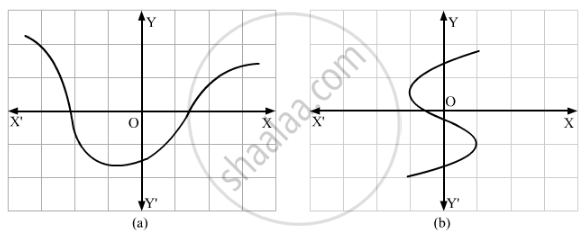
If f : R → R is defined by f(x) = x2, write f−1 (25)
Write the domain of the real function
`f (x) = sqrt([x] - x) .`
Write whether f : R → R, given by `f(x) = x + sqrtx^2` is one-one, many-one, onto or into.
If f : R → R is defined by f(x) = 3x + 2, find f (f (x)).
If f : {5, 6} → {2, 3} and g : {2, 3} → {5, 6} are given by f = {(5, 2), (6, 3)} and g = {(2, 5), (3, 6)}, then find fog. [NCERT EXEMPLAR]
Let
Let [x] denote the greatest integer less than or equal to x. If \[f\left( x \right) = \sin^{- 1} x, g\left( x \right) = \left[ x^2 \right]\text{ and } h\left( x \right) = 2x, \frac{1}{2} \leq x \leq \frac{1}{\sqrt{2}}\]
Mark the correct alternative in the following question:
Let f : R→ R be defined as, f(x) = \[\begin{cases}2x, if x > 3 \\ x^2 , if 1 < x \leq 3 \\ 3x, if x \leq 1\end{cases}\]
Then, find f( \[-\]1) + f(2) + f(4)
Write about strlen() function.
Let f, g: R → R be two functions defined as f(x) = |x| + x and g(x) = x – x ∀ x ∈ R. Then, find f o g and g o f
For sets A, B and C, let f: A → B, g: B → C be functions such that g o f is surjective. Then g is surjective.
Let f : [0, ∞) → [0, 2] be defined by `"f" ("x") = (2"x")/(1 + "x"),` then f is ____________.
The domain of the function `"f"("x") = 1/(sqrt ({"sin x"} + {"sin" ( pi + "x")}))` where {.} denotes fractional part, is
Given a function If as f(x) = 5x + 4, x ∈ R. If g : R → R is inverse of function ‘f then
Let f: R → R defined by f(x) = 3x. Choose the correct answer
If `f : R -> R^+ U {0}` be defined by `f(x) = x^2, x ∈ R`. The mapping is
A function f: x → y is said to be one – one (or injective) if:
A function f: x → y is/are called onto (or surjective) if x under f.
If f; R → R f(x) = 10x + 3 then f–1(x) is:
Consider a function f: `[0, pi/2] ->` R, given by f(x) = sinx and `g[0, pi/2] ->` R given by g(x) = cosx then f and g are
Let [x] denote the greatest integer ≤ x, where x ∈ R. If the domain of the real valued function f(x) = `sqrt((|[x]| - 2)/(|[x]| - 3)` is (–∞, a) ∪ [b, c) ∪ [4, ∞), a < b < c, then the value of a + b + c is ______.
Consider a set containing function A= {cos–1cosx, sin(sin–1x), sinx((sinx)2 – 1), etan{x}, `e^(|cosx| + |sinx|)`, sin(tan(cosx)), sin(tanx)}. B, C, D, are subsets of A, such that B contains periodic functions, C contains even functions, D contains odd functions then the value of n(B ∩ C) + n(B ∩ D) is ______ where {.} denotes the fractional part of functions)
A function is called one-one if different elements of the domain have:
The function \(f:\mathbb{N}\to\mathbb{N}\) defined by \(f(x)=5x\) is:
