Advertisements
Advertisements
Question
The distinct linear functions that map [−1, 1] onto [0, 2] are
Options
\[f\left( x \right) = x + 1, g\left( x \right) = - x + 1\]
\[f\left( x \right) = x - 1, g\left( x \right) = x + 1\]
\[f\left( x \right) = - x - 1, g\left( x \right) = x - 1\]
None of these
Advertisements
Solution
Let us substitute the end-points of the intervals in the given functions. Here, domain = [-1, 1] and range =[0, 2]
By substituting -1 or 1 in each option, we get :
Option (a):
\[f\left( - 1 \right) = - 1 + 1 = 0 \text{ and }f\left( 1 \right) = 1 + 1 = 2\]
\[g\left( - 1 \right) = 1 + 1 = 2 \text{ and }g\left( 1 \right) = - 1 + 1 = 0\]
So, option (a) is correct.
Option (b):
\[f\left( - 1 \right) = - 1 - 1 = - 2 \text{ and }f\left( 1 \right) = 1 - 1 = 0\]
\[g\left( - 1 \right) = - 1 + 1 =0 \text{ and }g\left( 1 \right) = 1 + 1 = 2\]
Here, f (-1) gives -2
\[\not\in \left[ 0, 2 \right]\]
So, (b) is not correct.
Similarly, we can see that (c) is also not correct.
APPEARS IN
RELATED QUESTIONS
Check the injectivity and surjectivity of the following function:
f : N → N given by f(x) = x2
Check the injectivity and surjectivity of the following function:
f : R → R given by f(x) = x2
Which of the following functions from A to B are one-one and onto ?
f3 = {(a, x), (b, x), (c, z), (d, z)} ; A = {a, b, c, d,}, B = {x, y, z}.
Let A = [-1, 1]. Then, discuss whether the following function from A to itself is one-one, onto or bijective : g(x) = |x|
Let A = {1, 2, 3}. Write all one-one from A to itself.
Find the number of all onto functions from the set A = {1, 2, 3, ..., n} to itself.
Given A = {2, 3, 4}, B = {2, 5, 6, 7}. Construct an example of each of the following:
(i) an injective map from A to B
(ii) a mapping from A to B which is not injective
(iii) a mapping from A to B.
Let f : N → N be defined by
`f(n) = { (n+ 1, if n is odd),( n-1 , if n is even):}`
Show that f is a bijection.
[CBSE 2012, NCERT]
Let f : R → R and g : R → R be defined by f(x) = x + 1 and g (x) = x − 1. Show that fog = gof = IR.
Find fog and gof if : f (x) = x+1, g (x) = sin x .
Consider the function f : R+ → [-9 , ∞ ]given by f(x) = 5x2 + 6x - 9. Prove that f is invertible with f -1 (y) = `(sqrt(54 + 5y) -3)/5` [CBSE 2015]
Which one of the following graphs represents a function?
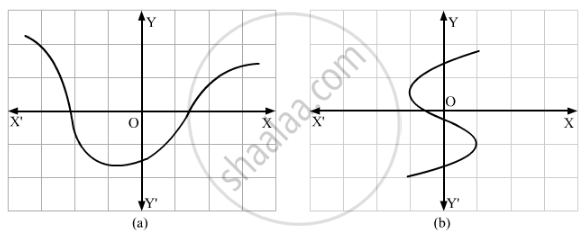
If A = {a, b, c} and B = {−2, −1, 0, 1, 2}, write the total number of one-one functions from A to B.
Let C denote the set of all complex numbers. A function f : C → C is defined by f(x) = x3. Write f−1(1).
Let f be a function from C (set of all complex numbers) to itself given by f(x) = x3. Write f−1 (−1).
If f : R → R is defined by f(x) = 10 x − 7, then write f−1 (x).
Let f be an invertible real function. Write ( f-1 of ) (1) + ( f-1 of ) (2) +..... +( f-1 of ) (100 )
Let\[A = \left\{ x \in R : - 1 \leq x \leq 1 \right\} = \text{B and C} = \left\{ x \in R : x \geq 0 \right\} and\]\[S = \left\{ \left( x, y \right) \in A \times B : x^2 + y^2 = 1 \right\} \text{and } S_0 = \left\{ \left( x, y \right) \in A \times C : x^2 + y^2 = 1 \right\}\]
Then,
Let
f : R → R be given by
\[f\left( x \right) = \left[ x^2 \right] + \left[ x + 1 \right] - 3\]
where [x] denotes the greatest integer less than or equal to x. Then, f(x) is
(d) one-one and onto
Which of the following functions from
to itself are bijections?
Let
\[A = \left\{ x : - 1 \leq x \leq 1 \right\} \text{and} f : A \to \text{A such that f}\left( x \right) = x|x|\]
If a function\[f : [2, \infty )\text{ to B defined by f}\left( x \right) = x^2 - 4x + 5\] is a bijection, then B =
\[f : R \to R\] is defined by
\[f\left( x \right) = \frac{e^{x^2} - e^{- x^2}}{e^{x^2 + e^{- x^2}}} is\]
The function
If the function
\[f : R \to R\] be such that
\[f\left( x \right) = x - \left[ x \right]\] where [x] denotes the greatest integer less than or equal to x, then \[f^{- 1} \left( x \right)\]
Let \[f\left(x\right) = x^3\] be a function with domain {0, 1, 2, 3}. Then domain of \[f^{-1}\] is ______.
Show that the function f: R → R defined by f(x) = `x/(x^2 + 1)`, ∀ ∈ + R , is neither one-one nor onto
Let X = {1, 2, 3}and Y = {4, 5}. Find whether the following subset of X ×Y are function from X to Y or not
f = {(1, 4), (1, 5), (2, 4), (3, 5)}
Let f: R → R be given by f(x) = tan x. Then f–1(1) is ______.
The function f : A → B defined by f(x) = 4x + 7, x ∈ R is ____________.
Range of `"f"("x") = sqrt((1 - "cos x") sqrt ((1 - "cos x")sqrt ((1 - "cos x")....infty))`
Students of Grade 9, planned to plant saplings along straight lines, parallel to each other to one side of the playground ensuring that they had enough play area. Let us assume that they planted one of the rows of the saplings along the line y = x − 4. Let L be the set of all lines which are parallel on the ground and R be a relation on L.
Answer the following using the above information.
- The function f: R → R defined by f(x) = x − 4 is ____________.
A function f: x → y is/are called onto (or surjective) if x under f.
The graph of the function y = f(x) is symmetrical about the line x = 2, then ______.
A function is onto when every element of the codomain has:
A function is called bijective if it is both:
The function \(f:\mathbb{N}\to\mathbb{N}\) defined by \(f(x)=5x\) is:
Many students choosing the same favourite subject resembles which type of function?
